September 22, 2026
New $18 million Bezos Earth Fund grant supports AI-driven soybean research to store more carbon in soil and strengthen agricultural resilience
New $18 million Bezos Earth Fund grant supports AI-driven soybean research to store more carbon in soil and strengthen agricultural resilience
LA JOLLA—The Salk Institute has received an $18 million grant from the Bezos Earth Fund to test whether deeper-rooted soybeans can store more carbon in soil and better withstand drought and disease in field conditions. The three-year project, called ROOTS, moves Salk’s climate-focused crop research into a new proof-of-concept phase. Scientists will use artificial intelligence (AI), field trials, soil carbon studies, and plant-microbe science to develop and test soybean plants with deeper, stronger roots.
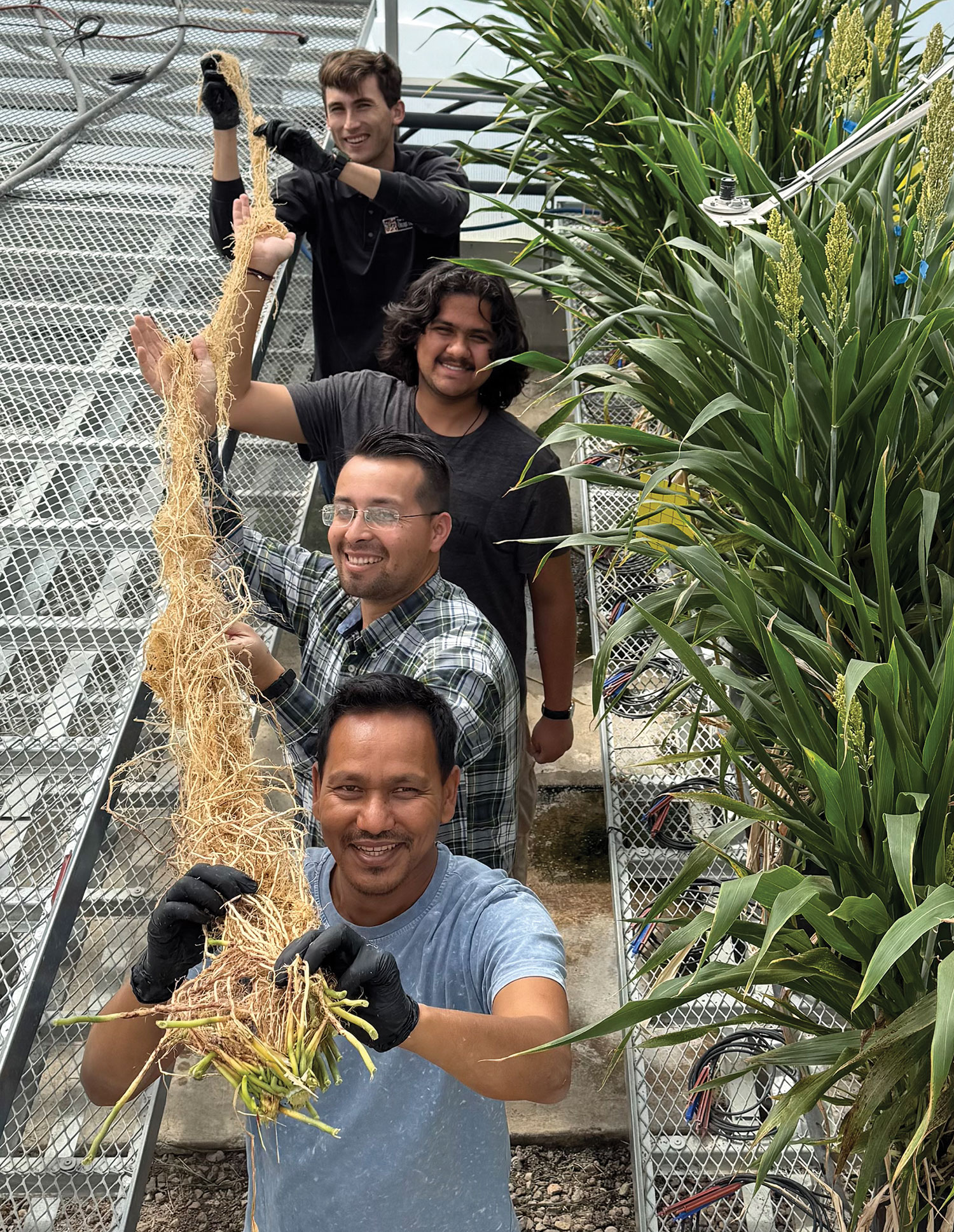
The grant builds on a $30 million Bezos Earth Fund grant in 2020 that helped support the first phase of Salk’s Harnessing Plants Initiative. That work enabled Salk scientists to identify 347 potential gene candidates tied to carbon-storing root traits and advance 37 projects across genes and crops.
“We are deeply grateful to the Bezos Earth Fund for their partnership and vision,” says Wolfgang Busch, PhD, professor and director of Salk’s Harnessing Plants Initiative. “Harnessing the power of plants to address global challenges begins with foundational science and understanding how plants interact with soil, microbes, and environmental stresses. This support allows us to uncover how roots grow and function in complex environments and swiftly translate those discoveries into solutions that benefit farmers, ecosystems, and communities around the world.”
Roots are one of the hidden and often overlooked parts of the food system, but they play an outsized role in plant health and soil carbon. Deeper roots can push carbon below the layer of soil most often disturbed by farming. Larger root systems can add more plant material underground. Roots rich in suberin, a natural cork-like compound, can help carbon remain in soil longer because suberin breaks down slowly.
For the Bezos Earth Fund, the farmer test is central.
“The Bezos Earth Fund looks for innovations that can change the equation for people and the planet,” says Andy Jarvis, PhD, director of Future of Food at the Bezos Earth Fund. “ROOTS is a golden opportunity to develop the next generation of crops, plants that are productive and resilient for farmers and able to draw carbon dioxide from the air and store it in the soil. That is the kind of solution agriculture needs.”
ROOTS will use RootGPT, a planned open-access AI platform designed by Salk scientists to help identify useful root traits faster.
RootGPT will analyze Salk data on plant genes, root traits, soil carbon, and plant-fungus relationships. The system will suggest promising genetic changes, which scientists will test in the lab, greenhouse, and field. Those results will feed back into the platform, helping it improve its predictions over time.
The goal is to shorten the time it takes to identify root traits that matter and move them into crops that can be tested by agricultural partners.
ROOTS will also measure whether deeper and stronger roots can increase durable soil carbon.
Salk will conduct laboratory, greenhouse, and field studies to track how root size, root depth, suberin, and plant-fungus partnerships affect carbon storage. The project will extend an ongoing Illinois field study and add Midwest field trials to test whether Salk Ideal Soybean varieties can store more carbon than conventional varieties over multiple years.
Salk modeling suggests enhanced root traits could add one to two metric tons of carbon dioxide removal per hectare per year, if they perform as expected in field conditions, or about 0.45 to 0.89 US tons per acre per year. ROOTS is designed to test that potential and strengthen the evidence for long-term soil carbon storage.
The project will also test whether deeper-rooted soybean lines can better handle drought and disease. That matters because climate-focused crops will only scale if they work for farmers. ROOTS will evaluate soybean lines under stress and normal conditions, while also tracking soil health and carbon storage. The team will look for trait combinations that can support strong crop performance while moving more carbon underground.
Salk will continue to work with Cquesta, a spinout company created to help move Salk Ideal PlantÒ traits from research into crop varieties that can be tested and, if successful, scaled.
“Scientific discovery is the first step, but getting improved crops into farmers’ fields requires strong partnerships between research institutions and the agricultural sector,” says Andrew Baum, CEO of Cquesta. “We’re excited to continue working with Salk to translate these breakthroughs into crop varieties that strengthen agricultural resilience while bringing the benefits of advanced root traits to farms in the US and around the world.”
Soybean is the first focus because it is widely grown and well-suited for testing carbon and resilience traits. The same root trait strategies could later be applied to other major crops, including maize, rice, and wheat.
If ROOTS succeeds, farmers could one day plant soybean varieties bred to handle stress aboveground while storing more carbon belowground.
The Bezos Earth Fund, guided by the belief that Earth is the best planet in this solar system, works to protect and restore the natural world. Working with partners around the globe, we are developing innovative solutions to ensure the planet remains a place we can – and want to – live on. Based in the United States, the organization is led by President and CEO Tom Taylor, under the direction of Chairman Jeff Bezos and Vice Chair Lauren Sánchez Bezos. To learn more, visit: bezosearthfund.org.
This press release was written by Heather Buschman
Contact: press@salk.edu
Office of Communications
Tel: (858) 453-4100
press@salk.edu
The Salk Institute is an independent, nonprofit research institute founded in 1960 by Jonas Salk, developer of the first safe and effective polio vaccine. The Institute’s mission is to drive foundational, collaborative, risk-taking research that addresses society’s most pressing challenges, including cancer, Alzheimer's disease, and agricultural vulnerability. This foundational science underpins all translational efforts, generating insights that enable new medicines and innovations worldwide.