
How can scientists visualize cellular life with greater precision?
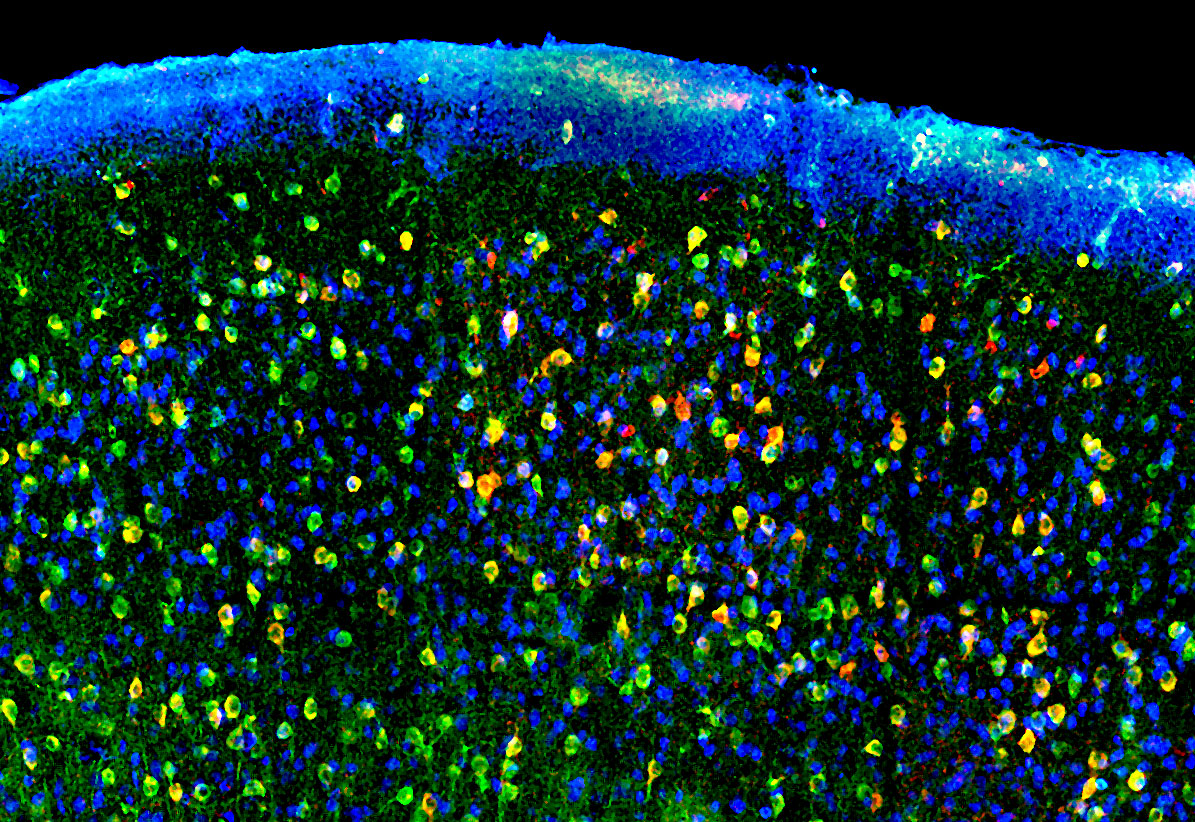
Credit: Barykina et al., Nature Methods
LA JOLLA—Fluorescent proteins have revolutionized science, enabling researchers to tag and visualize individual molecules in living cells, tissues, and animals. Using these tools, researchers have watched viruses infect cells in real time, observed cellular trash collection, and tracked the signaling that spurs tumor growth.
Salk scientists and collaborators at Albert Einstein College of Medicine have advanced this visualization technology. The new technology, called visible-spectrum antigen-stabilizable fluorescent nanobodies (VIS-Fbs), was validated in multiple mammalian cell types and provides a powerful tool for a wide range of life science research applications.
The study was published in Nature Methods on April 22, 2026.
“This work establishes a versatile platform for imaging proteins with high specificity and minimal background,” says co-corresponding author Axel Nimmerjahn, PhD, professor and Françoise Gilot-Salk Chair at Salk. “It opens new opportunities to study how molecular and cellular processes unfold in real time across diverse biological systems.”
Beyond Lab Walls Podcast: Nicola Allen on brain inflammation and lifelong cognitive health
Some of the most important work of protecting the brain may depend on immune and other cell types, which make up a surprising 50% of the human brain. In this special Beyond Lab Walls video podcast episode—part of the Salk Institute’s 2026 Year of Brain Health—Salk President Gerald Joyce, MD, PhD, speaks with Nicola Allen, PhD, a leading neuroscientist whose lab studies how non-neuronal brain cells shape brain function in health, aging, and disease.
Breaking the barrier between neuroscience and immunology
Credit: Salk Institute
Given their central role in running the body, it’s unsurprising that the brain and spinal cord are afforded considerable protection. For example, the tightly sealed capillary network that oxygenates and nourishes the brain also acts as a critical barrier that allows only a tiny subset of physiologically important molecules to pass through while deflecting the rest. Historically, the scientific community has believed that the immune cells circulating in our bloodstream are also barred from crossing the velvet rope into the VIP room of the central nervous system (CNS).
In some cases, this prohibition is lifted, as in the case of viral or bacterial infections that specifically affect the brain and require a rapid response from the immune system. “We knew immune cells could enter the brain under those kinds of conditions,” says Susan Kaech, an immunologist at the Salk Institute for Biological Studies. “But at steady-state in health, it was really considered an immune-privileged organ.”
Research from the past decade or so has overturned that dogma, however. Kaech credits this shift largely to pioneering work that has uncovered previously overlooked networks of lymphatic structures that allow cells from the immune system to keep careful tabs on the brain even when no infection is underway. Other recent studies have established a role for communication between the CNS and circulating immune cells in disease states ranging from chronic pain to cancer to age-related neurodegeneration and Alzheimer’s.
Salk Institute promotes three faculty members in neuroscience, immunology, and cancer research

Credit: Salk Institute
LA JOLLA—Three Salk Institute faculty members have been promoted for their notable, innovative contributions to science. Associate Professors Nicola Allen and Diana Hargreaves were promoted to full professors, and Assistant Professor Jesse Dixon was promoted to associate professor. The promotions were based on Salk faculty and nonresident fellow recommendations and approved by Salk’s president and Board of Trustees on April 4, 2025.
“Nicola, Diana, and Jesse are all pushing the boundaries of what is known and what is considered possible in their respective fields,” says Salk President Gerald Joyce. “Nicola has also made critical contributions to Salk’s programs in neuroimmunology and Alzheimer’s disease, and both Diana and Jesse have made important advances in cancer research. We are excited to see how their leadership and innovation will continue to shape the Institute’s success.”
Salk Institute launches Neuroimmunology Initiative with $20 million gift from NOMIS Foundation
Scientists will explore the understudied crosstalk between the immune and nervous systems, and the role it plays in health and disease
Credit: Salk Institute
LA JOLLA—The Salk Institute will receive $20 million over four years from the NOMIS Foundation to launch a new Neuroimmunology Initiative within the Institute’s NOMIS Centerfor Immunobiology and Microbial Pathogenesis. By funding research programs, faculty recruitment, and pilot grants, the generous gift will enable Salk scientists to develop a deep understanding of the crosstalk between the immune and nervous systems and the role it plays in health and disease.
“We are deeply grateful to the NOMIS Foundation for investing in neuroimmunology and in Salk,” says Salk President Gerald Joyce. “This funding will allow us to tackle currently unaddressed scientific questions, opening fundamentally new areas of scientific inquiry across human health and disease, and paving the way toward innovative therapeutic interventions for a wide range of disorders that have both a neurological and immunological component, such as Alzheimer’s disease, ALS, long COVID, and some forms of cancer."