
Victoria (00:02)
Welcome to Beyond Lab Walls, a podcast from the Salk Institute, a nonprofit foundational research institute bound by collaboration and curiosity, where scientists come together to ask, what if? The Salk Institute stands as a landmark monument to science overlooking the Pacific Ocean. Within the iconic Louis Kahn designed architecture, scientists tackle global questions in aging, agriculture, disease, nutrition, sleep, memory, and so much more. Here at Salk, we’re unlocking the secrets of life itself and sharing them beyond lab walls.
Isabella (00:49)
Hello listeners, welcome to another episode of Salk’s podcast, Beyond Lab Walls. I’m Isabella, and today we’re going to take a walk through the world of scientific funding. At Salk, we emphasize asking big questions that can lead to tangible differences in how we understand the world or develop therapeutics. And we also stress the importance of asking those questions together, crossing traditional disciplinary boundaries.
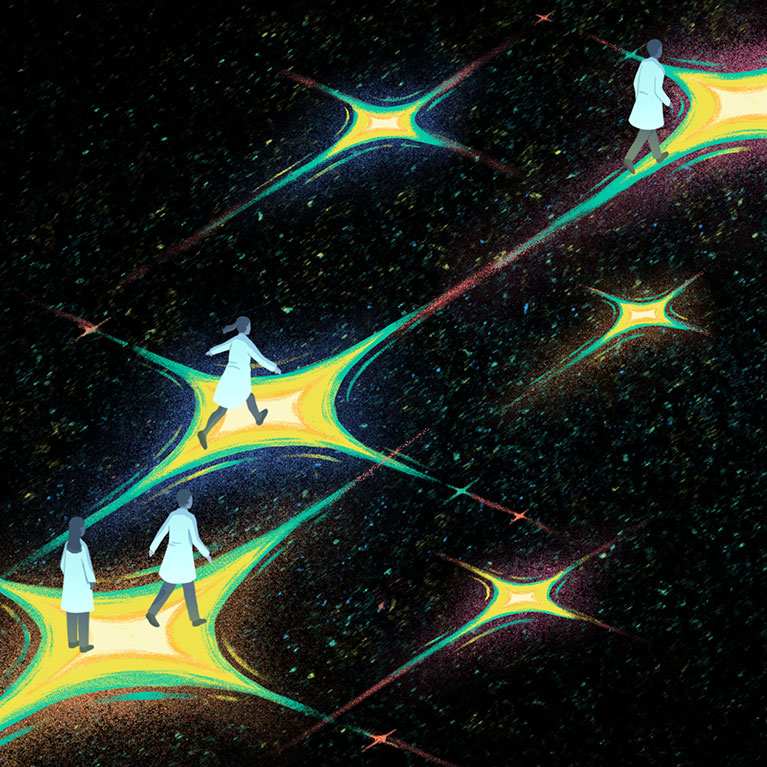
But how do big, bold questions get funding? And how does scientific funding even work in the first place? What roles do federal and philanthropic dollars play in getting bright ideas out of the dark?
We have a unique solution to funding risky ideas at Salk, but before we reveal our very clever solution, let’s start at the beginning. Let’s talk federal funding.
The National Institutes of Health, or the NIH, is the primary funder of biomedical science in the US. Their stake dwarfs all other contributors, providing around 80 % of the cash for research projects.
Their annual budget has sat between $40 and $50 billion for the last decade. Other federal funders, like the National Science Foundation, supply additional billions. Here at Salk, federal dollars have made many discoveries possible, including monumental collaborations like the NIH Brain Initiative, which ultimately aims to produce a new dynamic picture of mammalian brains. They also endorse our cancer research.
Salk was named one of the first National Cancer Institute Cancer Centers back in 1973.
Federal funding has been instrumental in carrying out Salk science for decades. Today, they fund half of all Salk science, but the projects they fund almost always require substantial preliminary data. This safeguard, among others, ensure taxpayer dollars are spent on high-quality evidence-based ideas. But over time, these safer investments can lead to disproportionate funding for more senior scientists, and incremental follow-up studies.
Salk researchers also face another challenging trend. Foundational research publications have been on the decline. This is in part because foundational science is often first on the chopping block when time comes to cut costs. While rejecting early stage research and risky questions is often a safe bet, it does narrow the window of discovery long term. Here is where private philanthropies can step in.
Philanthropies do the important work of funding interdisciplinary science that doesn’t neatly fit into the boxes the NIH or NSF provide. This investment complements the federal government’s and thus maximizes the monetary impact.
Prioritizing higher-risk research can take that impact to the next level.
This isn’t news for a long time Salk Irwin Jacobs. Irwin is a scientist and entrepreneur turned philanthropist who founded Qualcomm in 1985 and set the standard for cellular technology. But since his first visit to Salk’s campus in 1965, Irwin had his sights set on the Institute.
So when he left his CEO position at Qualcomm in 2006, he excitedly transitioned into Chair of Salk’s Board of Trustees. At a 2025 on Salk’s campus, Irwin recalled one of his first conversations as Chair:
Irwin (04:26)
Very shortly after becoming Chair, we had a fundraiser in New York City. And coming back from that fundraiser, I sitting next to a more senior faculty member and discussing what were some of the issues that might have to be considered over my chairmanship. And one of them that he raised was this fact that if you had a good idea, that often you couldn’t pursue it because there wasn’t enough funding.
And so we thought about, well, perhaps we should set up an innovation fund.
Isabella (05:01)
The plan was simple. Twice a year, Salk faculty could put together a short proposal describing their shot in the dark idea. Then other faculty would assess the proposals and select which to support that round. With any luck, these new ideas could spark into something bigger, lighting a path to larger grants from external funders who would have once turned the project down.
Irwin believed so much in this initiative that he immediately donated the funds to make it happen. By December 2006, the first Innovation Grant was awarded.
Dannie (05:38)
This Innovation Grant program sends the message that Salk is willing to invest in these bold mechanistic ideas that may not yet be fully de-risked but have the potential to change how we understand and treat pancreas cancer.
Isabella (05:52)
That’s
She’s a cancer researcher at Salk. She’s constantly asking what drives cancer, how we can stop it, and is particularly focused on pancreatic cancer, which is especially deadly and projected to be the deadliest cancer by 2030.
Dannie (06:09)
As a PI working in a field with very poor patient outcomes, there’s a constant pressure to stay safe and incremental in order to secure federal grants that have very challenging pay lines, which just continue to get worse and worse with the current climate.
Isabella (06:25)
Dannielle received an Innovation Grant in 2020 to study the relationship between pancreatic cancer tumors and a sugar molecule called CA19-9.
Dannie (06:35)
My project really starts off with this sugar molecule called CA19-9, which we measure in the blood of patients with pancreatic cancer to follow their treatment response. And so if their tumors are growing bigger, your CA19-9 levels go up. And if your tumors are shrinking and responding to treatment, your CA19-9 levels will go down.
And so this project asked a simple but very important question, does the pancreatic cancer biomarker CA19-9 actually help tumors spread and metastasize throughout the body? And if so, how does it do this?
Isabella (07:07)
She found that CA19-9 was teaming up with another protein called E-selectin and that partnership helped cancer cells leave the pancreas. This metastasis process is what kills patients, and blocking the interaction between CA19-9 and E-selectin significantly slows metastases.
Dannielle’s grant, along with the many that came before and after hers, was originally scored in three parts. Innovation, impact, and value.
The innovation metric asks whether the idea is creative and bold enough to transform existing research or open an entirely new research avenue. The impact metric asks whether the proposed research could have sustained scientific impact and address important problems. And the value metric asks whether this grant funding will give the project the legs it needs to pursue external funding.
Really that last value point, that this relatively small internal seed grant will generate the data needed to make external funding possible.
Since 2020, Dannielle has raised $1.5 million for her work. That’s 15 times the original Innovation Grant award.
Dannie (08:21)
Looking back at when I got this funding, it came at a really critical time in my career. So I had just been recently selected for this really prestigious award to fund this work. And unfortunately, because of the COVID-19 pandemic, they did not meet their fundraising goals. And they revoked the funding for this project. And so without the Salk Innovation Award, this idea would have been lost. It would have just…
been not right now, which a lot of times in science means you move on or you move to something safer, something more incremental. And so it’s truly a transformative program.
And honestly, it’s a model that we have to look towards expanding.
Isabella (09:02)
Dannielle’s not the only Innovation Grant success story.
Another cancer researcher, Tony Hunter, used an Innovation Grant to develop a tool to understand an understudied protein modification linked to cancer. He leveraged that initial seed money 111-fold, and his tool is now used to inform new cancer therapeutic strategies.
used a 2011 Innovation Grant to develop sonogenetics, a non-invasive technology for stimulating neuronal activity that could one day be used to treat neurological conditions like Parkinson’s disease. In spring, 2026, he received an up to $41.3 million award from the Projects Agency for Health, an agency within the US Department of Health and Human Services, to further explore sonogenetics clinical applications.
Salk’s monumental Harnessing Plants Initiative also started with an Innovation Grant. A 2017 grant helped the initiative’s founding director, Joanne Chory, earn an incredible $35 million TED Audacious Award. The Initiative is developing plants that can remove excess carbon from the atmosphere and store it underground, where it contributes to healthier ecosystems, increased crop resiliency, and more sustainable agriculture.
The Innovation Grant Program is uniquely Salk and has been going now for nearly two decades, but something else uniquely Salk is left out of this program: collaboration.
Collaboration is physically built into Salk’s campus. The absence of maps and signage encourages conversation, while open concept labs and shared core facilities necessitate connection.
Given this omnipresence of interdisciplinarity and interrelation, the 2019 launch of the Collaboration Grant Program seems inevitable.
Like Innovation Grants, Collaboration Grants must ask bold, risky questions. Their proposals are judged by similar metrics. Innovation, impact, and value are all still on the scorecard. One new metric, collaboration, differentiates these grants. How strong is this team, and does their combined effort make sense in relation to the question that they’re asking? For Axel Metallo, and Rusty Gage, the answers to those questions are very strong, and yes.
Axel (11:39)
Yeah, so this collaboration really grew out of like a shared scientific curiosity and the environment at Salk that encourages people to talk across
Isabella (11:49)
That’s Axel, a biologist and physicist at Salk. He explores the coordination of brain and spinal cord cells while also developing the tools needed to do so. Think miniature microscopes that fit on the tip of your finger. For a long time, he’s wondered why the central nervous system, which is generally quite resilient, begins to fail during infection or with age.
Axel (12:12)
And as we started…
thinking more deeply about this question, it became clear that no single lab can really tackle this complex issue.
At its core, the project asks a deceptively simple question. How does genetic risk, environmental factors, and aging how do they interact in the brain to drive Alzheimer’s disease?
And turns out that they do actually converge onto a single target, which is microglia, the immune cells in the brain.
So as part of the Collaboration Grant, we aim to build a comprehensive and multi-scale atlas of human microglia brain states.
Isabella (12:50)
real-time imaging technology, Rusty’s organoid models, which are 3D collections of cells that mimic human tissues, and Christian’s metabolic profiling, the team hope to create an atlas of the many states and stages that the brain immune cells called microglia take on over a lifetime. The atlas can help explain what factors converge to drive Alzheimer’s disease.
But beyond Alzheimer’s disease, Axel adds:
Axel (13:17)
So this work could reveal common immune mechanisms that underlie many neurodegenerative diseases and inflammatory diseases. So microglia, play a role in a number of different diseases. So if we understand like what could be going on in this particular disease, it could have implications for others where we also see inflammation or contribution of certain genetic risk factors. So we’re really looking for general principles that then can also be applied to other diseases.
Isabella (13:42)
The team was awarded a 2023 Collaboration Grant for this project. They’ve already published a paper in Cell, debuting their first of its kind microglia-populated brain organoid. With that effort behind them, it was much easier to raise funds for their follow-up questions. The team has since raised $4.2 million, a 13-fold return on investment.
Axel (14:07)
The project simply would not have been possible alone and through traditional federal funding routes, at least not from the outset. At the time when we asked this question, they were simply too new, too interdisciplinary and too risky. And NIH reviewers often want years of preliminary data before they feel comfortable supporting this work.
And the Salk Collaboration Grant is really one kind of funding vehicle that allowed us to assemble the team immediately, develop some new tools, and then bring them to bear to this sort of like really fundamental question. This flexibility really is essential when you try to open up entirely new conceptual directions in science.
Isabella (14:47)
In addition to return on investment and human health applications, another measure of the program’s success is repeat applicants. Two years after his first Christian teamed up with another Salk scientist, Janelle Ayers, on a 2025 proposal. Their proposal speaks to the flexibility of basic science.
When you do foundational research, one day you’re working on a brain organoid and the next you’re developing a topical therapeutic. Janelle and Christian are investigating a new class of sphingolipids found in human skin, which they call very long-chain sphingoid bases, or VLCBs. These VLCBs seem to be reduced in patients with atopic dermatitis or eczema, which led the two to ask…
What if VLCB treatment could with those conditions? As one of the latest Collaboration Grants, their project represents the continued interest Salk faculty hold in the program. And it also shows that that interest is reciprocated as their proposals continue to be worth investing in.
What started as a simple conversation between Irwin and a faculty member back in the early 2000s has turned into almost 20 years of investment in Salk science. $16.5 million have been invested into 129 Innovation and Collaboration Grants, and each dollar was worth it. Leveraged 13-fold as faculty turned out of the box thinking and early data into $216.7 million in follow-up funding. Today, other donors have joined the Jacobs’ generosity. Sarah and Jay Flatley, Richard Heyman and Annie Daigle, and the NOMIS Foundation all support these risky, rewarding grants.
Dannie (16:41)
Knowing that The Salk and its supporters are willing to back this kind of high risk, high reward science has given both myself and my team the confidence that we can pursue these questions that otherwise we might’ve set aside until we’re able to get more preliminary data or able to get more funding.
Isabella (16:58)
This monetary support has enabled Salk researchers to ask and answer questions that would otherwise be impossible with more conservative, disciplinarily siloed federal grants.
Axel (17:10)
Especially for when it comes to disease related questions, these are very complex, right? So there’s, so many different areas you have to consider biological areas, neuroscience, immunology, but then also you have to bring a lot of different tools to the table, like the imaging tools, molecular genetic tools. And that’s becoming harder and harder to do as an individual lab, so you really need to collaborate.
This is where the strength of Salk comes in.
Dannie (17:34)
We need programs like the Innovation Grant, like the Collaboration Grants, because it keeps the discoveries going. And without those discoveries in fundamental science, you don’t get new cures, you don’t get new biomarkers, you don’t get new medical devices. This is the fuel of innovation. This is the fuel of better patient outcomes.
Isabella (17:56)
Innovation and collaboration are crucial components of modern science everywhere, but they are especially inextricable from the Salk Institute’s mission.
Scientists are attracted to Salk for its emphasis on foundational exploratory research and its insistence on relationship building and cross-disciplinary idea sharing in the courtyard, over coffee, or across the lab bench.
Axel (18:20)
We regularly talk to each other and therefore we know each other, we feel comfortable discussing these ideas. And it’s much easier then to say, like, hey, you know, what if? What if this were true? And then, with the support, then we can actually give this a try.
Baked into these Collaboration Grants is that there is an expectation that some of these ideas, actually a large fraction might fail. But if a few of them pay off, they can pay off really big.
Isabella (18:45)
Thank you so much for listening. I hope you have a better sense for who funds science and what the future of funding can look like if we want to empower our scientists to take risks and change the world and change lives.
You can learn about other Innovation and Collaboration Grants on our website, Salk.edu
Victoria (19:08)
Beyond Lab Walls is a production of the Salk Office of Communications. Subscribe to this podcast to hear more exciting Salk science stories. Our monthly newsletter and seasonal magazine Inside Salk can also bring the lab to you, spotlighting our staff and scientists and the discoveries that are only possible at Salk. Visit Salk.edu to learn more about the world within these walls.