April 7, 2026
Bold, multi-institutional project will develop ultrasound-sensitive protein tools, wearable ultrasound delivery technology, and a translational path to the clinic for major unmet medical needs
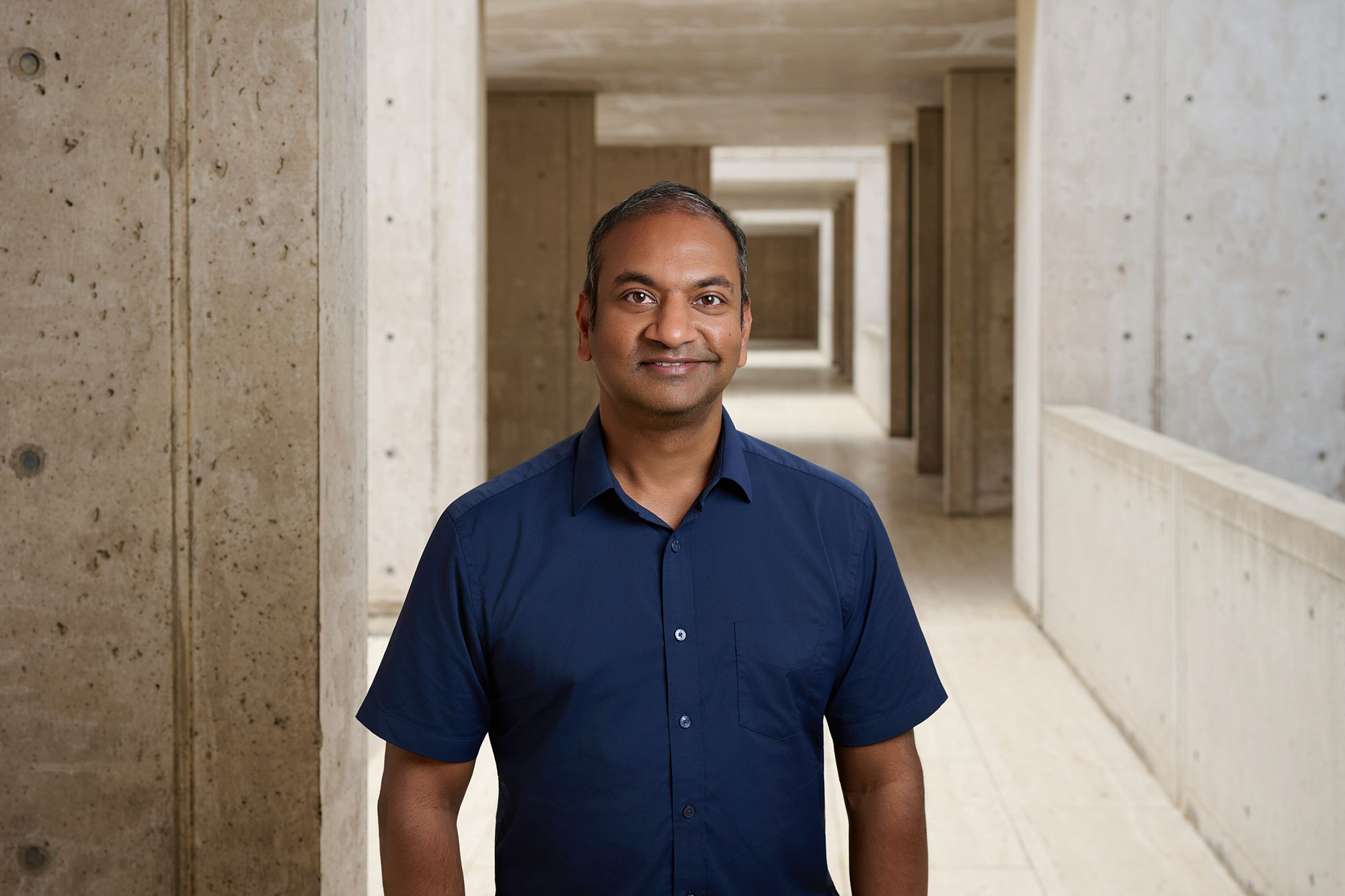
LA JOLLA—Salk Institute scientist Sreekanth Chalasani, PhD, has received an award of up to $41.3 million from the Advanced Research Projects Agency for Health (ARPA-H), an agency within the United States Department of Health and Human Services. The funding will allow Chalasani and his team to transform his lab’s sonogenetics discovery—using ultrasound to precisely control mammalian cells—into a potential new therapy for a number of human conditions, such as peripheral neuropathies.
Sonogenetics is an emerging approach that sensitizes specific cell types to ultrasound by equipping them with ultrasound-responsive proteins, enabling precise, noninvasive control. For up to 5.5 years, the ARPA-H award will support a multi-institution collaboration focused on developing core biological tools, next-generation ultrasound delivery systems, and the preclinical evidence needed to move sonogenetics into clinical trials for patients.
“This award is a major step toward a long-held goal—a drug-free way to deliver therapy exactly where it’s needed and only when it’s needed,” says Chalasani, Salk professor, sonogenetics developer, and lead principal investigator for the ARPA-H award. “We are building a platform that pairs engineered ultrasound-sensitive proteins with wearable ultrasound technology, which, unlike conventional pharmaceutical treatments, could let us treat conditions with cellular and temporal control.
Sonogenetics is the application of low-intensity ultrasound to achieve precise, noninvasive control over cellular activity. Chalasani pioneered this concept and coined the term “sonogenetics” to describe it. In 2015, his group first identified a protein in the roundworm Caenorhabditis elegans that makes cells sensitive to low-frequency ultrasound. When the researchers added this protein to C. elegans neurons that didn’t usually have it, they could activate these cells with a burst of ultrasound—the same sound waves used in medical sonograms. The team, along with several others worldwide, has since also demonstrated the ability of sonogenetics to manipulate mammalian cells.
The ARPA-H award will allow Chalasani and collaborators to move sonogenetics out of the lab and toward the clinic by testing the approach as a therapy for medical conditions such as peripheral neuropathy.
The project will integrate multiple technical tracks to develop an end-to-end therapeutic strategy: a tool kit of ultrasound-sensitive proteins, a noninvasive ultrasound delivery system suitable for long-term use, and the translational evidence needed to support regulatory progression.
Collaborating teams, listed in the order of workflow from discovery to translation, include:
Chalasani’s pioneering work on sonogenetics began with experiments in worms, supported by seed funding in 2011 from Salk’s Innovation and Collaboration Grants program, made possible by philanthropists Joan and Irwin Jacobs, co-founder of Qualcomm and former chair of Salk’s Board of Trustees. That early-stage support helped launch an idea that was bold, unproven, and difficult to fund through traditional mechanisms—an approach Salk is designed to champion as part of its commitment to foundational science that enables future therapies and innovations. The new ARPA-H award will now advance sonogenetics toward a clinical proof-of-concept in the periphery.
This project is funded by the Advanced Research Projects Agency for Health (ARPA-H) under Award Number D26AC50003-00. The content is solely the responsibility of the authors and does not necessarily represent the official views of the Advanced Research Projects Agency for Health.
Office of Communications
Tel: (858) 453-4100
press@salk.edu
The Salk Institute is an independent, nonprofit research institute founded in 1960 by Jonas Salk, developer of the first safe and effective polio vaccine. The Institute’s mission is to drive foundational, collaborative, risk-taking research that addresses society’s most pressing challenges, including cancer, Alzheimer's disease, and agricultural vulnerability. This foundational science underpins all translational efforts, generating insights that enable new medicines and innovations worldwide.