




00;00;06;06 – 00;00;55;07
VO Victoria
Welcome to Beyond Lab Walls, a podcast from the Salk Institute. Join hosts Isabella Davis and Nicole Mylnaryk on a journey behind the scenes of the renowned research institute in San Diego, California. We’re taking you inside the lab to hear the latest discoveries and cutting edge neuroscience, plant biology, cancer, aging, and more. Explore the fascinating world of science while listening to the stories of the brilliant minds behind it. Here at Salk, we’re unlocking the secrets of life itself and sharing them — beyond lab walls.
00;00;55;09 – 00;01;24;12
Isabella
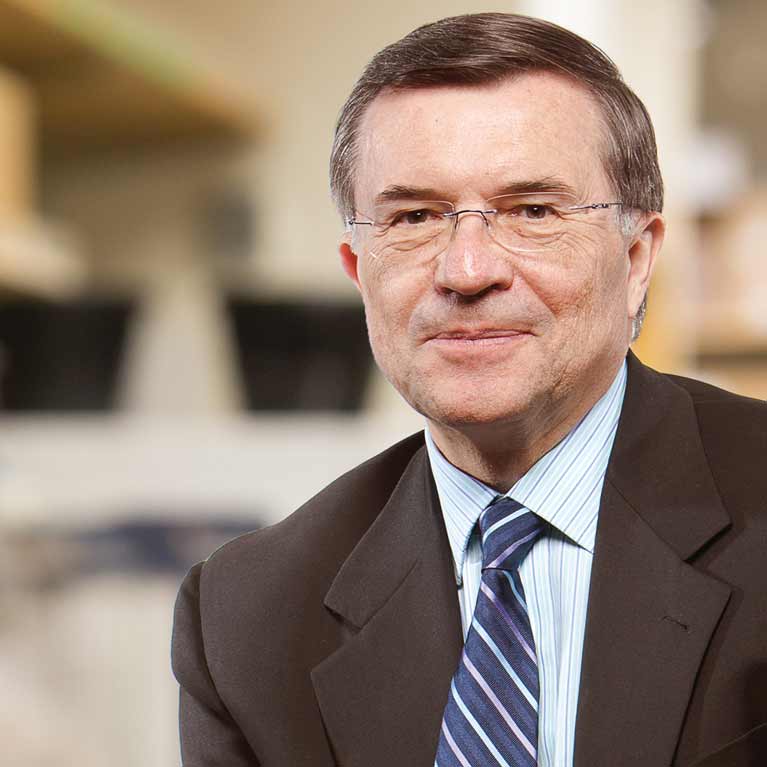
Hi, friends. Welcome to another episode of Beyond Lab Walls. I’m Isabella, and today I got to sit down with Terry Sejnowski, a computational neuroscientist and pioneer of modern AI. Terry is a towering figure in science. He’s highly decorated with appointments to societies like the UK’s Royal Society and the American Philosophical Society, and he’s earned incredible awards like the Brain Prize, which is the most prestigious neuroscience research award in the world.
00;01;24;18 – 00;01;48;09
Isabella
His work creating the Boltzmann Machine entered him into the records of history early in his career. The Boltzmann machine is the first algorithm to solve the problem of learning and multilayered neural networks. It remains the most biologically plausible of all subsequent learning algorithms for artificial neurons. He’s been shaping the fields of neuroeconomics, neuroanatomy, neurophysiology, psychology, and artificial intelligence ever since.
00;01;48;10 – 00;02;02;10
Isabella
And I’m really excited to get into this conversation. Terry, thank you so much for joining me. You’ve had such a crazy career and such an incredible one and I just want to know where you came from. Have you always been interested in science?
00;02;02;13 – 00;02;30;12
Terry
Yes. Science has always been one of my passions as far back as I could tell. I grew up in Cleveland, Ohio, and, one of my memories from grade school, and this was when I was probably around ten years old, was I won a science fair project. It was a working volcano. And, I made it from papier maché, and in my chemistry lab in my basement
00;02;30;12 – 00;03;02;07
Terry
I concocted some black powder and aluminum dust, you know, very tiny shavings. And it produced a fantastic spray of sparks and black smoke – it was fabulous. And I demonstrated it. I took it to school, I demonstrated. And I lit the bottle and off it went. And everybody in the class went, woo! It was really impressive.
00;03;02;13 – 00;03;22;27
Terry
And then the classroom filled with black smoke. And then the fire alarm went off. And then the entire school, of course, you know, marched out. And when they found out it was me, it made my reputation as the science guy.
00;03;23;00 – 00;03;29;20
Isabella
Immersive experience. So how do you get from volcanoes to computers and neuroscientist?
00;03;29;22 – 00;03;55;25
Terry
I fell in love with physics. I when I was in, it was the Case Institute of Technology. By the time I was a junior, I was already taking graduate courses. And then from there I went, did my graduate studies at Princeton University in theoretical physics and, realized that when I finally reached the peak, you know, like climbing a mountain that, gee, I can see forever from here, but how do you get up there?
00;03;56;00 – 00;04;18;08
Terry
You know, looking up. In physics, you either have to be a genius and you know, you have to have some contact with the powers that be. Or you have to wait for a supernova to go off. Or, in my case, I was working on general relativity. Had to wait for gravitational waves to be detected, and and so it did take 40 years.
00;04;18;09 – 00;04;42;07
Terry
In the meantime, I was taking, classes in biology and psychology. Learned all about Hubel and Wiesel and the visual cortex. I learned from Mark Konishi about barn owls – how sound localization and birdsong learning. It was all fascinating. And it could all is just as mysterious as the cosmos. Right? How brain works. And I was hooked.
00;04;42;10 – 00;05;11;14
Isabella
Once he was hooked, Terry transitioned from his PhD in theoretical physics to a summer in Woods Hole, Massachusetts, doing neurobiology. He gathered up enough experience there that he began a postdoc program afterward at Harvard. He worked there in the Medical School’s Department of Neurobiology and retrained as an experimental neurobiologist. Then, with that experience, he got his first job at Johns Hopkins, in their Department of Biophysics.
00;05;11;17 – 00;05;35;00
Terry
I pioneered a whole new area of neural networks that had lain dormant for a couple of decades, which was, how can you train a neural network, a very simple model of neurons and connections with weights connecting them. How strong is the connection? And there wasn’t any learning algorithm for training those weights if you had more than one layer of weights.
00;05;35;02 – 00;05;58;24
Terry
And so I could, in collaboration with Geoffrey Hinton, a good friend of mine, we discovered a learning algorithm for multilayer networks. This whole new way of computing with these, these massively parallel architectures, highly interconnected units and the learning was the was the magic sauce, which was allowed you to, for example, one of the projects I had back at Johns Hopkins was NETtalk.
00;05;58;26 – 00;06;13;06
Terry
And we trained a network – very simple and small by today’s standards, one layer of hidden units between input and output layers. And we trained it to to take in sequences of letters and pronounce the words. It’s called text to speech.
00;06;13;08 – 00;06;29;10
Isabella
Before we move on, I want to dig a little into this early period where you were creating this text to speech program and really laying the groundwork for folks having ChatGPT on their iPhones today. What was it like being there in the early days and watching the science take shape?
00;06;29;13 – 00;06;50;29
Terry
I remember going to my first neuroscience meeting and being overwhelmed. First of all, the number of people, tens of thousands of people. But, there was, talks going on, simultaneous talks in 50 rooms. And then there was a sea of posters as far as you could see. I was looking for somebody who’s doing some modeling. I did find some people who are using math to study the biophysics of neurons.
00;06;50;29 – 00;07;10;21
Terry
And so the biophysicist were camaraderie with them. I could feel that, you know, I could this is something I could help with. And so when I set up my own lab, that’s one of the projects that we started was, to try to understand a little bit more about the dynamics, nonlinear dynamics of neurons. It was clear to me that you had to look at populations of neurons.
00;07;10;21 – 00;07;35;18
Terry
And experimentally that was very difficult, but we could simulate them. And so that’s what we did. We simulated these networks and and the artificial neural networks sort of took off on their own because the engineers were interested in them for building practical devices. I was interested in them for understanding how the brain works. This is a field that, like I say, grew from the biophysicists, to, to building more and more sophisticated models.
00;07;35;18 – 00;07;39;11
Terry
And it became a whole field called computational neuroscience.
00;07;39;13 – 00;07;46;09
Isabella
Okay. So these neural networks that you are working on are computer representations of the human brain. How does that even work?
00;07;46;12 – 00;08;07;14
Terry
So the neurons in your brain are connected with each other through synapses that have – some of them are excitatory, positive, and some are inhibitory, negative. And in our neural network model, we had weights that connected the units that were very simple. The units that the neuron takes in its inputs integrates the, all the inputs, the positive and negative.
00;08;07;17 – 00;08;26;29
Terry
And then there’s a output which is some non-linearities – a threshold. You don’t get any output until you get to a threshold. And then you have some output. And that is the fundamental unit. Now the the the weights are the ones that have the information flowing through the network in a feed forward network. It goes from the inputs to the hidden layers.
00;08;27;01 – 00;08;43;29
Terry
Now we have hundreds of hidden layers. So there’s like a stack like a pancake, you know, a bunch of pancakes on top of each other. But the strengths have to be determined. The way that we train the network is by giving it lots of examples, like a lot of images that are labeled. This is a dog, this is a banana.
00;08;44;01 – 00;09;06;00
Terry
And we have millions of those images. Right? You have to give the network the clues about what it is that it’s looking at. And if you have enough data and you train it long enough in a large enough network, it then can generalize. And that’s the thing that makes it powerful, is that after training it up on a bunch of different dogs, it will recognize new dogs it’s never seen before.
00;09;06;06 – 00;09;21;04
Terry
It has somehow generalized the concept of a dog, and then distinguished that from other animals, from cats, and from other objects that are similar in terms of the colors or the outlines and so forth. Like clocks.
00;09;21;06 – 00;09;28;10
Isabella
And so in the 80s, that was something that you could train a computer program to do?
00;09;28;13 – 00;09;49;05
Terry
You know, very small networks. That’s right. And that were literally the computers we had back then were a billion times less powerful than your cell phone. Now what we didn’t know back then, back in the 80s, was how large a network can you build? As it gets bigger and bigger, how does that affect the performance?
00;09;49;05 – 00;10;12;21
Terry
And how much, how much bigger does it need to get to the point where you can solve a problem like a very difficult problem, like image recognition or speech recognition or language translation? We just didn’t know. And again, it took like 40 years, right? So now we know. And in fact it’s far exceeded anything I could have imagined back then.
00;10;12;23 – 00;10;30;02
Isabella
As computers got more powerful, the models scientists could build were more complex, larger, and scientists like Terry began wondering, what can these modern, sophisticated models teach us about our biology?
00;10;30;04 – 00;10;51;25
Terry
And so the applications that I worked on that I was interested in was applying them to the brain. If you want to understand the function of a neuron that you record from blindly, just put your electrode in and you see some response, you know, either a sensory response or maybe a motor related or decision related response, that – you cannot deduce that just from the response itself.
00;10;51;28 – 00;11;10;29
Terry
What’s called the receptive field. The inputs that the real function depended – equally importantly – on the output. Where is it projecting downstream? Those outputs are the ones that are going to then give rise to behavior. Right? And at the time it was very difficult to know that. How do you know where the neuron is heading?
00;11;10;29 – 00;11;23;24
Terry
But it turned out that that was that now we have techniques for doing that, for figuring out the projections very, you know, rapidly and efficiently. And it turns out that because neurons have multiple projections, they can have multiple functions.
00;11;23;26 – 00;11;37;23
Isabella
In creating these increasingly more sophisticated neural models, is the goal wanting to understand our brains more or is it wanting to create systems that can answer bigger, more complicated questions faster than we could?
00;11;37;23 – 00;11;59;14
Terry
Okay, why not both? In fact, there’s a whole new field has sprouted up just within the last few years, which is called NeuroAI. It turns out that the modern architecture in AI, it’s completely taken over from the previous one in the last century, which was based on rules and logic and symbols which are very, useful. That’s how digital computers work.
00;11;59;14 – 00;12;33;03
Terry
But that’s not how the brain works, right? But but now that we have a different architecture is closer to the brain, it means that we can go back and forth between artificial networks, deep learning networks that we see in the brain. We can go back and forth. And in fact, in 2012, Jeff Hinton showed that with a special kind of a network, called a convolution neural network, that you could recognize objects in the images much, much, much, much better than the traditional ways that people use in computer vision, which was to build right programs and build the features by hand.
00;12;33;05 – 00;13;11;00
Terry
Very labor intensive. But if you have lots of data – and ImageNet had 20 million images of objects across 10,000 categories – you could train very large networks and so that was a turning point. And that really set the stage because it means now that we showed was that this new architecture, which resembles the brain, can actually, in similar ways, help us understand the responses of neurons in monkeys’ brains.
00;13;11;03 – 00;13;28;14
Isabella
This is really going back to basics, but I think a lot of times when people imagine a scientist, they’re thinking lab coat, wet lab pouring bubbling acid from one beaker into another beaker. And I’m curious, what does it literally physically look like to do computational neuroscience?
00;13;28;16 – 00;13;53;28
Terry
That’s a really good question. So my subfield in neuroscience is computational neuroscience. So we develop models – different kinds of models. And I’ve been describing these network models. But we also create models of individual neurons you know detailed models with biophysics in it. And we collaborate with experimental labs. And so what we do in the lab is we pour over experimental data from other labs.
00;13;54;02 – 00;14;22;10
Terry
We have people from many different backgrounds in terms of, you know, their training and, you know, have graduate students from neuroscience and cognitive science, and from physics and from even philosophy. And so we could solve problems that otherwise, you know, you couldn’t with one discipline. And so that’s that’s why we work. We work, you know, primarily using computers, but we use computers in many different ways to both analyze data and to create models based on the data.
00;14;22;12 – 00;14;36;20
Isabella
It’s amazing you’ve seen two fields emerge. First computational neuroscience, and now neuro AI. Do you have any reflections on that sort of watching the science expand and change in these tremendous ways over the years?
00;14;36;23 – 00;14;57;15
Terry
When I came to the Salk in the 90s, was the golden period, because I had amazing graduate students and postdocs who went on to have fabulous careers. And so I, like I trained a whole generation of people went through my lab over those ten years that, you know, really established a whole approach, a new approach to understanding the brain.
00;14;57;17 – 00;15;19;04
Terry
And now, which was really satisfying is that, last year I got the Brain Prize, which was the highest honor for a neuroscientist, along with, Haim Sompolinsky and Larry Abbott, two other physicists who are using the tools from physics to understand how brain circuits work. And that sort of shows that we’re recognized, the field is recognized.
00;15;19;06 – 00;15;45;22
Isabella
You mentioned working with philosophers, and I know you’ve done some of your book writing with them, too. And I think all the philosophical, ethical conversations around AI have been really interesting and important in the last few years. But I’m curious for you personally what those conversations look like and why you think having philosophers in the mix is necessary.
00;15;45;24 – 00;16;07;27
Terry
There’s a lot of issues that have come up where we need help from philosophers and humanities in general. And one of the things that we don’t really have that much control over is the – it takes in a tremendous amount of data or texts from the whole internet. Right? I mean, that’s that’s one of its strengths is that it has such broad coverage.
00;16;08;00 – 00;16;35;03
Terry
However, one of its weaknesses is that it also picks up a lot of biases from people, humans, you know, human biases. Now, it turns out that each one of these things are things that happens in humans, too, right? And and actually hallucination – what is hallucination? Well, it’s when it just makes things up, right? And the difference is that when ChatGPT hallucinates, it sounds completely true because it’s with great accuracy.
00;16;35;03 – 00;16;53;04
Terry
It can even give you references that don’t exist. And and so really the problem with regulating is how does the brain regulate its ability to hallucinate? Right? And and that’s what we need to do. And it’s this, by the way, this is – there are hundreds probably thousands of people out there right now who are working on this problem.
00;16;53;04 – 00;16;58;18
Terry
And it’s a technical problem. And the only reason we know it can be solved is that nature has solved it.
00;16;58;20 – 00;17;03;04
Isabella
Given all those considerations, what are your best practices with ChatGPT?
00;17;03;06 – 00;17;34;19
Terry
Okay. So, so first of all, it’s really important that you tell ChatGPT who it is. You know, it absorbed the world’s personalities, everything. And the question is, which one is it going adopt? What actually, what it does do, I have discovered, is it adopts your personality. It, it starts mirroring you, it starts feeding you things that you are expecting or you want to hear, you know, and that might be good or bad, I mean, depending on what you are looking for.
00;17;34;19 – 00;17;53;23
Terry
But if you’re actually trying to get some ground truth somewhere, you have to tell it, okay, let’s say you want to learn something about medicine. You are a doctor. You are the best diagnostician in the world. I need to know the answer to this medical question. Here are the symptoms. You get much better results if you, if you do that.
00;17;53;25 – 00;18;16;07
Terry
If you get, you tell it ahead of time. The other thing and this is now this this comes from – I’ve written a book on ChatGPT and the future of AI. I actually go through this in great detail. I came across an article where it was a technical writer who decided to work with ChatGPT for a month and and so she said, I would come in and I would use it all day and at the end I”d be completely exhausted.
00;18;16;11 – 00;18;34;27
Terry
And and then she started figuring out there are ways to make it more efficient. She would ask for ten examples of what she was looking for, and then she would read them and say, “hey, number three is the best one you’ve got, but here’s what we need to fix.” And then you dig down and you give instructions and then you iterate down.
00;18;34;27 – 00;18;56;13
Terry
And then she said it was a lot easier because – I now know how to use the tool! Right. Okay. But then she said at one point I said “that was fantastic. The way you phrase this is really amazing, I think is just absolutely amazing. Oh thank you. I really appreciate it.” Okay. So and she discovered that if you’re polite it gives you better answers.
00;18;56;15 – 00;19;17;09
Terry
Well it’s mimicking a human okay. Now, now, now here’s the amazing thing. And this is the part that blew my mind. She said that, once I realize this and I just treat it like I would another human that would praise and approbation when it did something wrong and so forth. You know, she said it the other day, I felt wonderful.
00;19;17;11 – 00;19;20;12
Terry
I didn’t feel exhausted anymore. So she said it was natural.
00;19;20;12 – 00;19;22;16
Isabella
Right. Because. Very interesting.
00;19;22;20 – 00;19;31;27
Terry
Well, we’re just beginning to learn how to use these tools. I mean, is this is is it’s early days. This is like the early days of aviation. The Wright brothers.
00;19;32;00 – 00;19;55;09
Isabella
It’s so interesting that it takes the mental load off to treat it like a companion, less like, you know, not human. So while there are some people like this that are learning to optimize these tools, I know others, including myself, are still a bit hesitant to fully lean in. And I’m curious what you would say to people that are more anxious about this all.
00;19;55;09 – 00;20;13;00
Terry
All technologies can be used for good and bad. What happens is that you have to regulate the technology. You have to come up with rules within which you have to set boundaries. And at the international level, they have to be treaties between countries. And then, at the cultural level, you have to learn in school, you know.
00;20;13;02 – 00;20;36;05
Terry
What, what is acceptable and what is not behavior? And and so that that has to be done with AI, too. Instead of writing a computer program, you give it examples and that and that was a branch of machine learning. Machine learning are algorithms that do that with different kinds of mathematical formulas. And it turns out that neural networks is just another one of those.
00;20;36;05 – 00;20;55;16
Terry
Right? It’s a one of a toolkit, as these other algorithms came in and it was clear that the learning part was the heart of neural networks. And so we could expand that, make it richer. And interestingly, it turns out that of all the algorithms, which ones scale the best. And by that I mean you can make it bigger and take on bigger problems.
00;20;55;16 – 00;21;16;29
Terry
It turns out that the neural networks had the best scaling at the bigger it is, the better it is. Right? And so now deep learning has been, in a sense, become the premier representation and solution for a lot of problems. It has a huge impact in almost every area of science. In biology, deep learning has solved the problem of protein folding.
00;21;16;29 – 00;21;41;00
Terry
Unbelievably important because it’s the folded protein that determines its function, not the sequence. It’s been used for image processing. It’s been used for physics for helping create pictures of black holes from lots of data. So whenever there’s lots of data, you can use it to organize the data and then ask questions of the data. And so it’s helped engineering.
00;21;41;00 – 00;22;02;26
Terry
We can build things now that we couldn’t before. It’s in medicine. It’s been a great way to help doctors come up with better diagnoses. Everybody was worried that, oh, you know, it’s going to take my job that the doctors it could be replaced with AI. That’s not how it’s playing out. And I in my book I this is something I predicted back in, back in 2017.
00;22;02;28 – 00;22;21;20
Terry
And here’s what I said, that you’re not going to lose your job but it’s going to change. So so melanomas, for example, which are skin cancers are death sentences. Or until recently now we can treat them. They would metastasize and you’d be dead. But what they did was train up a network to look at these images and give you a diagnosis, 92%.
00;22;21;21 – 00;22;42;21
Terry
They gave the same set of images to expert doctors and they were at 92%. So saying, wow, the AI is just as good as the doctor, right? Well, it turns out that it’s much more interesting. So they let the doctor use the AI. So as a partner together they were 98% accurate. That’s much, much better because you go from 8% error down to 2% error.
00;22;42;21 – 00;22;46;16
Terry
That’s 400%. This is amazing. I mean it saves lives.
00;22;46;18 – 00;23;10;06
Isabella
It seems like so much reality today was once science fiction. Pipe dreams or maybe nightmares. I’m curious, are there any movies or shows or representations of AI that you think are the most accurate to what’s happening today, or what our future may look like?
00;23;10;13 – 00;23;36;00
Terry
Okay, so there is a movie which really nailed it, which I think is is actually so accurate that I really wonder whether whoever wrote the movie either had some special insight. That’s the movie Her. You’ve seen that?
00;23;36;00 – 00;23;36;01
Isabella
Yes.
0;23;36;00 – 00;23;36;01
Terry
But he’s very lonely!
0;23;36;01 – 00;23;36;02
Isabella
He is very lonely.
0;23;36;01 – 00;23;36;02
Terry
He has like – every day, he’s, he doesn’t have friends or, you know, he’s he’s kind of depressed and he gets a digital assistant.
00;23;36;03 – 00;23;56;11
Terry
And, you know, they talk with each other. They have a relationship. And every once in a while she gives him advice about things, and he – it really helps his mood. I mean he really looks forward to their discussions and so forth. And you know, it’s like it’s really been, for him, life changing. I really was I was moved by the story and it’s happening.
00;23;56;13 – 00;24;06;27
Isabella
I mean, I mostly appreciate that he’s a writer and he’s still got a job. That’s an ideal future for me. Continuing to be creative while an AI assistant handles my clerical work.
00;24;06;29 – 00;24;19;29
Terry
That will happen. It is happening right now. The hot topic this year in AI is agency. In other words, building agents that will do that for you, you know, book airplanes and, restaurants and.
00;24;20;02 – 00;24;27;22
Isabella
Never being on a two hour hold again with customer service would be amazing.
00;24;27;25 – 00;24;41;03
Isabella
You’ve accomplished so much, and yet you’re still so driven, still publishing, still getting awards. I’m curious, what makes you curious? What questions are you asking and what’s driving you?
00;24;41;06 – 00;25;06;19
Terry
Artificial intelligence is dominated by the – logic and rules and symbols and what are symbols? Like, words are symbols, right? But don’t have any structure. But, you know, there’s one symbol for each word. And then you put them together in logical propositions that are true or false, and then you and you have to write down a bunch of rules that then are going to be followed by how the words are ordered and that dominated in linguistics.
00;25;06;21 – 00;25;33;03
Terry
And the trouble in retrospect was that, it’s, it’s a very brittle representation, that’s to say, true and false doesn’t really match all the grays in the world. The world is really probabilistic. Neural networks are really based on probabilities. That’s the way we analyze them. That’s what they how they represent things. So that’s a much better match for the the gray levels in the world, the uncertainties in the world.
00;25;33;06 – 00;25;54;26
Terry
So this is a neat idea. The idea is that you have an internal model that allows you to predict whether, if I pick up this piece of fruit, it’s going to be good for me or not, right? It looks like an apple. Maybe it’s not. Maybe it’s something else. And you predict, they say, well, it looks like a really tasty apple and you put it in your mouth and if it isn’t, if it’s sour, well, you update your value function, right?
00;25;54;29 – 00;26;18;21
Terry
The brain’s a very strange system that was evolved for survival, obviously, but it turns out that, that there are many, many turns in the road that cannot actually be understood rationally in terms of decisions that were made by evolution and especially, for social species like humans. Humans are hyper social. I mean, you know, there’s obvious connections with kin, right?
00;26;18;21 – 00;26;39;19
Terry
That’s true of almost all animals. But we can form bonds that have nothing to do with, genetics. It just has to do with common interests, like, you know, physics or chess or sports. In other words, we can form these groups and social structures that are very important for society. And that’s that’s something I’ve always been fascinated with, with what drives people.
00;26;39;19 – 00;26;55;26
Terry
And in fact, I had a lab, lab had a birthday party for me just a couple days ago. And, you know, so they want us to be to give a little speech. And I said, well, okay. So when I was in high school, one of my teachers asked me what was my mission in life. It never occurred to me I had one.
00;26;55;26 – 00;27;19;00
Terry
Ever since then, I’ve been thinking about, well, what is it? Why are we here? What is it I want to do while I’m here? Right? As you know, I have this limited amount of time. And what is it that I can accomplish and what would be satisfying? And so. And, you know, if you don’t think about that, it turns out that you don’t get anywhere because you take a random walk and, you know, a lot of things that in life are random and you have no control over it.
00;27;19;03 – 00;27;45;09
Terry
But in physics, there’s something called drift and diffusion, right? Diffusion is the random walk, and drift is a little force that pushes you in a direction. And so you have to have that little push. You have to have that you have to be heading in the right direction. And I have to say that I wouldn’t have predicted if I could go back to that high school teacher where I’d be today if I, he hadn’t asked me that question.
00;27;45;11 – 00;27;47;10
Isabella
What is kept you at sock all these years?
00;27;47;16 – 00;28;21;13
Terry
So Salk is a very special place for a lot of different reasons, but for me, one of the attractions was the fact that the faculty is so interactive. And faculty, specific faculty like Francis Crick, Chuck Stevens, I’ve interacted with many different faculty and it’s just the right size for me. I’m also on the faculty at UC San Diego across the street, which has its own advantages, but because I have both institutions that I can interact with, it’s really the ideal arrangement for me.
00;28;21;15 – 00;28;43;25
Terry
Now, when I first came, one of the strengths that we had, we had two strengths. We had one in molecular genetics, cancer and so forth. The other the other was neuroscience. So I had colleagues that were doing molecular neuroscience, you know, trying to figure out what molecules were at synapses and how brains develop. And it’s really important that you have someone you can go to when you have a question, and can help you and form a collaboration.
00;28;43;25 – 00;29;06;28
Terry
If you have a project that might be of interest to both of you. But then we also they have a great vision group. So that was one of my big interests early on, was tracing how the cortex, visual cortex works. And even Ursula Bellugi, when I was first here, was she was working on language. Again, I mean, those what a great range of interesting problems that, covers all of my interests, right?
00;29;07;01 – 00;29;14;19
Terry
From language all the way down to molecular structure of synapses. And so for me, it was it was like a kid in a candy shop.
00;29;14;21 – 00;29;17;27
Isabella
Terry, thank you so much for joining me today. This was great.
00;29;17;27 – 00;29;24;23
Terry
Sure. Yeah, it was fun. I enjoyed.
00;29;24;25 – 00;29;54;19
Isabella
There’s so much to unpack with Terry’s many accomplishments. He’s seen the birth of computational neuroscience and now NeuroAI. And he’s shaped both of those fields in their fledgling stages. And his influence stems not only from the things he’s discovered, but the people he’s discovered them with. As he said, his lab has seen many scientists come and go, his efforts to train students and his insistence that collaboration and interdisciplinarity is key have enabled his continued success, recognition, and impact.
00;29;54;19 – 00;30;29;29
Isabella
You can learn more about Terry’s work by visiting his webpage on Salk.edu, or by reading one of his books, like The Deep Learning Revolution from 2018 or ChatGPT and the Future of AI from 2024. Thanks for tuning in, and I hope you’re just as eager as I am to have an AI assistant take your place the next time you need to call customer service.
00;30;30;01 – 00;31;00;17
VO Victoria
Beyond Lab Walls is a production of the Salk Office of Communications. To hear the latest science stories coming out of Salk, subscribe to our podcast and visit Salk.edu to join our new exclusive media channel, Salk Streaming. There, you’ll find interviews with our scientists, videos on our recent studies, and public lectures by our world-renowned professors. You can also explore our award winning magazine, Inside Salk, and join our monthly newsletter to stay up to date on the world within these walls.