
Victoria (00:02)
Welcome to Beyond Lab Walls, a podcast from the Salk Institute, a nonprofit foundational research institute bound by collaboration and curiosity, where scientists come together to ask, what if? The Salk Institute stands as a landmark monument to science overlooking the Pacific Ocean. Within the iconic Louis Kahn designed architecture, scientists tackle global questions in aging, agriculture,
disease, nutrition, sleep, memory, and so much more. Here at Salk, we’re unlocking the secrets of life itself and sharing them beyond lab walls.
Isabella (00:44)
We are living longer than ever. Today, the average US citizen lives to 79, but as the years roll on, cognitive decline can creep in. One-sixth of adults over 65 and one-third over 85 will get Alzheimer’s disease. These statistics are why the increase in lifespan is accompanied by a new attention to health span, our ability to not just live longer, but to maintain health in those extended years.
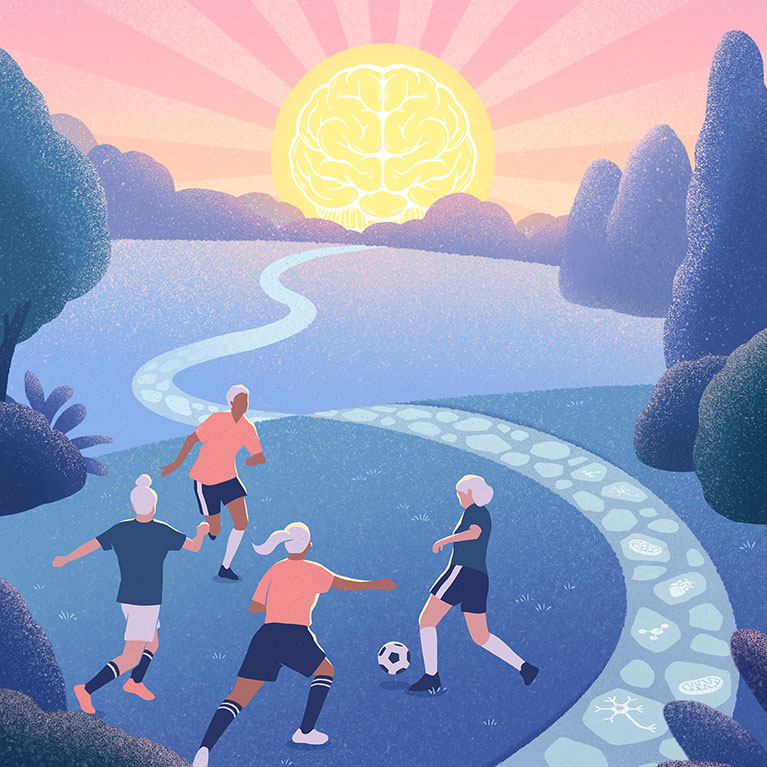
The question is, how? How can we extend health span, especially in the brain, to avoid age-related cognitive decline? The San Diego Women’s Soccer League may have some answers.
Nancy Petit (01:22)
I fell in love with the sport, I fell in love with the camaraderie, and here we are, forty some years later.
Isabella (01:29)
That’s Nancy Petit an eighty one year old league player.
Nancy Petit (01:33)
it’s just a community and we can laugh on the soccer field and we can get serious on the soccer field. And when we come off the soccer field it’s like was there a score?
What was the score?
Isabella (01:48)
One of her teammates, Jo Matthews, is also eighty one. She agrees with Petit.
Jo Matthews (01:53)
Four days a week I’m out playing soccer and it keeps me moving and I know how important that is, especially at my age,
and afterwards we always go out for coffee. That’s become part of the tradition.
Isabella (02:04)
Beneath these anecdotes from the field are real biological mechanisms supporting the brain health of these “Over 80s Ladies,” as they call themselves. Salk scientists are unraveling those mechanisms to outline exactly which cells and molecules are at play. That includes Salk president Gerald Joyce.
Gerald Joyce (02:21)
We’re so lucky to have the brains we have as a species. The human brain is just one of evolution’s greatest inventions. You know, it gives us such a rich intellectual and emotional life. but we weren’t quite evolved to live as long as we do. And so there’s a challenge in keeping that wonderful brain fit over the many decades, the seven to eight decades that is now average lifespan in in the United States.
So that’s why we’re focusing on the issue of brain health through a long lifespan. We’re looking at all different aspects of this. you know, what you can do to maintain brain health through a long lifespan. So, cardiovascular health, metabolic health, immune health, exercise, building cognitive strength, good sleep habits, and so on. We’ve heard of all these recipes for for good brain health, but
we want to dig deeper into, why are these good things? And what how can we learn more about them? And that’s of course what we’re doing here at the Salk Institute.
Isabella (03:15)
These are the types of questions foundational researchers at Salk are especially well suited to tackle. Foundational science searches for the underpinnings of biological phenomena that, once described, can be used to develop better therapeutics or inform better habits that can protect you long term.
When foundational discoveries reveal the mechanisms and molecules our bodies use to keep us healthy, scientists can determine what lifestyles support those mechanisms and molecules and find ways to supplement or repair them when they dysfunction. This year, Salk is focusing those foundational research powers on brain health. How do exercise, cardiovascular health, immune health, metabolic health, and mental health converge to support a healthy brain?
And what actionable tips can be gleaned from understanding the foundational biology of brain health?
Exercise is energy intensive, but it’s not just your muscles gobbling up energy. While the brain constitutes only 2% of the volume of the body, it consumes 20% of the energy. That energy is used to fuel the tens of billions of neurons that zap information back and forth to facilitate running, scoring, jumping, playing, and everything else the body needs. For years, it was believed that the neurons you’re born with are all you get.
It was a neuroscientist at Salk, Rusty Gage, that discovered that’s just not the case. Neurogenesis can occur throughout life, and exercising can boost it. This can help stabilize the brain in later years, when neurons and the connections between them get lost, leading to age-related neurodegeneration. Recently, scientists have pinpointed two exercise-related proteins that encourage neurogenesis.
One is BDNF, a protein that increases during exercise and helps neurons make more connections with one another. What causes this increase is still under investigation, but Gage suspects something begins circulating in the blood during exercise that tells the brain to make more BDNF.
The other is GPLD1, a protein that gets made in the liver and sent through the bloodstream up to the brain.
Rusty Gage (05:09)
The brain is connected to the rest of the body, and the rest of the body affects the brain as well.
Isabella (05:13)
Exercise stirs up these proteins and encourages connectivity in the brain that keeps it healthy longer. One day of exercise a month will not produce these benefits, though. While one exercise session is good for you, a long-term, sustainable exercise routine is better. But routine does not have to mean boring.
Rusty Gage (05:32)
You really need to have a balanced plan.
Because for one thing, if you’re doing exercise, you don’t want to get hurt. You want to do things in moderation, especially at the beginning.
So getting deep breaths, getting a lot a lot of oxygen, eating right is just absolutely important. But you know, stretching exercise, balancing exercise, just simply balancing, as well as aerobic exercise like running, but it should be all of them.
Isabella (05:56)
And the soccer ladies agree. Jany Staley, an eight-two-year-old teammate
of Petit and Matthews, adds
Jany Staley (06:03)
You gotta keep your body moving. You gotta keep those muscles active.
Isabella (06:07)
Staley runs the Sunday morning league, is the president of another league, and dabbles in pickleball and
cards.
A mix of strength, agility, aerobics, and most importantly, fun can keep exercise feeling doable and the brain feeling energized. And starting now can set the stage for healthier aging.
A major benefit to exercise is improving circulation, the continuous stream of blood through the heart, arteries, and veins that constitute the cardiovascular system. Good circulation ensures that oxygen and nutrients reach the brain efficiently, and a consistent exercise regimen can improve circulation.
In fact, with routine exercise, the body can increase its energy making capacity by making more of the little cellular engines called mitochondria that turn oxygen and nutrients into usable fuel.
This ability to make more mitochondria in response to exercise and healthy circulation is especially important in the energy-hungry brain, where mitochondria power the connections between neurons.
Loss or dysfunction of mitochondria in the brain has been linked to neurodegeneration, as the brain lacks the power it needs to function normally. Salk scientists are curious why and when this happens, and whether therapeutic or lifestyle interventions exist that could prevent or remedy mitochondrial dysfunction.
One major source of mitochondrial dysfunction is overeating. When energy consumption exceeds energy expenditure, fat cells storing excess energy can grow in both size and number. While some excess storage is manageable, too much can cause fat deposits to accumulate around the body, which leads to whole body inflammation and organ dysfunction.
Alan Saghatelian, a chemical and molecular biologist at Salk, has been on the hunt for new therapeutic targets for obesity and its related metabolic conditions. He’s been looking at the dark side of the human proteome. In these mysterious waters are a class of molecules called microproteins, and Saghatelian found dozens that regulate fat cell proliferation and lipid accumulation.
Saghatelian is one of many Salk researchers taking a unique approach to studying mitochondrial function.
Identifying molecules involved in obesity can help inform future development of therapeutics that can prevent cardiovascular dysfunction, ensuring that circulation and non-brain organs contribute to the whole body health ecosystem that supports a healthy brain.
Now for the immune system. The immune system does not just come to the rescue during the flu or after a cut, it is always around, scouring the body for intruders and cleaning up threats before they turn into problems. And in the brain, immune surveillance and maintenance are carried out in part by specialized non-neuronal cells called glial cells.
Neurons make up half the cells in the brain, and glial cells the other half. There are billions of glial cells in the brain, including star-shaped cells called astrocytes. Salk scientist Nicola Allen has championed a movement in neuroscience to prioritize astrocytes in research.
Nicola Allen (09:02)
If we think about when neurons communicate, they use chemical messengers. So one neuron releases a specialized chemical that the second neuron responds to. That’s the synaptic communication. But that’s actually a pretty messy process. So the first neuron releases way too much of this chemical in order to make sure the second one gets activated.
So if you want to keep that communication really precise and encoding things correctly, then the astrocyte is there, has specialized ways to take up those chemicals and remove them from surrounding the neurons.
Isabella (09:30)
One single astrocyte can support up to one million neuronal connections in the human brain. Like neurons, age brings dysfunction of these cells, changing their properties to reduce neuronal support.
If we can figure out how to recover dysfunctional astrocytes, it’s likely their renewed strength would also promote renewed neuronal strength, renewed connections, and a healthier brain.
Nicola Allen (09:51)
We’ve now identified when your brain is forming, when it’s young. We now know how these astrocyte cells signal to the neurons to tell them to make new connections. And also to keep the right connections. So now what we’re doing in the context of healthy aging or Alzheimer’s disease is actually
re expressing these signals or giving them back to the neurons again and asking, is this able to actually recover some of the cognitive function? that’s
Isabella (10:13)
Keeping these brain-resident glial cells healthy ensures healthy brain activity. Immune cells that live elsewhere in the body are important, too, as inflammation elsewhere from another organ, injury, or dietary issue sends immune signals through the bloodstream to the brain where they can impact neurons. This is where Janelle Ayres’ expertise comes in.
Janelle Ayres (10:34)
We often equate immune health to immune strength. And we think that those with
the strong immune response and that can kill the pathogen the best. We often say that that is the one with the healthiest immune system. But the immune system, it’s a double-edged sword. It’s not just beneficial for us because it can kill pathogens, in addition to many other functions that it plays in the body, but it can also damage our bodies. If it produces too much of an inflammatory response, that can damage our bodies. And so in this case,
the strongest is not necessarily the healthiest one.
Isabella (11:08)
Ayres studies this tricky balancing act between mounting enough of a response to get rid of a pathogen and not mounting too much of a response that we start hurting ourselves. And she believes this trick gets harder for us over time.
Janelle Ayres (11:22)
We have all of these health mechanisms in place that allow us to manage or balance our immune response. And as we age, the function of those management mechanisms, they start to decline.
Isabella (11:33)
And this, of course, all ties back to the brain. Ayres explains this interaction between the immune system and the brain
with the flu as an example.
Janelle Ayres (11:42)
We get the flu, we feel lousy. And so what happens is our our immune system detects this virus is present in the body, it turns on this inflammatory response, and this actually signals to the brain to induce a set of stereotypical responses
that we collectively refer to as sickness behavior. So this is why we don’t like to eat as much, this is why we sleep more, because our immune system is telling the brain to turn on all of these responses. And these were originally thought to just be maladaptive responses.
Our lab and others have found that these behaviors that the immune system is telling the brain to turn on are actually beneficial for the host.
Isabella (12:23)
So take some solace in the fact that your lack of appetite, constant napping, general lousy feelings during sickness are doing you some good. Ayres has also found relationships between the gut and brain and the kidney and brain, wherein these non-brain areas can influence the brain’s inflammatory state. Taking care of your immune system means taking care of your brain. Supporting the health of one ensures the health of the other.
And that support can be as simple as treating injury and sickness properly, even small things like gingivitis
or eating what Ayres calls a good gut diet.
Fiber, fermented foods, yogurt—happy microbes balance your immune system and in turn make you more resilient.
Usually talking about your diet and your gut makes people think of metabolism and their metabolic health. But for Christian Metallo a metabolic scientist at Salk,
metabolism is a bit more complicated than just what you eat.
Christian Metallo (13:18)
The best way to start is
with the definition of metabolism. To me, is the set of biochemical reactions that are occurring in our cells, in our tissues, throughout our body. This also encompasses physiology and it basically drives how nutrients get from the food we eat to the different tissues.
Isabella (13:37)
Metallo applies the same tools used to study chemical plants to study biochemical processes in humans. His approach allows him to ask questions like what, when, and where are biochemical reactions happening in the human body. All the energy brains consume cannot come directly from the food we eat.
Those nutrients must be processed in a series of biochemical reactions that turn food into usable cellular fuel. Typically, glucose is the nutrient of choice, an abundant sugar the body extracts from fruits, vegetables, and starchy foods like bread or pasta.
During a fasted state, however, the brain can switch from glucose as the primary fuel to ketone bodies. Between snacks and meals, glucose levels decline and the body begins converting stored fats into ketone bodies. These little molecules are critical in keeping the brain and heart running when glucose gets low during fasting.
But Metallo thinks this important switch between glucose and ketone bodies may malfunction in aging.
Christian Metallo (14:34)
The human body is a beautifully designed machine. That has this exquisite flexibility and can sense
different nutritional environments and change the way it fuels. But it’s that changing of the guard, which often goes awry in metabolic disease and in aging.
Isabella (14:53)
Metallo studies this by tracking nutrients as they move through the body. He tags different nutrients with non-radioactive isotopes or little flags, feeds those tagged nutrients to a person or a cell in a petri dish, then uses instruments to track where they go, what tissues they end up in, how they’re metabolized, and how fast they’re converted to other biochemicals.
Metallo is particularly interested in tracking the metabolism of amino acids,
which are the building blocks of peptides and proteins, and relatedly, sphingolipids, which are bioactive fats made from amino acids that are present in specialized cells throughout the body. Curiously, sphingolipid-related genes and molecules have been linked to neurodegeneration and neurodevelopmental defects. Metallo wants to know why.
Christian Metallo (15:37)
Those metabolic signals that we often see that are starting to go awry, the metabolic deterioration that we experience with age or chronic diseases, that ultimately will feed back and compromise some of the nutrient sources that the brain relies on.
So these systems are intertwined. And that’s kind of the essence of studying these systems as an engineer, taking a systems approach and looking at not just one tissue in isolation, but the whole sum of its parts.
Isabella (16:05)
A systems approach appears in Metallo’s advice for healthy metabolism too. Ensure the whole body is healthy by exercising, maintaining an appropriate body weight, and supporting your mental health.
Let’s dig deeper into that last point. How does mental health support brain health?
Retaining memory, attention, language, and problem solving is key to extending cognitive health span. With age-related cognitive decline, these systems can begin to fail, and vulnerabilities from isolation, anxiety, and mental health disorders can exacerbate that decline. Sung Han is a behavioral neuroscientist and expert in tying molecular clues to physiological responses.
Han pays special attention to a class of brain communication molecules called neuropeptides, and how they transduce environmental stresses into changes in physiology, metabolism, behavior, and emotion.
Dysfunctional neuropeptides can trigger overreactions to non-threatening situations, causing hypersensitivity characteristic of neuropsychiatric disorders like PTSD or other panic and anxiety conditions.
One easy to act on discovery that Han has made is identifying the brain circuit used to consciously slow breathing to reduce anxiety and negative emotions. The circuit he identified offers further scientific grounding for the beneficial effects of practices like yoga and mindfulness on alleviating negative emotions. And Han even envisions a future where the circuit could be triggered by a drug, a so-called yoga pill.
Though it sounds a little silly, the idea is to create a pill that could target the circuit he identified, to instantly slow breathing and soothe your mind. Taking deep breaths, slowing down, and utilizing practices like yoga and mindfulness can keep your nervous system regulated, helping prevent chronic anxiety that can harm your body by spiking blood pressure and flooding your system with stress hormones.
In addition to breath-related practices, people can also benefit from connecting with each other.
The “Over 80s Ladies” all shared that camaraderie keeps them coming back to soccer.
Jany Staley (18:07)
it’s convinced me how important not only the physical but the interactions with people are.
it’s a great support system. Everybody’s had different things, whether it’s injuries, loss of a family member, and the soccer community pulls together to assist them during those tough times.
Jo Matthews (18:26)
When we go out for coffee, we’re talking about current events, we’re talking about what’s going on in the world, we’re talking about what’s happening to our friends, families, in general, and it just makes you want to be with them and think about what’s going on.
A lot of empathy with things that are happening, you know, whether it’s to us, to our group, or out there.
Isabella (18:49)
The science behind socialization is a special interest for Kay Tye After first identifying a cluster of neurons in mice that were associated with a drive to socialize after isolation, Tye found similar results in a small human cohort. Humans craved social contact when lonely in a similar way to craving food when hungry, and Tye identified the circuit responsible for that craving.
Social isolation, like anxiety, can cause stress or disorder. Maintaining both quantity and quality of social interactions can keep your brain from craving connection and falling into disorder over time. Tye especially encourages taking on new experiences. Be adventurous. Build new brain paths.
Kay Tye (19:30)
Of everything we’ve learned, what I would say overall is just to try to expand your bands of tolerance and that’s gonna make you have more cognitive resilience. And I think that goes especially for social environmental things, but also anything cognitive. Like if you always take the same route home from work to home, then if that road is blocked, you don’t know how to get home.
But if you take lots of different routes, then if one road is blocked, you have a lot of other ways.
Isabella (19:59)
By finding different routes, you ultimately expand the connectivity in your brain. And the more connections you have and neurons you keep active, the less you’ll feel the cognitive impacts of age.
Eat healthy, exercise, make new friends, get good sleep. This advice, though repetitive and ubiquitous, is true.
Gerald Joyce (20:19)
The Salk style here
is not merely to say, yeah, this would be a do good thing, or this would be a do good thing, or this is a don’t do thing. We want to understand, the why, the mechanism behind these things.
Because if we can understand the mechanism, then we know the bullseye of what the do-good is, right? Then it’s not a sort of generic almost platitude, it’s a more specific thing.
If we can understand why this particular behavior helps us avoid cognitive decline, then that leads to opportunity to intervene.
Isabella (20:48)
Salk Scientists are continuing to explore the mechanisms behind why and how exercise, cardiovascular health, immune health, metabolic health, mental health, and other factors support a healthy brain. And it’s all about teamwork.
Whether in the lab, in the body, or on the soccer field, nothing happens in isolation. No one scientist or discipline can understand life by themselves. No singular part of the body can be untangled from the rest. And no one soccer player can win a game alone. Supporting brain health can happen at any age, and it never has to stop.
Jany Staley (21:20)
You can never say you can’t learn new things just because you’re older. And I think any older person can learn anything if they want to.
Nancy Petit (21:31)
And my kids go, my gosh, Mom, I’m like they said, Don’t you think it’s maybe almost time to hang up your cleats? And I’m like, No I just yelled at ’em. No I’m not ready to hang up my cleats.
Victoria (21:50)
Beyond Lab Walls is a production of the Salk Office of Communications. Subscribe to this podcast to hear more exciting Salk science stories. Our monthly newsletter and seasonal magazine, Inside Salk, can also bring the lab to you, spotlighting our staff and scientists and the discoveries that are only possible at Salk. Visit Salk.edu to learn more about the world within these walls.