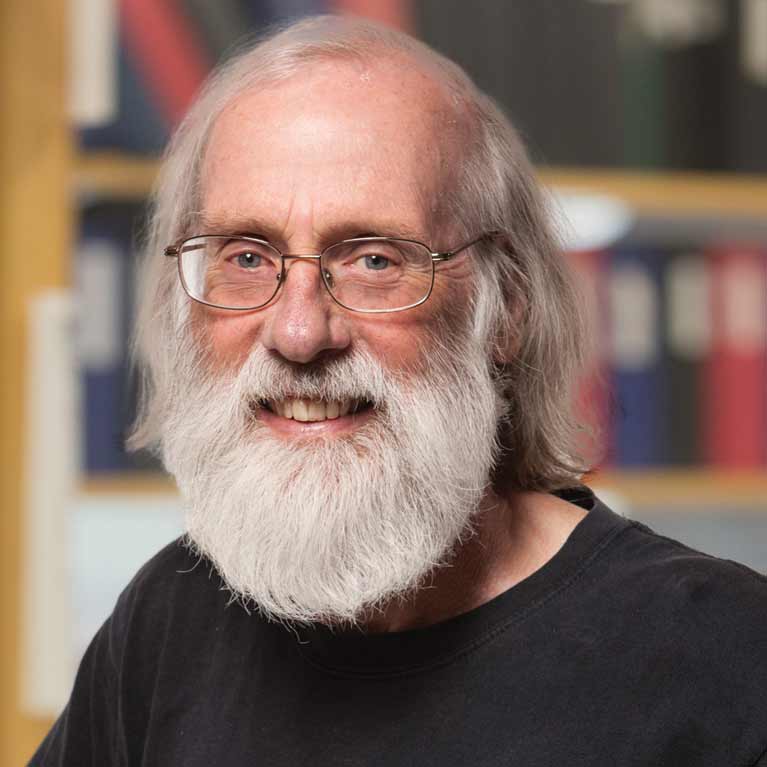
Tony Hunter
American Cancer Society Professor
Molecular and Cell Biology Laboratory
Renato Dulbecco Chair
Research
Tony Hunter, a professor in the Molecular and Cell Biology Laboratory and director of the Salk Institute Cancer Center, studies how cells regulate their growth and division, and how mutations in genes that regulate growth lead to cancer. His lab has made significant contributions in the area of signal transduction, how signals that stimulate or rein in growth are routed within a cell.
In 1979, his lab discovered that phosphate can be attached to tyrosine residues in proteins. This seminal discovery opened the door to the study of tyrosine kinases and their role in signal transduction, and in cell growth and development, as well as to their role in cancer and other human diseases. This knowledge already has resulted in a new approach to cancer treatment.
His current efforts are aimed at elucidating how protein phosphorylation, ubiquitination, and SUMOylation events are used to regulate cell proliferation and growth control, and cell cycle checkpoint activation in response to DNA damage. His recent work has highlighted the importance of crosstalk and feedback loops in the PI-3 kinase-Akt-mTOR cell growth pathway, has elucidated mechanisms of activation of the ATM protein kinase in response to double strand DNA breaks, and has identified a role for the ERK MAP kinase pathway in the motility of early breast carcinoma cells.
"The goal of our group is to elucidate signal transduction mechanisms utilizing protein phosphorylation/dephosphorylation, ubiquitylation, and sumoylation and to investigate how these processes regulate cell proliferation, growth control and the cell cycle. Ultimately, we want to use this information to uncover how dysregulation of such post-translational modifications is involved in cancer."
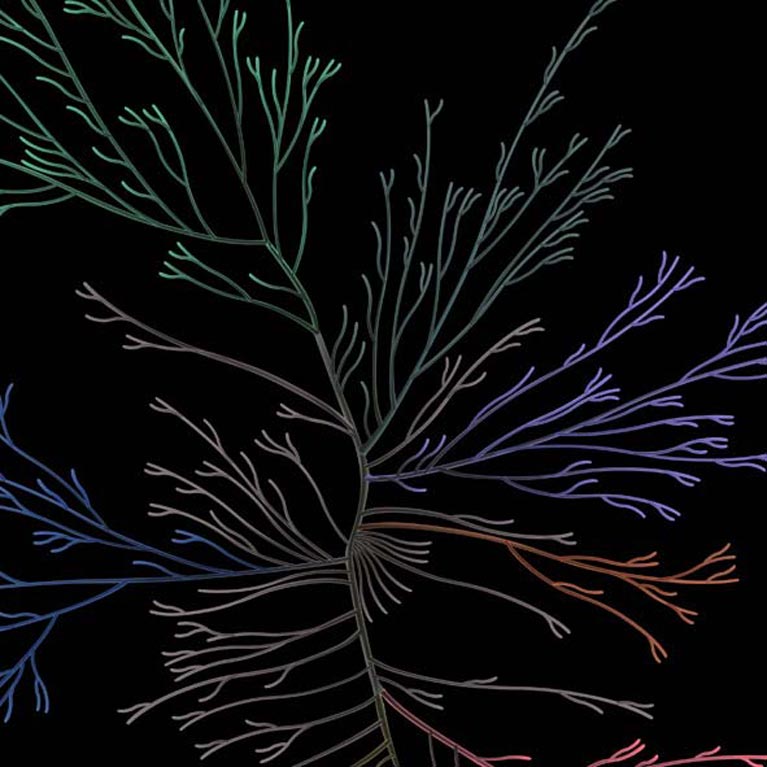
Protein kinases are key cellular enzymes; they attach phosphates to other proteins in the cell and thereby regulate their activities. This process, which is known as phosphorylation, is reversed by a second type of enzyme that removes the phosphate. Phosphorylation therefore acts as a molecular on/off switch. The human genome encodes nearly 540 different protein kinases, making them among the most abundant and important types of gene products.
One major function of protein phosphorylation is to control cell proliferation in response to external signals. A hallmark of cancer cells is that they continue to proliferate even in the absence of external signals to grow. In many cases, this is due to genetic changes that result in a protein kinase being continuously active instead of being toggled on and off in response to signals. Kinases that add phosphate to the amino acid tyrosine in proteins are particularly important cancercausing "oncoproteins," and a number of new cancer drugs are designed to block these rogue enzymes. However, kinases that add phosphates to the amino acids serine or threonine in proteins also play roles in cancer. Recent efforts to sequence entire tumor genomes have revealed that many types of protein kinases sustain mutations in cancer, including numerous ones that were not previously known to be involved.
Hunter and his team have analyzed the consequences of mutations in some of these cancer mutant kinases in the hope that they might identify new cancer drug targets. For one kinase that phosphorylates serine and threonine, known as death-associated protein kinase 3 or DAPK3, they found that the cancer mutations actually cause a decrease in the ability of the kinase to add phosphate to proteins. This unexpected discovery suggests a new model in which DAPK3 normally acts to rein in the growth of cells, whereas in cancer cells this "suppressor" activity has been lost through inactivating mutations. Thus, DAPK3 would not be a target for inhibitor drugs. Nevertheless, other mutant kinases emerging from sequencing studies may prove to be good targets, and Hunter's group is continuing to study cancer mutant kinases in the hope that unlocking their secrets will lead to better cancer therapies.
Back row, left to right:
Mike French, Justin Zimmermann
Front row, left to right:
Brandon Lamarche, Huaiyu Sun, Andrea Carrano, Megan Lambert, Yu Shi,
Jill Meisenhelder, Lorena Puto, Tony Hunter, Natalie Luhtala, Suzy Simon, Xinde Zheng, Aaron Aslanian,
Zheng Wang, Hui Ma
Salk News Releases
-
American Association for Cancer Research appoints Salk scientists to inaugural class of fellows
March 25, 2013 -
What can the water monster teach us about tissue regeneration in humans?
September 25, 2012 -
Salk Institute Hosts Cell Cycle Symposium - Discussions that Change Lives
June 9, 2011 -
Salk Institute cancer researcher Tony Hunter named to Frederick W. and Joanna J. Mitchell Chair
March 2, 2010 -
Mobilizing the repair squad: Critical protein helps mend damaged DNA
December 24, 2009 -
Chemotherapy resistance: Checkpoint protein provides armor against cancer drugs
August 31, 2009 -
Climbing the ladder to longevity: critical enzyme pair identified
June 24, 2009 -
Breast cancer cells have to learn to walk before they can run
January 2, 2008 -
Get in Touch First
October 30, 2007 -
Tony Hunter receives Robert. J. and Claire Pasarow Award for Cancer Research
May 22, 2007 -
Distinguishing friend from foe in the battle against cancer
September 11, 2006 -
Genetically modified mice are resistant to obesity despite a high fat diet
February 7, 2006 -
Molecular 'zipcode' guides nerves to correct places in body
April 7, 2005 -
Salk Scientist who discovered cancer \'switch\' awarded the Wolf Prize in Medicine
January 14, 2005 -
Salk Scientist Who Revolutionized Cancer Research Awarded Horwitz Prize
December 3, 2004 -
Salk Institute Scientist Tony Hunter Named to Institute of Medicine
November 8, 2004 -
Hunter Receives Two Major Cancer Awards
March 2, 2004 -
Salk Researchers Ranked in Top 25 of Scientific Citations Worldwide
September 29, 2003 -
Missing Enzyme Found to Lead to Alzheimer?s Disease Symptoms
July 31, 2003 -
Salk Institute and SUGEN Scientists Map 'Human Kinome'
December 5, 2002 -
Potential Male Contraceptive Target Discovered by Salk Scientists
January 31, 2000
Awards and Honors
- Fellow of the Royal Society of London
- Member of the United States National Academy of Sciences
- Fellow of the American Academy of Arts and Sciences
- Institute of Medicine of the National Academics
- Member of the American Philosophical Society
- American Cancer Society Research Professorship
- General Motors Cancer Research Foundation Prize, 1994
- Gairdner Foundation International Award, 1994
- J. Allyn Taylor International Prize in Medicine, 2000
- Keio Medical Science Prize, 2001
- Sergio Lombroso Award in Cancer Research, 2003
- City of Medicine Award, 2003
- American Cancer Society Medal of Honor, 2004
- Kirk A. Landon-AACR Prize for Basic Cancer Research, 2004
- Prince of Asturias Award for Scientific and Technical Research 2004
- Louisa Gross Horwitz Prize, 2004
- Wolf Prize in Medicine, 2005
- Daniel Nathan's Memorial Award, 2006
- Robert J. and Claire Pasarow award for Cancer Research, 2006
- Clifford Prize for Cancer Research, 2007