
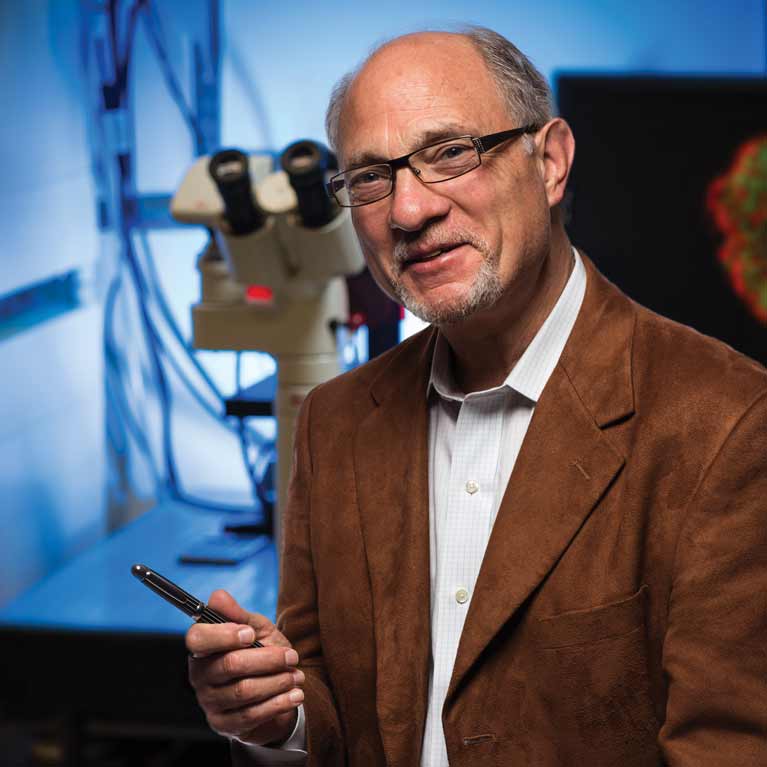
Geoffrey M. Wahl
Professor
Gene Expression Laboratory
Daniel and Martina Lewis Chair
Research
Geoffrey M. Wahl, a professor in the Gene Expression Laboratory, is studying the genetic basis of the origin and progression of cancer and why tumors become resistant to drugs.
The underlying mechanisms of the genetic instability of cancer cells, and of their ability to develop resistance to anti-cancer drugs have remained a mystery to cancer biologists for the better part of a century. Wahl has found evidence that the instability derives from mutations in key genes that determine when it is safe for the cell to begin the important process of duplication of the genetic material. Such mutations also prevent cancer cells from responding to treatments commonly used in therapy that produce DNA damage, such as ionizing radiation. This increases the chances that a mutant cell will be produced every time it tries to reproduce itself. While this gives cancer cells many advantages for growth under stressful conditions, it also provides novel routes for the development of new anti-cancer therapies. The lab is now investigating how p53 is regulated, as 50% of human cancers express wild type p53 that is functionally compromised. Their efforts center on the use of in vitro systems and genetically modified mice to understand the contributions of two related proteins, Mdm2 and Mdm4 (Mdmx) to p53 regulation. Previous studies have shown that these proteins are essential for controlling p53 activity, and that they are frequently over-expressed in cancer cells as a way to mitigate p53 function in tumors containing wild type p53 genes. A goal of these studies is to develop drugs that antagonize Mdm2 and Mdmx to treat patients when tumors over-express these proteins. Another area of investigation concerns the identification and isolation of stem cells that are required to form each of the different types of cells in organs such as the mammary gland. This is important as the special properties of such cells, including their abilities to self-renew and to divide infrequently may enable them to contribute to cancer formation and to drug resistance.
"We are studying the genetic basis of the origin and progression of cancer and developing new strategies to tailor-make drugs based on the genetic signature of a patient's tumor."
Significant advances in breast cancer prevention and treatment have come from strategies based on knowledge of mammary cell biology and the unique molecular fingerprints of individual tumors. Despite such advances, however, more than 40,000 patients in the United States and about 500,000 worldwide will die of breast cancer in the next 12 months. In too many cases, treatment failures resulting from emergence of drug-resistant cells and metastases will shorten lifespan and reduce quality of life. The overarching issue the Wahl lab addresses is whether a better understanding of the stem-like cells Wahl and others have found in many breast cancers could provide clues to the development of more effective treatment strategies.
During the 1800s pathologists and developmental biologists emphasized that understanding cancer requires deep knowledge of the principles governing the development of the tissue of origin in which the cancer will arise. Thus, even in the 19th century, scientists appreciated that cancer is a caricature of normal development. Wahl's group therefore expended considerable effort studying the development of the mouse mammary gland in the hope that it would provide insight into the types of cells and processes that are perturbed in the generation of human breast cancers.
His team recently reported the first identification, isolation and characterization of mouse fetal mammary stem cells (fMaSCs) and their associated gene expression profiles. Significantly, they found that many growth regulatory pathways present in fMaSCs appear to be enriched in specific patients with aggressive and frequently chemoresistant basal-like and triple-negative cancers. This is important, as these cancers currently lack molecular targets around which to build personalized therapeutic agents, such as Herceptin for those breast cancers that overexpress Her2 (a growth factor receptor that Herceptin inactivates). The researchers tested whether currently available targeted therapeutic agents directed against some fMaSC growth factor pathways would inhibit their growth and found that the agents tested worked well to inhibit fMaSC growth.
Wahl and his group are now doing the work needed to extend these studies to the clinic in the hope that this basic research can be translated to the bedside to help patients with breast cancers that currently lack targeted therapeutic strategies. An implication of the work is that cells that fuel cancer progression may revert to, or acquire, gene expression characteristics initially found in the stem cells of the embryonic tissue of origin.
Left to right:
T. Morrell, Rose Rodewald, Justin La, Payal Desai, Geoff Wahl, Ben Spike,
Miranda Cox, Chris Dravis, Leo Li
Salk News Releases
-
American Association for Cancer Research appoints Salk scientists to inaugural class of fellows
March 25, 2013 -
Prestigious endowed chairs awarded to Salk scientists
March 30, 2012 -
Salk scientists use an old theory to discover new targets in the fight against breast cancer
February 7, 2012 -
The genome guardian's dimmer switch: regulating p53 is a matter of life or death
June 30, 2011 -
The stemness of cancer cells
December 13, 2010 -
Tumor suppressor pulls double shift as reprogramming watchdog
August 9, 2009 -
The two faces of Mdmx: Why some tumors don't respond to radiation and chemotherapy
July 6, 2009 -
Salk Institute Scientist Plays Pivotal Role in More Than $100 Mill National "Stand Up To Cancer" Fundraising, Pancreatic Cancer Research "Dream Team"
May 27, 2009 -
Geoffrey M. Wahl named 2008 AAAS Fellow
December 18, 2008 -
New model of p53 regulation proposed that suggests novel anticancer strategy
April 10, 2006 -
Cancer related gene p53 not regulated as indicated by previous tissue culture research; results may be relevant to drug development
June 27, 2005 -
Salk Institute scientist Geoff Wahl named President-elect of world's largest cancer research organization
June 9, 2005 -
Elusive Chromosomal "Ignition" Identified By Salk Scientists
July 13, 1998
Awards and Honors
- National Institutes of Health Postdoctoral Fellowship
- American Cancer Society Senior Fellowship
- American Men and Women of Science
- "Citation Classic" Designation for one of the most highly cited scientific papers, 1961-1982
Salk scientists use an old theory to discover new targets in the fight against breast cancer
February 07, 2012
Reviving a theory first proposed in the late 1800s that the development of organs in the normal embryo and the development of cancers are related, scientists at the Salk Institute for Biological Studies have studied organ development in mice to unravel how breast cancers, and perhaps other cancers, develop in people. Their findings provide new ways to predict and personalize the diagnosis and treatment of cancer. Read more>>


