




Salk Institute
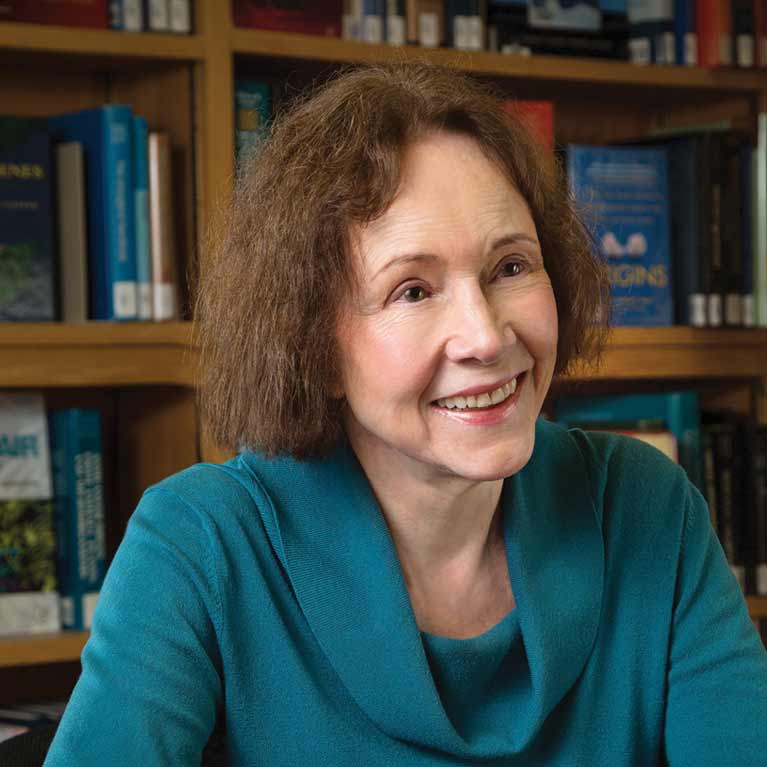
Suzanne Bourgeois
Professor Emerita
Regulatory Biology Laboratory
Suzanne Bourgeois

Professor Emerita
Regulatory Biology Laboratory


Research

Suzanne Bourgeois, a professor at the Salk Institute, has extensively studied the effects of steroid hormones on cancer cells. Bourgeois' laboratory has also been investigating drug resistance, a major problem in cancer treatment. They demonstrated that certain steroid hormones can restore drug sensitivity to cancer cells in tissue culture. These studies will be extended to animal model systems, a necessary step before clinical trials can begin.

Recently, Bourgeois has become interested in public education and has been giving lectures to inform and educate the public in the area of cancer.

"Today we take the Salk Institute and its success for granted. It is edifying–and makes a good story– to explore what it took to get us here and to be what we are: the idea, the people, the circumstances, the location, the building."

After a scientific career researching bacterial cell regulation and gene expression in cancer cells, Bourgeois has turned her attention to the history of science—specifically, the early history of the Salk Institute. Because she was a witness to the Institute's history since before its inception, Bourgeois is uniquely qualified to bring that story alive. She also had the privilege, while working in New York and Paris in the 1950s and 1960s, of knowing many of the pioneers of molecular biology, several of whom helped establish the Salk Institute. She therefore is completing work on a book-length history of the Salk Institute, which will be a well-documented personal chronicle that is based on extensive research encompassing archival material, interviews and her own diaries.

Jonas Salk's original concept for an institute evolved under many influences, including those of the physicists Robert Oppenheimer and Leo Szilard. In the late 1950s and early 1960s, Salk contacted the scientists who were to become the Institute's founders: Melvin Cohn, Francis Crick, Renato Dulbecco, Edwin Lennox and Jacques Monod. At the same time a mathematician and humanist, Jacob Bronowski, joined the group, and another mathematician and remarkable man became the first chairman of the Board of Trustees: Warren Weaver, who coined the term "molecular biology." The success of the polio vaccine earned Jonas Salk the respect and friendship of Basil O'Connor, the first president of the March of Dimes, whose support ultimately made the Salk Institute a reality.

The Institute's founders belonged to the generation of World War II and the Manhattan Project and, afterward, the Cold War. The original faculty and several of the early presidents and trustees had actively participated in those events, which shaped what they wanted to do, how they operated and how they saw the future. Most importantly, that background distinguished them as members of an impressive network of outstanding achievers. That legacy of accomplishment remains the foundation of the Salk Institute to this day.


Get Involved
Join our online community
Facebook    Facebook
Twitter    Twitter
YouTube    YouTube
RSS    RSS
Contact
Salk Institute for Biological Studies
Street: 10010 North Torrey Pines Rd
City: La Jolla, CA 92037
Email: webrequest@salk.edu
Phone: 858.453.4100
Charity Navigator Rating
© Copyright 2013 Salk Institute for Biological Studies About Scientists & Research News & Media Events Support