2022年10月4日
Salk Institute and UC San Diego Health clinical trial shows how lifestyle intervention can improve cardiovascular health in shift workers
Salk Institute and UC San Diego Health clinical trial shows how lifestyle intervention can improve cardiovascular health in shift workers
拉霍亚—消防员是我们社会的英雄,全天候保护着我们。但这些 24 小时的轮班工作对身体非常不利,并且会增加患心脏代谢疾病(如心脏病和糖尿病)以及癌症的风险。圣地亚哥消防局与索尔克研究所和加州大学圣地亚哥分校健康中心的科学家合作进行的一项临床试验发现,限时进食可以改善消防员的健康和福祉指标。这种生活方式干预措施仅要求消防员在 10 小时的时间窗口内进食,并且不涉及跳餐。.
The new findings, published in 细胞代谢 on October 4, 2022, may also have implications for shift workers, such as military personnel; health care, food service, and transportation professionals; telecommunications staff; and new parents, whose schedules often mimic shift work when caring for a new baby.
“Doctors and researchers are always thinking about the magic pill that can cure or reduce disease. Our study showed that shift workers with high blood pressure, blood sugar, or cholesterol can benefit from a simple lifestyle intervention called time-restricted eating,” says Salk Professor 萨奇达南达·潘达, co-corresponding author of the study and holder of the Rita and Richard Atkinson Chair. “It’s not a pill, but a healthy habit that can significantly reduce these three risks of disease without any adverse side effects.”

Almost every cell in the body has a 24-hour biological clock that produces circadian (daily) rhythms. These rhythms regulate behavior (e.g., when to be active and when to rest) and physiology (e.g., blood pressure, blood sugar, muscle function). Circadian rhythms coordinate with the environment in part by regular, timed cycles of light and dark and eating and fasting. Disruptions to these cycles, which can occur with shift work, can impact health, leading to obesity, heart disease, diabetes, and cancer.
Nearly 30 percent of Americans are considered shift workers, in which the individual must stay awake for two to three hours between 10:00 p.m. and 5:00 a.m. for at least 50 days a year. Increasing sleep and reducing calorie intake are often difficult, but previous studies have suggested that time-restricted eating (eating within a certain window of time) may offer a simple behavioral change to improve health.
“We were excited to participate in this clinical trial because our department is always looking for innovative ways to improve the health of our firefighters,” says San Diego Fire-Rescue Health and Safety Battalion Chief David Picone.
In this clinical trial, 150 firefighters from the San Diego Fire-Rescue Department used the myCircadianClock app on their phones to track their eating for three months. Half the group ate within a 10-hour window, while the other half (the control group) changed nothing and ate within a 14-hour window. Both groups were encouraged to follow a Mediterranean diet, which is known to have health benefits. The study included both individuals who were healthy and those who were overweight or who had health conditions such as high blood pressure, cholesterol, and/or blood glucose.

“Most clinical trials exclude shift workers, but these are the individuals at the highest risk of disease. So, it was imperative for us to test our lifestyle intervention in shift workers with a continuum of disease risks,” says first author Emily Manoogian, a staff scientist in Panda’s lab at Salk. “Since shift workers are incredibly busy, using an app to track their habits, and being monitored at their stations instead of the clinic, when possible, enabled these individuals to participate more readily in the trial.”
The researchers found that time-restricted eating within a 10-hour eating window was feasible without adverse effects and helped the firefighters significantly decrease their VLDL (“bad”) cholesterol size by 1.34 nanometers (small VLDL is less likely to block arteries), improve their mental health, and reduce their alcohol intake by roughly three drinks per week. Time-restricted eating also significantly improved blood sugar and blood pressure in firefighters who had elevated levels at the start of the study. The researchers concluded that time-restricted eating may provide even greater benefit for those at risk for cardiometabolic disease and other chronic diseases.
“We’ve shown that time-restricted eating is a feasible way for shift workers, such as firefighters, to improve their cardiovascular health and wellbeing,” says Pam Taub, co-corresponding author and professor of medicine at the UC San Diego School of Medicine and a cardiologist at UC San Diego Health. “These findings can likely be extended to a wider population, including health care workers like nurses and others who experience abnormal sleep-wake patterns.”
“Participating in this study was an eye-opening experience that provided valuable information we can use to make better choices to improve our health,” says San Diego Fire-Rescue Captain Mark Dombrosky.
In the future, the authors plan to expand the use of time-restricted eating to multiple fire districts to help more firefighters improve their health.
Other authors included Nikko R. Gutierrez, Azarin Shoghi, Xinran Wang, Jialu Sui, and Zhaoyi Hou of Salk; and Adena Zadourian, Hannah C. Lo, Ashley Rosander, Aryana Pazargadi, Cameron K. Ormiston, Jason G. Fleischer, and Shahrokh Golshan of UC San Diego.
The work was funded by the Federal Emergency Management Agency (EMW-2016-FP-00788), a Larry L. Hillblom Foundation Postdoctoral Fellowship, a Salk Women in Science Fellowship, the National Institutes of Health (DK118278, CA 258221, and CA236352), the Robert Wood Johnson Foundation, the Wu Tsai Human Performance Alliance and the Joe and Clara Tsai Foundation, the William H. Donner Foundation, and the Martha P. Mack Foundation.
DOI: 10.1016/j.cmet.2022.08.018
日记
细胞代谢
作者
Emily N.C. Manoogian, Adena Zadourian, Hannah C. Lo, Nikko R. Gutierrez, Azarin Shoghi, Ashley Rosander, Aryana Pazargadi, Cameron K. Ormiston, Xinran Wang, Jialu Sui, Zhaoyi Hou, Jason G. Fleischer, Shahrokh Golshan, Pam R. Taub and Satchidananda Panda
期刊封面
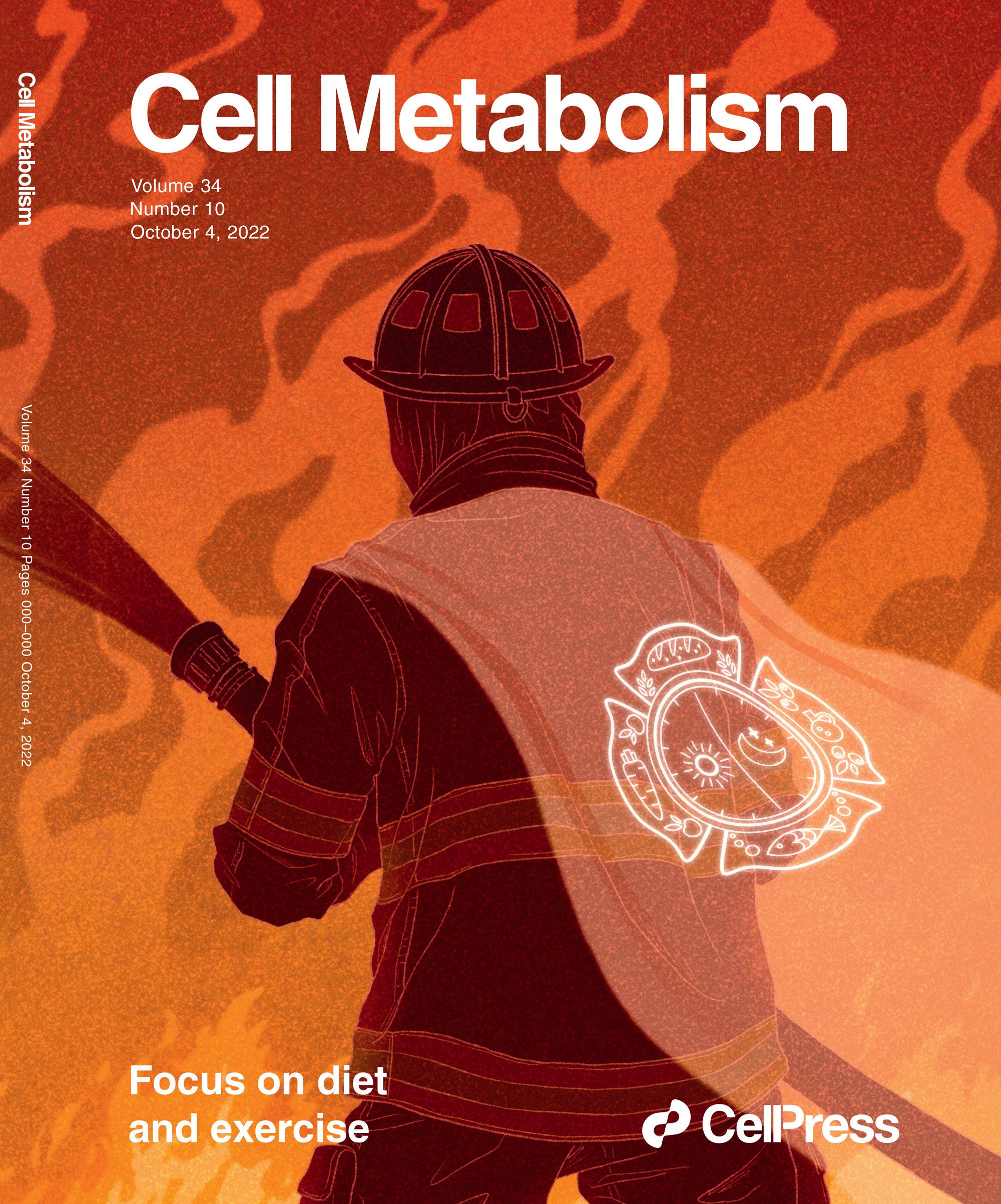
Journal cover image of 细胞代谢 illustrating a firefighter wearing a cape that represents eating within a time-restricted window.
Credit: Courtesy of 细胞代谢
宣传办公室
电话:(858) 453-4100
press@salk.edu
萨尔克研究所是一个独立的非营利性研究机构,由首个安全有效的脊髓灰质炎疫苗的研发者乔纳斯·索尔克于1960年创立。该研究所的使命是推动以合作、敢于冒险为特点的基础性研究,以应对癌症、阿尔茨海默病和农业脆弱性等社会最紧迫的挑战。这项基础科学支撑着所有的转化研究,产生有助于全球新药和创新的见解。.