July 15, 2015
Salk scientists have created mutation-free lines of stem cells from human patients with mitochondrial diseases
Salk scientists have created mutation-free lines of stem cells from human patients with mitochondrial diseases
LA JOLLA–Healthy brain, muscle, eye and heart cells would improve the lives of tens of thousands of people around the world with debilitating mitochondrial diseases. Now, researchers at the Salk Institute have gotten one step closer to making such cures a reality: they’ve turned cells from patients into healthy, mutation-free stem cells that can then become any cell type. The new approach is described July 15, 2015 in 自然.
“Right now, there are no cures for mitochondrial diseases,” says senior author 胡安·卡洛斯·伊兹皮苏亚·贝尔蒙特, professor in Salk’s 基因表达实验室. “Very recently, we’ve developed ways to prevent these diseases, so it was natural to next ask how we could treat them.”
Mitochondrial diseases are caused by any of about 200 mutations that affect the genes of mitochondria, tiny powerhouses inside nearly every cell of the body. Depending on the affected genes and cell types, the diseases can cause muscle weakness, liver disease, diabetes, seizures, developmental delays or vision problems. Existing therapies aim to ease the symptoms or slow the progression of the diseases, but can’t entirely cure them.
In their new work, Belmonte and collaborators from around the world collected skin samples from patients with mitochondrial encephalomyopathy or Leigh Syndrome, both severe disorders that affect the brain and muscles.
The teams began by using current standard protocols to derive pluripotent stem cells from the skin cells, a process that resets the cells to their most basic state.
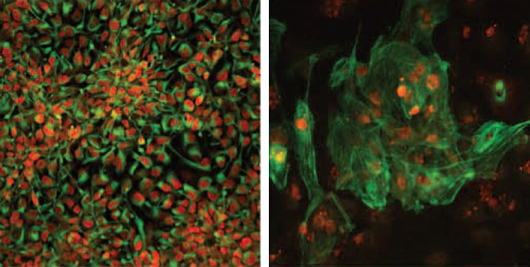
Salk researchers have generated disease-free stem cells from patients with mitochondrial disease that can be converted into any cell type including neuronal progenitors (left) or heart cells (right). These could potentially be used for future transplantation into patients.
图片:由萨克生物研究所提供
“During the process of stem cell generation, you spontaneously get different types of clones,” says Alejandro Ocampo, a research associate in Izpisua Belmonte’s lab and one of the authors of the new paper. If the patient cells have an initial mix of healthy and diseased mitochondria, healthy and diseased stem cells will be generated. Then, the stem cells with healthy mitochondria can be picked out.
For some patients, though, this straightforward approach doesn’t work; their cells don’t have enough–or any–healthy mitochondria to start with.
So the team came up with a second approach: move the nucleus of the patient’s skin cells, which contains most of their genes, into a donor egg cell with healthy mitochondria. Then, use the new egg cell to generate pluripotent stem cells. When the researchers did this, they found the healthy mitochondria took over, and healthy, genetically similar cells from the patient were successfully generated.
“In either case, the idea is that we have healthy stem cells, and we know how to convert pluripotent stem cells into different cell types,” says Jun Wu, an author of the paper and research associate in Izpisua Belmonte’s lab. “They have the potential to give rise to every cell type in the body.”
For now, that means that researchers can use the healthy cells to generate heart, brain, muscle or eye cells from the mutation-free stem cells. But methods to make those cells fully mature and functional and transplant them into patients are still under development.
The new method will also be a boon to basic research, Izpisua Belmonte adds. Scientists have long struggled to understand why different organs and tissues are affected so differently by mitochondrial mutations. By comparing stem cells with mitochondrial mutations with healthy ones, and coaxing each to develop into different cell types, they can study this aspect of mitochondrial diseases in more detail.
Other researchers on the study were Li Ma of the Salk Institute; Hong Ma, Riffat Ahmed, Eunju Kang, Yeonmi Lee, Tomonari Hayama, Ying Li Crystal Van Dyken, Nuria Marti Gutierrez, Rebecca Tippner-Hedges, Amy Koski, Nargiz Mitalipov, Paula Amato, Don P. Wolf, and Shoukhrat Mitalipov of Oregon Health & Science University; Clifford D. L. Folmes, and Andre Terzic of the Mayo Clinic; Robert Morey, Sergio Mora-Castilla, and Louise C. Laurent of the 加州大学圣地亚哥分校; Joanna Poulton of the University of Oxford; and Xinjian Wang and Taosheng Huang of Cincinnati Children’s Hospital.
The work was supported by the G. Harold and Leila Y. Mathers Charitable Foundation and the Leona M. and Harry B. Helmsley Charitable Trust.
日记
自然
作者
Jun Wu, Alejandro Ocampo, Li Ma, and Juan Carlos Izpisua Belmonteof the Salk Institute; Hong Ma, Riffat Ahmed, Eunju Kang, Yeonmi Lee, Tomonari Hayama, Ying Li Crystal Van Dyken, Nuria Marti Gutierrez, Rebecca Tippner-Hedges, Amy Koski, Nargiz Mitalipov, Paula Amato, Don P. Wolf, and Shoukhrat Mitalipov of Oregon Health & Science University; Clifford D. L. Folmes, and Andre Terzic of the Mayo Clinic; Robert Morey, Sergio Mora-Castilla, and Louise C. Laurent of the University of California, San Diego; Joanna Poulton of the University of Oxford; and Xinjian Wang and Taosheng Huang of Cincinnati Children’s Hospital
宣传办公室
电话:(858) 453-4100
press@salk.edu
萨尔克研究所是一个独立的非营利性研究机构,由首个安全有效的脊髓灰质炎疫苗的研发者乔纳斯·索尔克于1960年创立。该研究所的使命是推动以合作、敢于冒险为特点的基础性研究,以应对癌症、阿尔茨海默病和农业脆弱性等社会最紧迫的挑战。这项基础科学支撑着所有的转化研究,产生有助于全球新药和创新的见解。.