November 9, 2018
Multidisciplinary team led by Salk President Rusty Gage will unravel the mysteries of age-related cognitive decline as a failure of
interconnected biological systems
Multidisciplinary team led by Salk President Rusty Gage will unravel the mysteries of age-related cognitive decline as a failure of interconnected biological systems
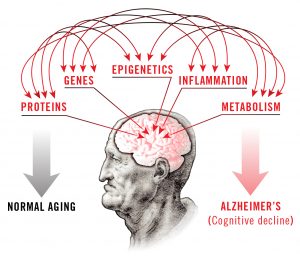
LA JOLLA—A team of Salk Institute researchers led by President 鲁斯蒂·盖奇 has been awarded $19.2 million over eight years by the American Heart Association-Allen Initiative in Brain Health and Cognitive Impairment to investigate mechanisms underlying Alzheimer’s disease and aging-related cognitive decline and uncover new therapies. This bold venture will comprehensively analyze interactions between five areas key to brain health: proteins, genes, metabolism, inflammation and epigenetics.
“At the Salk Institute, we have devised a completely new way of approaching Alzheimer’s and aging research,” says Gage, a world-renowned researcher in neuroscience and genetics who holds the Vi and John Adler Chair for Research on Age-Related Neurodegenerative Disease. “With the generous support of The Paul G. Allen Frontiers Group, the American Heart Association and other philanthropic donors to this initiative, we believe we can make significant progress in the diagnosis and treatment of Alzheimer’s and other age-related cognitive diseases.”
点击此处 用于高分辨率图像。.
版权:萨克研究所
An aging-related disorder that results in severe memory loss, Alzheimer’s disease represents a global health crisis with estimates suggesting that 130 million people will be affected by 2050. To date, there are no therapies to effectively treat the disease.
To respond to this critical need, Gage will be leading a multidisciplinary team of 10 Salk scientists, all luminaries in their respective fields across metabolism, immunology and inflammation, genetics and epigenetics, and protein analysis. The all-star interdisciplinary group believes that Alzheimer’s and other age-related brain disorders are triggered not by a single event, but by a failure of complex, interdependent biological systems in our body that start to break down as we age. Failure in any one of these systems can cause a domino-like crash that results in devastating brain disorders like Alzheimer’s. By studying the networks that keep our brains healthy, the team aims to reveal new targets for therapeutic research and biomarkers of early stage cognitive decline.
“The fact that numerous clinical trials over the past several decades have not yielded effective therapies points to the complex nature of neurodegeneration,” says Professor 苏珊·凯奇, director of Salk’s NOMIS Center for Immunobiology and Pathogenesis, holder of the NOMIS Chair, and a member of the project’s leadership team. “We are grateful for this support, which will help us learn more about the role of inflammation in Alzheimer’s and how it affects other cellular processes associated with this disease. We are hopeful this work will lead to the breakthroughs humanity so desperately needs.”

点击此处 用于高分辨率图像。.
版权:萨克研究所
To accomplish this, Salk research teams are developing cutting-edge methods to study aging and diseased neurons and other brain cells through cell cultures, brain organoids and a new primate model of cognitive aging. In addition to these technological advances, the team will use sophisticated machine-learning algorithms that can integrate diverse datasets, allowing scientists to identify the cell types and biological pathways most critical for brain aging.
“Age is the greatest risk factor for a diversity of devastating diseases including Alzheimer’s, heart disease and cancer,” says Professor 扬·卡尔塞德, a member of the project’s leadership team who directs the Glenn Center for Biology of Aging Research and holds the Donald and Darlene Shiley Chair. “Since the effects of aging are themselves comprehensive, taking a systems approach seems promising. We very much appreciate the generosity of The Paul G. Allen Frontiers Group and American Heart Association in supporting this research to advance our understanding of aging.”
“The innovative approaches that have come about through this initiative are a clear testament to Allen Institute founder Paul G. Allen’s legacy in science,” said Allan Jones, PhD, President and Chief Executive Officer of the Allen Institute. “Paul inspired all of us every day to tackle hard problems that require systematic, comprehensive approaches to solve, and these new research teams are a perfect example of that way of thinking about mysteries in science and human health.”
The Salk investigators on the grant are:
尼古拉·艾伦, assistant professor
约瑟夫·埃克尔, professor
鲁斯蒂·盖奇, professor
马丁·赫策尔, professor
苏珊·凯奇, professor
扬·卡尔塞德, professor
萨凯特·纳夫拉克哈, assistant professor
约翰·雷诺兹, professor
杰拉尔德·沙德尔, professor
鲁本-肖, professor
宣传办公室
电话:(858) 453-4100
press@salk.edu
萨尔克研究所是一个独立的非营利性研究机构,由首个安全有效的脊髓灰质炎疫苗的研发者乔纳斯·索尔克于1960年创立。该研究所的使命是推动以合作、敢于冒险为特点的基础性研究,以应对癌症、阿尔茨海默病和农业脆弱性等社会最紧迫的挑战。这项基础科学支撑着所有的转化研究,产生有助于全球新药和创新的见解。.