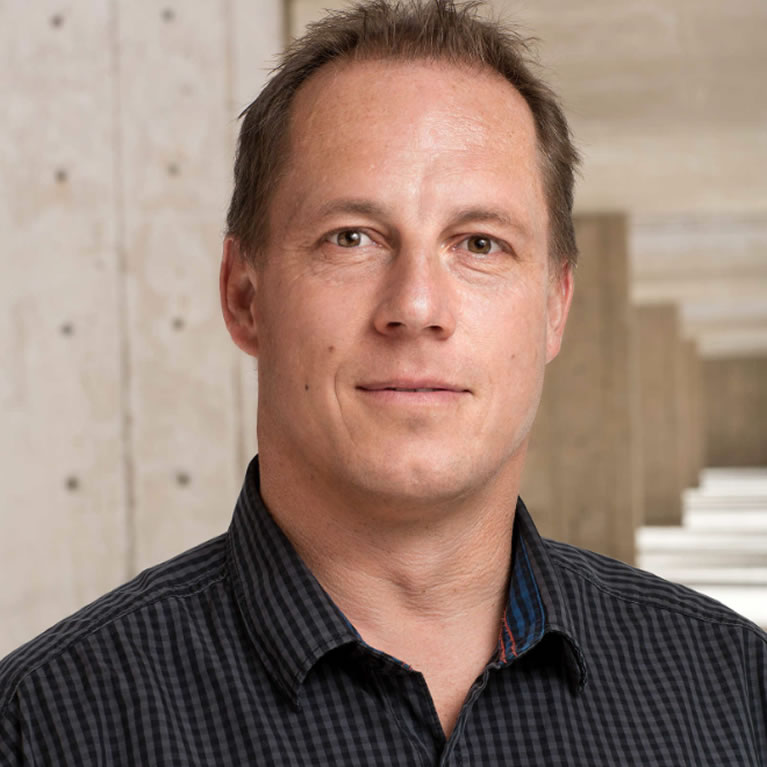
My name is Jan Karlseder.
I'm a professor here in
the Molecular and Cell
Biology Laboratory,
and I'm the Director of
the Glenn Center for Research
on the Biology of Aging.
I grew up in Austria.
I grew up in the
west of Austria,
in the mountains, in a very
small village actually.
And I went to University
in Innsbruck,
and then I switched to
the University of Vienna
to study molecular biology there
because that branch didn't
exist in Innsbruck.
We had certainly a very
nice childhood because we
could just go behind the house
into the forest and play.
But at the same time you feel
very quickly that it's a
fairly small minded place.
I enjoy going back now
because it's a beautiful
area of Austria,
but it hasn't changed
in the last 50 years at all.
Still the same people
looking through the same
window in the same house,
that makes me very happy
that I'm not there anymore.
We skied a lot.
We grew up in the middle of
skiing country in Austria.
We took our skis to school,
and then when school ended at
one or so in the afternoon,
we took the gondola
and went skiing.
That was absolutely fantastic.
That's how our winters
were like.
It's difficult.
My childhood is a little bit
split because I had
an elder brother who
died and before and after
was a little bit different.
So I mean, yeah,
we grew up playing in
the forest and going
to school and doing whatever
what all normal kids do.
And then that happened
and my parents had
kids again after that.
So it changed a lot for
me because I migrated
from being a younger
brother to being
a very old sibling to
two very young ones.
My grandfather actually
was a professor
at the University of
Vienna in botany.
He took us out a lot just
walking and hiking and
explaining every plant and
every insect and every mushroom.
My dad is an engineer,
so he actually wanted me to go
into a technical direction.
I tried that very
briefly and the math was
overwhelming and I
escaped into science.
But I really don't recall
this conscious decision of
saying I want to be a
molecular biologist,
I need to study cancer because
this is important to me
or something like that.
It really just happened
from an interest in biology
and then a decision
of doing something that
actually can get you a job.
When I got my PhD in Vienna,
and then I moved to New
York City to do a postdoc,
which I did at
Rockefeller University.
After that, I looked for
faculty positions both
in Europe and in the US.
I walked into the
courtyard and was
captivated. In that sense,
It really wasn't very conscious.
again, I just
perceived this place
as beautiful and
creative and a sign.
I am interested in
what turns a normal healthy
cell into a cancer cell.
I'm interested in cancer
initiation as a function of age.
We work with what is
called the telomeres,
which are the ends
of the chromosomes,
and they play a major role
in aging and cancer biology.
What my lab does is trying to
understand all the different
molecular pathways
that are triggered
by this telomere shortening
process. And that ranges
from simply stop
of the cell cycle,
to activation of inflammation,
to changes in
mitochondrial metabolism,
genome instability.
We are trying to understand how
all these seemingly
independent pathways are
connected through the process of
telomere shortening and
signaling from short telomeres.
The next steps are going to
be to really walk away from
this idea that
molecular pathways
work independently
of each other,
and that can lead
to breakthroughs that
lead to therapies.