March 28, 2016
LA JOLLA—A team led by scientists at The Scripps Research Institute (TSRI) and the Salk Institute for Biological Studies has discovered two enzymes that appear to play a role in metabolism and inflammation—and might someday be targeted with drugs to treat type 2 diabetes and inflammatory disorders.
The discovery is unusual because the enzymes do not bear a resemblance—in their structures or amino-acid sequences—to any known class of enzymes. The team of scientists nevertheless identified them as “outlier” members of the serine/threonine hydrolase class, using newer techniques that detect biochemical activity.
“A huge fraction of the human ‘proteome’ remains uncharacterized, and this paper shows how chemical approaches can be used to uncover proteins of a given functionality that have eluded classification based on sequence or predicted structure,” said co-senior author Benjamin F. Cravatt, chair of TSRI’s Department of Chemical Physiology.
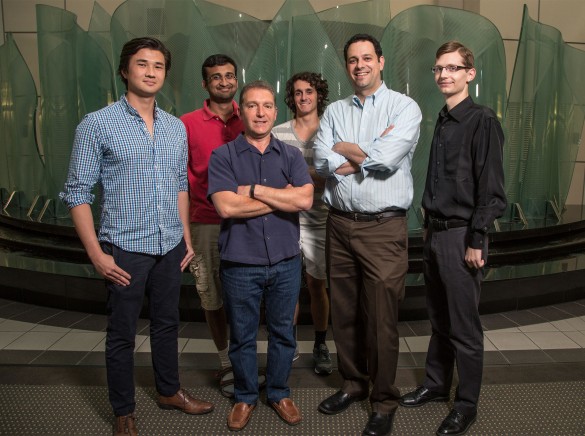
版权:萨克研究所
“In this study, we found two genes that control levels of lipids with anti-diabetic and anti-inflammatory activity, suggesting exciting targets for 糖尿病 and inflammatory diseases,” said co-senior author 艾伦·萨加特利安, who holds the Dr. Frederik Paulsen Chair at the Salk Institute.
Into the Unknown
The study, which appears as a Nature Chemical Biology Advance Online Publication on March 28, 2016, began as an effort in the Cravatt laboratory to discover and characterize new serine/threonine hydrolases using fluorophosphonate (FP) probes—molecules that selectively bind and, in effect, label the active sites of these enzymes.
Pulling FP-binding proteins out of the entire proteome of test cells and identifying them using mass spectrometry techniques, the team matched nearly all to known hydrolases. The major outlier was a protein called androgen-induced gene 1 protein (AIG1). The only other one was a distant cousin in terms of sequence, a protein called ADTRP.
“Neither of these proteins had been characterized as an enzyme; in fact, there had been little functional characterization of them at all,” said William H. Parsons, a research associate in the Cravatt laboratory who was co-first author of the study. Experiments on AIG1 and ADTRP revealed that they do their enzymatic work in a unique way. “It looks like they have an active site that is novel—it had never been described in the literature,” said Parsons.
Initial tests with panels of different enzyme inhibitors showed that AIG1 and ADTRP are moderately inhibited by inhibitors of lipases—enzymes that break down fats and other lipids. But on what specific lipids do these newly discovered outlier enzymes normally work?
Regulators of FAHFAs
At the Salk Institute, the Saghatelian laboratory was investigating a class of lipids it had discovered in 2014. Known as fatty acid esters of hydroxy fatty acids (FAHFAs), these molecules showed strong therapeutic potential. Saghatelian and his colleagues had found that boosting the levels of one key FAHFA lipid normalizes glucose levels in diabetic mice and also reduces inflammation.
“Ben’s lab was screening panels of lipids to find the ones that their new enzymes work on,” said Saghatelian, who is a former research associate in the Cravatt laboratory. “We suggested they throw FAHFAs in there—and these turned out to be very good substrates.”
The Cravatt laboratory soon developed powerful inhibitors of the newly discovered enzymes, and the two labs began working together, using the inhibitors and genetic techniques to explore the enzymes’ functions 体外 and in cultured cells. Co-first author Matthew J. Kolar, an MD-PhD student, performed most of the experiments in the Saghatelian lab.
The team concluded that AIG1 and ADTRP, at least in the cell types tested, appear to work mainly to break down FAHFAs and not any other major class of lipid.
In principle, inhibitors of AIG1 and ADTRP could be developed into FAHFA-boosting therapies. “Our prediction,” said Saghatelian, “is that if FAHFAs do what we think they’re doing, then using an enzyme inhibitor to block their degradation would make FAHFA levels go up and should thus reduce inflammation as well as improve glucose levels and insulin sensitivity.”
The two labs are now collaborating on further studies of the new enzymes—and the potential benefits of inhibiting them—in mouse models of diabetes, inflammation and autoimmune disease.
“One of the neat things this study shows,” said Cravatt, “is that even for enzyme classes as well studied as the hydrolases, there may still be hidden members that, presumably by convergent evolution, arrived at that basic enzyme mechanism despite sharing no sequence or structural homology.”
Other co-authors of the study were Siddhesh S. Kamat, Armand B. Cognetta III, Jonathan J. Hulce and Enrique Saez, of TSRI; and co-senior author Barbara B. Kahn of Beth Israel Deaconess Medical Center and Harvard Medical School.
Funding was provided in part by the U.S. National Institutes of Health (DA033760, DK909810), The Leona M. and Harry B. Helmsley Charitable Trust (2012-PG-MED002), National Cancer Institute Cancer Center Support (grant P30 [CA014195 MASS core]) and the Dr. Frederick Paulsen Chair/Ferring Pharmaceuticals.
Content provided by TSRI.
About The Salk Institute for Biological Studies
索尔克生物学研究所是世界顶尖的基础研究机构之一,其国际知名的教职员工在一个独特的、合作和富有创造力的环境中,探索生命科学的基本问题。索尔克科学家致力于科学发现和培养下一代研究人员,通过对神经科学、遗传学、细胞和植物生物学以及相关学科的研究,在癌症、衰老、阿尔茨海默病、糖尿病和传染病等领域取得了开创性的贡献,加深了我们对这些疾病的理解。.
教职员工的成就获得了无数荣誉,包括诺贝尔奖和美国国家科学院院士资格。该研究所由脊髓灰质炎疫苗先驱 Jonas Salk 医生于 1960 年创立,是一家独立的非营利组织和建筑地标。.
About The Scripps Research Institute
The Scripps Research Institute (TSRI) is one of the world’s largest independent, not-for-profit organizations focusing on research in the biomedical sciences. TSRI is internationally recognized for its contributions to science and health, including its role in laying the foundation for new treatments for cancer, rheumatoid arthritis, hemophilia, and other diseases. An institution that evolved from the Scripps Metabolic Clinic founded by philanthropist Ellen Browning Scripps in 1924, the institute now employs about 2,700 people on its campuses in La Jolla, CA, and Jupiter, FL, where its renowned scientists—including two Nobel laureates—work toward their next discoveries. The institute’s graduate program, which awards PhD degrees in biology and chemistry, ranks among the top ten of its kind in the nation. For more information, see www.scripps.edu.
日记
Nature Chemical Biology
作者
William H Parsons, Matthew J Kolar, Siddhesh S Kamat, Armand B Cognetta III, Jonathan J Hulce, Enrique Saez, Barbara B Kahn, Alan Saghatelian & Benjamin F Cravatt
宣传办公室
电话:(858) 453-4100
press@salk.edu