October 15, 2015
LA JOLLA–The Society for Neuroscience (SfN), an organization of nearly 40,000 scientists and clinicians, will award the Swartz Prize for Theoretical and Computational Neuroscience to 特伦斯·塞津诺维奇, Salk professor and head of the 计算神经生物学实验室.
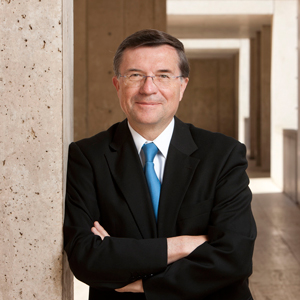
Terrence Sejnowski, head of Salk’s Computational Neurobiology Laboratory
点击此处 用于高分辨率图像。.
图片:由萨克生物研究所提供
The $25,000 prize, supported by The Swartz Foundation, recognizes an individual who has produced a significant cumulative contribution to theoretical models or computational methods in neuroscience. The award will be presented during Neuroscience 2015, SfN’s annual meeting and the world’s largest source of emerging news about brain science and health.
“Dr. Sejnowski is deserving of this prize for his role in founding and growing the field of computational neuroscience, his commitment to training and mentoring young scientists, and his many major research discoveries,” says SfN President Steven Hyman. “It is an honor to recognize his tireless efforts to understand the computational resources of the brain and to computationally model how brain activity becomes behavior.”
Sejnowski has demonstrated significant breadth in his research career. He has developed artificial neural network models as well as learning models for birdsong and neuroeconomics. He helped develop the algorithm for independent component analysis, a method now widely used in many fields.
Most recently, he demonstrated how the loss of a critical receptor in a special class of inhibitory neurons in the brain may be responsible for neurodevelopmental disorders including autism and schizophrenia. He also showed how little known supportive cells in the brain called astrocytes may be responsible for controlling patterns of brain waves (gamma oscillations).
“This is a great honor to have SfN bestow a prize named for Jerome Swartz, who did so much for the field of computational neuroscience by supporting centers at Salk and other major research universities,” says Sejnowski.
In addition to his efforts to bring attention and funding to the field of computational neuroscience through organizing conferences and consulting for numerous agencies and panels, Sejnowski always found time to run experiments in his lab. These ranged from investigating the pacemaker neurons of electric fish, to modeling the changes that occur in the hippocampus during learning, to understanding how sensory information is represented in the cerebral cortex.
Sejnowski earned his PhD at Princeton University and taught at Johns Hopkins University before joining the faculty at the 加州大学圣地亚哥分校, and the Salk Institute. He was named a Howard Hughes Medical Institute investigator and now holds the Francis Crick Chair at the Salk Institute.
宣传办公室
电话:(858) 453-4100
press@salk.edu
萨尔克研究所是一个独立的非营利性研究机构,由首个安全有效的脊髓灰质炎疫苗的研发者乔纳斯·索尔克于1960年创立。该研究所的使命是推动以合作、敢于冒险为特点的基础性研究,以应对癌症、阿尔茨海默病和农业脆弱性等社会最紧迫的挑战。这项基础科学支撑着所有的转化研究,产生有助于全球新药和创新的见解。.