April 16, 2014
LA JOLLA—Scientists at the Salk Institute have created a new model of memory that explains how neurons retain select memories a few hours after an event.
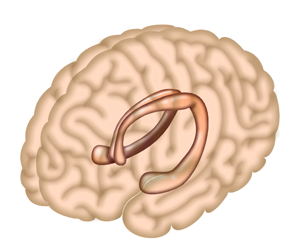
The hippocampus is a region of the brain largely responsible for memory formation.
图片:由萨克生物研究所提供
This new framework provides a more complete picture of how memory works, which can inform research into disorders like Parkinson’s, Alzheimer’s, post-traumatic stress and learning disabilities.
“Previous models of memory were based on fast activity patterns,” says 特伦斯·塞津诺维奇, holder of Salk’s Francis Crick Chair and a Howard Hughes Medical Institute Investigator. “Our new model of memory makes it possible to integrate experiences over hours rather than moments.”
Over the past few decades, neuroscientists have revealed much about how long-term memories are stored. For significant events—for example, being bit by a dog—a number of proteins are quickly made in activated brain cells to create the new memories. Some of these proteins linger for a few hours at specific places on specific neurons before breaking down.
This series of biochemical events allow us to remember important details about that event—such as, in the case of the dog bite, which dog, where it was located and so on.
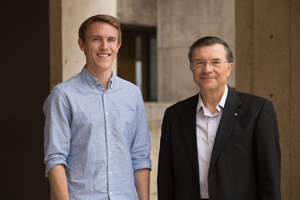
Cian O’Donnell and Terrence Sejnowski
图片:由萨克生物研究所提供
One problem scientists have had with modeling memory storage is explaining why only selective details and not everything in that 1-2 hour window is strongly remembered. By incorporating data from previous literature, Sejnowski and first author Cian O’Donnell, a Salk postdoctoral researcher, developed a model that bridges findings from both molecular and systems observations of memory to explain how this 1-2 hour memory window works. The work is detailed in the latest issue of 神经元.
Using computational modeling, O’Donnell and Sejnowski show that, despite the proteins being available to a number of neurons in a given circuit, memories are retained when subsequent events activate the same neurons as the original event. The scientists found that the spatial positioning of proteins at both specific neurons and at specific areas around these neurons predicts which memories are recorded. This spatial patterning framework successfully predicts memory retention as a mathematical function of time and location overlap.
“One thing this study does is link what’s happing in memory formation at the cellular level to the systems level,” says O’Donnell. “That the time window is important was already established; we worked out how the content could also determine whether memories were remembered or not. We prove that a set of ideas are consistent and sufficient to explain something in the real world.”
The new model also provides a potential framework for understanding how generalizations from memories are processed during dreams.
While much is still unknown about sleep, research suggests that important memories from the day are often cycled through the brain, shuttled from temporary storage in the hippocampus to more long-term storage in the cortex. Researchers observed most of this memory formation in non-dreaming sleep. Little is known about if and how memory packaging or consolidation is done during dreams. However, O’Donnell and Sejnowski’s model suggests that some memory retention does happen during dreams.
“During sleep there’s a reorganizing of memory—you strengthen some memories and lose ones you don’t need anymore,” says O’Donnell. “In addition, people learn abstractions as they sleep, but there was no idea how generalization processes happen at a neural level.”
By applying their theoretical findings on overlap activity within the 1-2 hour window, they came up with a theoretical model for how the memory abstraction process might work during sleep.
关于索尔克生物研究所:
索尔克生物研究所是世界顶尖的基础研究机构之一,其国际知名的教职人员在一个独特、协作和富有创造性的环境中,深入探究生命科学的基本问题。索尔克科学家们致力于发现和指导未来几代研究人员,通过研究神经科学、遗传学、细胞和植物生物学以及相关学科,在癌症、衰老、阿尔茨海默氏症、糖尿病和传染病的认识方面做出了开创性的贡献。.
学院取得了许多成就,获得了包括诺贝尔奖和美国国家科学院院士在内的无数荣誉。该研究所由脊髓灰质炎疫苗先驱 Jonas Salk 博士于 1960 年创立,是一家独立的非营利组织和建筑地标。.
日记
神经元
作者
Cian O'Donnell, Terrence J. Sejnowski
宣传办公室
电话:(858) 453-4100
press@salk.edu