September 19, 2014
The switch controls the growth of telomeres, the timekeepers of cells
The switch controls the growth of telomeres, the timekeepers of cells
LA JOLLA–Scientists at the Salk Institute have discovered an on-and-off “switch” in cells that may hold the key to healthy aging. This switch points to a way to encourage healthy cells to keep dividing and generating, for example, new lung or liver tissue, even in old age.
In our bodies, newly divided cells constantly replenish lungs, skin, liver and other organs. However, most human cells cannot divide indefinitely–with each division, a cellular timekeeper at the ends of chromosomes shortens. When this timekeeper, called a telomere, becomes too short, cells can no longer divide, causing organs and tissues to degenerate, as often happens in old age. But there is a way around this countdown: some cells produce an enzyme called telomerase, which rebuilds telomeres and allows cells to divide indefinitely.
In a new study published September 19th in the journal Genes and Development, scientists at the Salk Institute have discovered that telomerase, even when present, can be turned off.
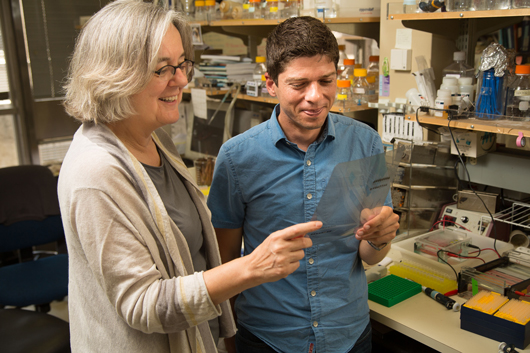
“Previous studies had suggested that once assembled, telomerase is available whenever it is needed,” says senior author 维姬·伦德布拉德, professor and holder of Salk’s Ralph S. and Becky O’Connor Chair. “We were surprised to discover instead that telomerase has what is in essence an ‘off’ switch, whereby it disassembles.”
Understanding how this “off” switch can be manipulated–thereby slowing down the telomere shortening process–could lead to treatments for diseases of 衰老 (for example, regenerating vital organs later in life).
Lundblad and first author and graduate student Timothy Tucey conducted their studies in the yeast Saccharomyces cerevisiae, the same yeast used to make wine and bread. Previously, Lundblad’s group used this simple single-celled organism to reveal numerous insights about telomerase and lay the groundwork for guiding similar findings in human cells.
“We wanted to be able to study each component of the telomerase complex but that turned out to not be a simple task,” Tucey said. Tucey developed a strategy that allowed him to observe each component during cell growth and division at very high resolution, leading to an unanticipated set of discoveries into how–and when–this telomere-dedicated machine puts itself together.
Every time a cell divides, its entire genome must be duplicated. While this duplication is going on, Tucey discovered that telomerase sits poised as a “preassembly” complex, missing a critical molecular subunit. But when the genome has been fully duplicated, the missing subunit joins its companions to form a complete, fully active telomerase complex, at which point telomerase can replenish the ends of eroding chromosomes and ensure robust cell division.
Surprisingly, however, Tucey and Lundblad showed that immediately after the full telomerase complex has been assembled, it rapidly disassembles to form an inactive “disassembly” complex — essentially flipping the switch into the “off” position. They speculate that this disassembly pathway may provide a means of keeping telomerase at exceptionally low levels inside the cell. Although eroding telomeres in normal cells can contribute to the aging process, cancer cells, in contrast, rely on elevated telomerase levels to ensure unregulated cell growth. The “off” switch discovered by Tucey and Lundblad may help keep telomerase activity below this threshold.
This research was supported by the 美国国立卫生研究院, the Fritz B. Burns Foundation and a Rose Hills Foundation Fellowship.
关于索尔克生物研究所:
索尔克生物学研究所是世界上首屈一指的基础研究机构之一,其国际知名的教职员工在一个独特的、协作和创新的环境中,深入探索生命科学的基本问题。索尔克科学家既注重科学发现,也注重培养下一代研究人员,通过研究神经科学、遗传学、细胞生物学、植物生物学及相关学科,为我们理解癌症、衰老、阿尔茨海默病、糖尿病和传染病做出了开创性的贡献。.
教职员工的成就获得了无数荣誉,包括诺贝尔奖和美国国家科学院院士资格。该研究所由脊髓灰质炎疫苗先驱 Jonas Salk 医生于 1960 年创立,是一家独立的非营利组织和建筑地标。.
日记
Genes and Development
作者
Timothy M. Tucey and Victoria Lundblad
宣传办公室
电话:(858) 453-4100
press@salk.edu