August 8, 2017
LA JOLLA—As part of the National Science Foundation’s funding for new multidisciplinary approaches to neuroscience, Salk Professor 特伦斯·塞津诺维奇 together with the California Institute of Technology will receive over $1 million over 3 years to pursue advanced modeling of the brain.
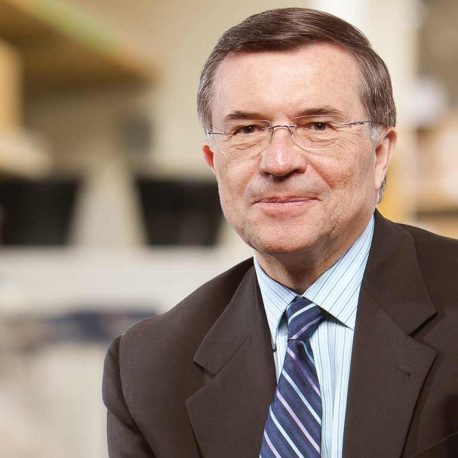
点击此处 用于高分辨率图像。.
版权:萨克研究所
The NSF awarded a total of $16 million in 19 awards to cross-disciplinary teams from across the United States to conduct innovative research focused on neural and cognitive systems. The awards will contribute to NSF’s investments in support of Understanding the Brain and the BRAIN Initiative, a coordinated research effort that seeks to accelerate the development of new neurotechnologies.
“This generous NSF award will advance the cutting-edge computational neuroscience research the Sejnowski lab is carrying out,” says Salk President Elizabeth Blackburn. “Awards such as these help foster collaborations that will continue to reveal the intricacies of the brain and lead us closer to treatments for devastating brain diseases.”
Sejnowski’s lab uses computer modeling and other techniques to test hypotheses on how brain cells process, sort and store information. By creating and refining computational models on how the brain stores information for different activities, Sejnowski gets a better understanding of what information different cell types encode, what molecules are needed and how signals move throughout the brain. At the same time, his lab learns how diseases such as schizophrenia or Parkinson’s might alter these patterns.
“Our new NSF award will enable us, together with Caltech collaborators, to model the brain as a layered control system operating on a wide range of time scales,” says Sejnowski, who is a Howard Hughes Medical Institute investigator and holder of the Francis Crick chair. “We will test our models on humans with tasks that require fast reflexes and long-range planning, such as riding a mountain bike down a bumpy, twisting trail.”
"(《世界人权宣言》) new NSF projects leverage advanced research to investigate how neural and cognitive systems interact with education, engineering and computer science, thanks to the support of the NSF Integrative Strategies for Understanding Neural and Cognitive Systems (NCS) program. The NCS program supports innovative, boundary-crossing efforts to push the frontiers of brain science.
“It takes insight and courage to tackle these problems,” said Ken Whang, NSF program director in the Computer and Information Science and Engineering Directorate (CISE). “These teams are combining their expertise to try to forge new paths forward on some of the most complex and important challenges of understanding the brain. They are posing problems in new ways, taking intellectual and technical risks that have huge potential payoff.”
宣传办公室
电话:(858) 453-4100
press@salk.edu
萨尔克研究所是一个独立的非营利性研究机构,由首个安全有效的脊髓灰质炎疫苗的研发者乔纳斯·索尔克于1960年创立。该研究所的使命是推动以合作、敢于冒险为特点的基础性研究,以应对癌症、阿尔茨海默病和农业脆弱性等社会最紧迫的挑战。这项基础科学支撑着所有的转化研究,产生有助于全球新药和创新的见解。.