August 11, 2015
Mice lacking a set of receptors in one type of neuron in the brain developed compulsive, anti-social behaviors, Salk scientists found
Mice lacking a set of receptors in one type of neuron in the brain developed compulsive, anti-social behaviors, Salk scientists found
LA JOLLA–The loss of a critical receptor in a special class of inhibitory neurons in the
brain may be responsible for neurodevelopmental disorders including autism and schizophrenia, according to new research by Salk scientists.
The importance of the receptor, called mGluR5, in other areas of the brain had been previously established. Until now, however, no one had studied their specific role in a cell type known as parvalbumin-positive interneurons, thought to be important in general cognition and generating certain types of oscillatory wave patterns in the brain.
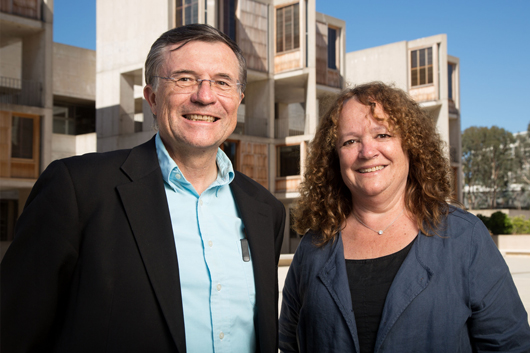
“We found that without this receptor in the parvalbumin cells, mice have many serious behavioral deficits,” says 特伦斯·塞津诺维奇, head of Salk’s 计算神经生物学实验室, which led the research published in 分子精神病学 on August 11, 2015. “And a lot of them really mimic closely what we see in schizophrenia.”
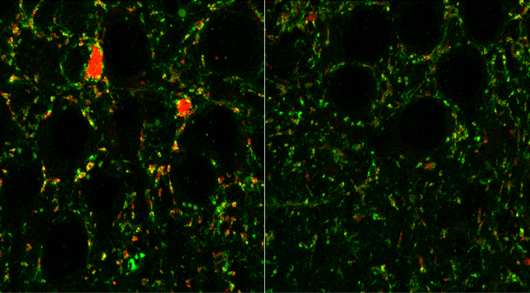
When mice are engineered to lack the mGluR5 receptor in parvalbumin cells (right), they have fewer inhibitory (red) connections controlling the activity of excitatory neurons.
点击此处 用于高分辨率图像。.
图片:由萨克生物研究所提供
Scientists had previously discovered that when molecular signaling was disrupted in these cells during development, the brain’s networks didn’t form correctly. Separate studies have revealed that mGluR5 receptors, which transmit glutamate signaling in the brain, are linked to addiction disorders, anxiety and Fragile X Syndrome. But, in these cases, mGluR5 is affected in excitatory cells, not inhibitory cells like the parvalbumin-positive interneurons.
The Salk team wondered what the role of mGluR5 was in the parvalbumin cells since the cells were deemed so important in brain development. They partnered with Athina Markou’s team from the Department of Psychiatry at the University of California, San Diego, to examine what happened when the receptor was selectively deleted from these cells after the brain’s initial formation. Without the receptor in these cells, they found, mice had a host of developmental problems, including obsessive, repetitive grooming behavior and anti-social tendencies. Moreover, the patterns of activity in the animals’ brains resembled those seen in humans suffering from schizophrenia.
“This discovery implies that changes after birth, not just before birth, are affecting the way the network is set up,” says 玛格丽塔·贝伦斯, corresponding author and Salk staff scientist.
The results suggest that an alteration in mGluR5 receptors in these brain cells may be a critical step in the formation of some neurodevelopmental disorders, adds Sejnowski. It’s good news, he says, because the molecular change is potentially reversible.
“The cells are still alive, and if we can figure out how to go in and change some of these molecular switches, we might actually be able to put the cells back into healthy, functioning states,” he says.
Behrens says the study also should be a signal of caution to the pharmaceutical industry to be wary of drugs that affect mGluR5 throughout the whole brain. “There are a lot of clinical trials ongoing looking at modulating mGluR5 for anxiety and Fragile X Syndrome,” she says. “But our results suggest that if you affect parvalbumin neurons, you might get behavioral changes you weren’t expecting.”
More research is needed to show whether the parvalbumin cells’ mGluR5 receptors are linked to disease in humans and, if so, what causes the loss or disruption to the receptors.
Other researchers on the study were A. Pinto-Duarte, A. Kappe, A. Zembrzycki, E.A. Mukamel, K. Lucero, and X. Wang of the Salk Institute; and S.A. Barnes and A. Markou of the University of California, San Diego.
The work and the researchers involved were supported by grants from the National Institutes of Health and Howard Hughes Medical Institute, and a Calouste Gulbenkian Foundation Fellowship.
日记
分子精神病学
作者
Barnes SA, Pinto-Duarte A, Kappe A, Zembrzycki A, Metzler A, Mukamel EA,Lucero J, Wang X, Sejnowski TJ, Markou A, Behrens MM
宣传办公室
电话:(858) 453-4100
press@salk.edu
萨尔克研究所是一个独立的非营利性研究机构,由首个安全有效的脊髓灰质炎疫苗的研发者乔纳斯·索尔克于1960年创立。该研究所的使命是推动以合作、敢于冒险为特点的基础性研究,以应对癌症、阿尔茨海默病和农业脆弱性等社会最紧迫的挑战。这项基础科学支撑着所有的转化研究,产生有助于全球新药和创新的见解。.