May 26, 2016
Salk team first to discover protein that controls the strength of body’s circadian rhythms
Salk team first to discover protein that controls the strength of body’s circadian rhythms
LA JOLLA—At noon every day, levels of genes and proteins throughout your body are drastically different than they are at midnight. Disruptions to this 24-hour cycle of physiological activity are why jet lag or a bad night’s sleep can alter your appetite and sleep patterns for days—and even contribute to conditions like heart disease, sleep disorders and cancers.
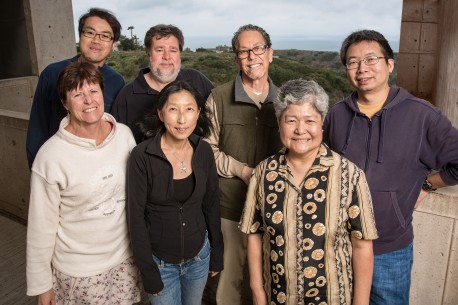
Now, scientists at the Salk Institute and collaborators have discovered a key player—a protein called REV-ERBα—that controls the strength of this circadian rhythm in mammals. The discovery is unusual in the field, as most circadian genes and proteins only shift the timing or length of the daily cycle.
“Whether it is Beethoven’s 9th Symphony on your stereo or the symphony of genes in our bodies, both require volume to be heard,” says senior author 罗纳德·埃文斯, director of Salk’s Gene Expression Laboratory, a 霍华德·休斯医学研究所 investigator, and holder of the March of Dimes Chair in Molecular and Developmental Biology. “Our recent work describes how REV-ERBα acts as a molecular conductor to allows the volume or activity of thousands of genes to be dialed up or down.”
点击此处 用于高分辨率图像
版权:萨克研究所
Disrupting just the amplitude—or strength—component of the circadian cycle, Evans adds, was enough to alter hormone levels, including those that wake us up in the morning. This means that people with lower amplitude fluctuations of the genes might feel flat and have less energy during the day. The results are described in the May 26, 2016 issue of 细胞.
Previous research in the field revealed genes that cycle on and off throughout the day and showed how altering these circadian genes can shift the timing of the cycle and make the circadian rhythm longer or shorter than 24 hours. In 2012, Evans’ group showed that REV-ERBα bound to many of these circadian genes and acted as a brake, affecting when during the day or night they were expressed.
“We saw REV-ERBα interacting with all these circadian-related genes,” says Xuan Zhao, a research associate in the Evans lab and first author of the new paper. “So we wanted to see if it had a more central role in circadian rhythms.”
In the new work, the team analyzed levels and molecular characteristics of REV-ERBα in the livers of mice throughout the day. They found that after its levels peaked during the day, two proteins, CDK1 and FBXW7, interacted with REV-ERBα to help reduce its levels to a low point by the middle of the night.
Click here for a high-resolution image
版权:萨克研究所
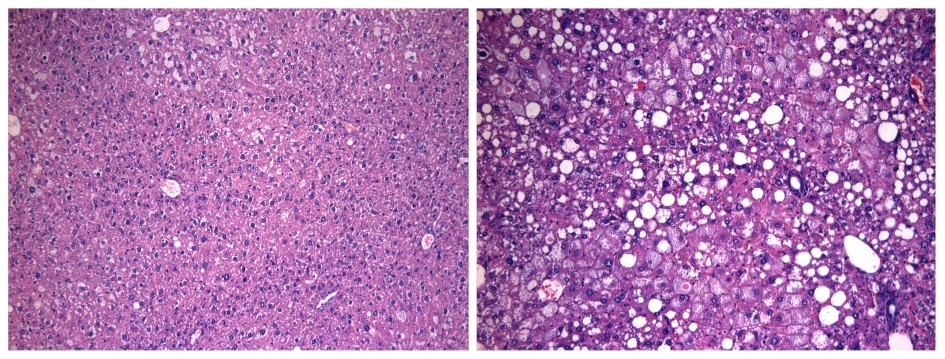
When Evans and his colleagues targeted these proteins to block the degradation of REV-ERBα in the livers of mice, normal daily fluctuations in gene expression were suppressed, but the timing of the cycles wasn’t affected. Interestingly, merely altering the amplitude of the gene expression oscillations profoundly affected metabolism, disrupting the levels of fats and sugars in the blood.
“This study provides compelling molecular evidence for a key role for the circadian clock in regulating glucose and lipid metabolism, and points to new potential avenues for therapeutic intervention,” says Steve Kay, president of The Scripps Research Institute, who collaborated with Evans on the work.
The observation is the first time scientists have discovered a way to control the amplitude—rather than the timing—of the circadian cycle. Moreover, mice that lacked REV-ERBα developed fatty liver disease, stressing the importance of regulating the intensity of the cycle.
“We think that if you have a ‘weak’ circadian cycle, you can’t get enough signal to affect physiology,” says Zhao. “Conversely, having an extra ‘strong’ circadian cycle would probably not be good. Evolution has given us a Goldilocks, or ‘just right,’ circadian cycle that is optimal for our health.”
The researchers hope to investigate whether pharmacological compounds that block CDK1 may have the potential to treat circadian rhythm disruptions.
“Pharmacologically, we can manipulate this system,” says Michael Downes, a Salk senior scientist and a co-corresponding author of the paper. “The more we understand about how to do this, the better we can treat metabolic diseases and cancers related to the circadian cycle.”
Other researchers on the study were Han Cho, Ling-Wa Chong, Katja Lamia, Sihao Liu, Annette R. Atkins, Ester Banayo, and Ruth T. Yu of the Salk Institute; Tsuyoshi Hirota of the 加州大学圣地亚哥分校; Xuemei Han and John R. Yates III of The Scripps Research Institute; and Christopher Liddle of the University of Sydney.
这项工作以及参与研究的学者得到了以下机构资助: 霍华德·休斯医学研究所, 美国国立卫生研究院, , 那个 格伦医学研究基金会, 利昂娜·M·哈里·B·赫尔姆斯利慈善信托, 益普森/生物测量, The Lawrence Ellison Foundation, , 那个 塞缪尔·瓦克斯曼癌症研究所, Susan G. Komen, ,和 格伦医学研究基金会.
日记
细胞
作者
Xuan Zhao, Han Cho, Ling-Wa Chong, Katja Lamia, Sihao Liu, Annette R. Atkins, Ester Banayo, Ruth T. Yu, Michael Downes, and Ronald M. Evans of the Salk Institute; Tsuyoshi Hirota and Steve A. Kay of the University of California, San Diego; Xuemei Han and John R. Yates III of The Scripps Research Institute; and Christopher Liddle of the University of Sydney
宣传办公室
电话:(858) 453-4100
press@salk.edu
萨尔克研究所是一个独立的非营利性研究机构,由首个安全有效的脊髓灰质炎疫苗的研发者乔纳斯·索尔克于1960年创立。该研究所的使命是推动以合作、敢于冒险为特点的基础性研究,以应对癌症、阿尔茨海默病和农业脆弱性等社会最紧迫的挑战。这项基础科学支撑着所有的转化研究,产生有助于全球新药和创新的见解。.