July 16, 2012
Protocol may open new avenues for cell-replacement therapies for neurological conditions
Protocol may open new avenues for cell-replacement therapies for neurological conditions
LA JOLLA, CA—For more than 20 years, doctors have been using cells from blood that remains in the placenta and umbilical cord after childbirth to treat a variety of illnesses, from cancer and immune disorders to blood and metabolic diseases.
Now, scientists at the Salk Institute for Biological Studies have found a new way-using a single protein, known as a transcription factor-to convert cord blood (CB) cells into neuron-like cells that may prove valuable for the treatment of a wide range of neurological conditions, including stroke, traumatic brain injury and spinal cord injury.
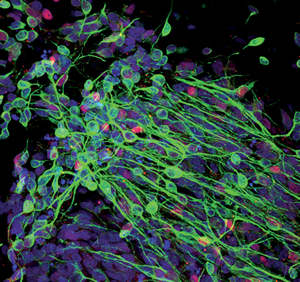
This microscope image shows a colony of neurons derived from cord-blood cells using stem cell reprogramming technology. The green and red glow indicates that the cells are producing protein makers found in neurons, evidence that the cord-blood cells did in fact morph into neurons. The blue glow marks the nuclei of the neurons.
Image: Courtesy of Alessandra Giorgetti
The researchers demonstrated that these CB cells, which come from the mesoderm, the middle layer of embryonic germ cells, can be switched to ectodermal cells, outer layer cells from which brain, spinal and nerve cells arise. “This study shows for the first time the direct conversion of a pure population of human cord blood cells into cells of neuronal lineage by the forced expression of a single transcription factor,” says 胡安·卡洛斯·伊兹皮苏亚·贝尔蒙特, ,索尔克研究所的教授 基因表达实验室, who led the research team. The study, a collaboration with 弗雷德·H·盖奇, ,索尔克研究所的教授 遗传实验室, and his team, was published on July 16 in the 美国国家科学院院刊.
“Unlike previous studies, where multiple transcription factors were necessary to convert skin cells into neurons, our method requires only one transcription factor to convert CB cells into functional neurons,” says Gage.
The Salk researchers used a retrovirus to introduce Sox2, a transcription factor that acts as a switch in neuronal development, into CB cells. After culturing them in the laboratory, they discovered colonies of cells expressing neuronal markers. Using a variety of tests, they determined that the new cells, called induced neuronal-like cells (iNC), could transmit electrical impulses, signaling that the cells were mature and functional neurons. Additionally, they transferred the Sox2-infused CB cells to a mouse brain and found that they integrated into the existing mouse neuronal network and were capable of transmitting electrical signals like mature functional neurons.
“We also show that the CB-derived neuronal cells can be expanded under certain conditions and still retain the ability to differentiate into more mature neurons both in the lab and in a mouse brain,” says Mo Li, a scientist in Belmonte’s lab and a co-first author on the paper with Alessandra Giorgetti, of the Center for Regenerative Medicine, in Barcelona, and Carol Marchetto of Gage’s lab. “Although the cells we developed were not for a specific lineage-for example, motor neurons or mid-brain neurons-we hope to generate clinically relevant neuronal subtypes in the future.”
Importantly, says Marchetto, “We could use these cells in the future for modeling neurological diseases such as autism, schizophrenia, Parkinson’s or Alzheimer’s disease.。”
Cord blood cells, says Giorgetti, offer a number of advantages over other types of stem cells. First, they are not embryonic stem cells and thus they are not controversial. They are more plastic, or flexible, than adult stem cells from sources like bone marrow, which may make them easier to convert into specific cell lineages. The collection of CB cells is safe and painless and poses no risk to the donor, and they can be stored in blood banks for later use.
“If our protocol is developed into a clinical application, it could aid in future cell-replacement therapies,” says Li. “You could search all the cord blood banks in the country to look for a suitable match.”
Other researchers on the study were Diana Yu, Yangling Mu, Cedric Bardy and Guang-Hui Liu, from the Salk Institute; and Rafaella Fazzina, Antonio Adamo, Ida Paramonov, Julio Castaño Cardoso, Montserrat Barragan Monasterio and Riccardo Cassiani-Ingoni of the Center for Regenerative Medicine in Barcelona.
这项工作得到了...的支持 加州再生医学研究所, The Lookout Foundation, the G. Harold and Leila Y. Mathers Charitable Foundation, , 那个 Leona M. 和 Harry B. Helmsley 慈善信托基金, the JPB Medical Foundation, MINECO, Fundacion Cellex and Sanofi.
关于索尔克生物研究所:
索尔克生物研究所是世界顶尖的基础研究机构之一,其国际知名的教职人员在一个独特、协作和富有创造性的环境中,深入探究生命科学的基本问题。索尔克科学家们致力于发现和指导未来几代研究人员,通过研究神经科学、遗传学、细胞和植物生物学以及相关学科,在癌症、衰老、阿尔茨海默氏症、糖尿病和传染病的认识方面做出了开创性的贡献。.
学院取得了许多成就,获得了包括诺贝尔奖和美国国家科学院院士在内的无数荣誉。该研究所由脊髓灰质炎疫苗先驱 Jonas Salk 博士于 1960 年创立,是一家独立的非营利组织和建筑地标。.
日记
美国国家科学院院刊
作者
Alessandra Giorgetti, Maria Carolina Marchetto, Mo Li, Diana Yu, Raffaella Fazzina, Yangling Mu, Antonio Adamo, Ida Paramonov, Julio Castaño Cardoso, Montserrat Barragan Monasterio, Cedric Bardy, Riccardo Cassiani-Ingoni, Guang-Hui Liu, Fred H. Gage and Juan Carlos Izpisua Belmonte
宣传办公室
电话:(858) 453-4100
press@salk.edu