January 27, 2014
A daily dose of the antioxidant fisetin keeps mice—even those with genetic mutations linked to Alzheimer's—from experiencing memory and learning deficits as they age.
A daily dose of the antioxidant fisetin keeps mice—even those with genetic mutations linked to Alzheimer's—from experiencing memory and learning deficits as they age.
LA JOLLA—A chemical that’s found in fruits and vegetables from strawberries to cucumbers appears to stop memory loss that accompanies Alzheimer’s disease in mice, scientists at the 索尔克生物研究所 have discovered. In experiments on mice that normally develop Alzheimer’s symptoms less than a year after birth, a daily dose of the compound—a flavonol called fisetin—prevented the progressive memory and learning impairments. The drug, however, did not alter the formation of amyloid plaques in the brain, accumulations of proteins which are commonly blamed for Alzheimer’s disease. The new finding suggests a way to treat Alzheimer’s symptoms independently of targeting amyloid plaques.
“We had already shown that in normal animals, fisetin can improve memory,” says Pamela Maher, a senior staff scientist in Salk’s 细胞神经生物学实验室 who led the new study. “What we showed here is that it also can have an effect on animals prone to Alzheimer’s.”
More than a decade ago, Maher discovered that fisetin helps protect neurons in the brain from the effects of aging. She and her colleagues have since—in both isolated cell cultures and mouse studies—probed how the compound has both antioxidant and anti-inflammatory effects on cells in the brain. Most recently, they found that fisetin turns on a cellular pathway known to be involved in memory.
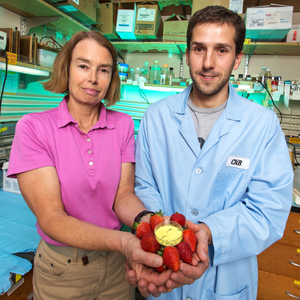
Pamela Maher and Antonio Currais
图片:由萨克生物研究所提供
“What we realized is that fisetin has a number of properties that we thought might be beneficial when it comes to Alzheimer’s,” says Maher.
So Maher—who works with Dave Schubert, the head of the Cellular Neurobiology Lab—turned to a strain of mice that have mutations in two genes linked to Alzheimer’s disease. The researchers took a subset of these mice and, when they were only three months old, began adding fisetin to their food. As the mice aged, the researchers tested their memory and learning skills with water mazes. By nine months of age, mice that hadn’t received fisetin began performing more poorly in the mazes. Mice that had gotten a daily dose of the compound, however, performed as well as normal mice, at both nine months and a year old.
“Even as the disease would have been progressing, the fisetin was able to continue preventing symptoms,” Maher says.
In collaboration with scientists at the 加州大学圣地亚哥分校, Maher’s team next tested the levels of different molecules in the brains of mice that had received doses of fisetin and those that hadn’t. In mice with Alzheimer’s symptoms, they found, pathways involved in cellular inflammation were turned on. In the animals that had taken fisetin, those pathways were dampened and anti-inflammatory molecules were present instead. One protein in particular—known as p35—was blocked from being cleaved into a shorter version when fisetin was taken. The shortened version of p35 is known to turn on and off many other molecular pathways. The results were published December 17, 2013, in the journal 衰老细胞.
Studies on isolated tissue had hinted that fisetin might also decrease the number of amyloid plaques in Alzheimer’s affected brains. However, that observation didn’t hold up in the mice studies. “Fisetin didn’t affect the plaques,” says Maher. “It seems to act on other pathways that haven’t been seriously investigated in the past as therapeutic targets.”
Next, Maher’s team hopes to understand more of the molecular details on how fisetin affects memory, including whether there are targets other than p35.
“It may be that compounds like this that have more than one target are most effective at treating Alzheimer’s disease,” says Maher, “because it’s a complex disease where there are a lot of things going wrong.”
They also aim to develop new studies to look at how the timing of fisetin doses affect its influence on Alzheimer’s.
“The model that we used here was a preventive model,” explains Maher. “We started the mice on the drugs before they had any memory loss. But obviously human patients don’t go to the doctor until they are already having memory problems.” So the next step in moving the discovery toward the clinic, she says, is to test whether fisetin can reverse declines in memory once they have already appeared.
Other researchers on the paper were Antonio Currais, Marguerite Prior, Richard Dargusch, Jennifer Ehren, and David Schubert of the Salk Institute and Aaron Armando and Oswald Quehenberger of the University of California at San Diego.
The work was supported by grants from the Alzheimer’s Association, Paul Slavik, the National Institutes of Health, the Alzheimer’s Drug Discovery Foundation, and the George E. Hewitt Foundation.
关于索尔克生物研究所:
索尔克生物研究所是世界顶尖的基础研究机构之一,其国际知名的教职人员在一个独特、协作和富有创造性的环境中,深入探究生命科学的基本问题。索尔克科学家们致力于发现和指导未来几代研究人员,通过研究神经科学、遗传学、细胞和植物生物学以及相关学科,在癌症、衰老、阿尔茨海默氏症、糖尿病和传染病的认识方面做出了开创性的贡献。.
学院取得了许多成就,获得了包括诺贝尔奖和美国国家科学院院士在内的无数荣誉。该研究所由脊髓灰质炎疫苗先驱 Jonas Salk 博士于 1960 年创立,是一家独立的非营利组织和建筑地标。.
日记
Aging Cell
作者
Antonio Currais, Marguerite Prior, Richard Dargusch, Aaron Armando, Jennifer Ehren, David Schubert, Oswald Quehenberger, Pamela Maher
宣传办公室
电话:(858) 453-4100
press@salk.edu