December 3, 2018
Salk scientists discover new protein complex that keeps embryonic stem cells at stage of fullest potential, a key to regenerative medicine
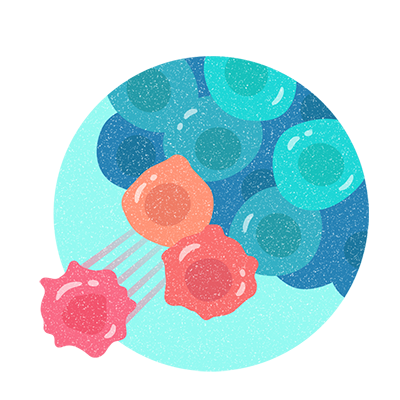
LA JOLLA—Embryonic stem cells (ESCs) are the very definition of being full of potential, given that they can become any type of cell in the body. Once they start down any particular path toward a type of tissue, they lose their unlimited potential. Scientists have been trying to understand why and how this happens in order to create regenerative therapies that can, for example, coax a person’s own cells to replace damaged or diseased organs.
Scientists from the Salk Institute discovered a new protein complex that keeps the brakes on stem cells, allowing them to maintain their indefinite potential. The new complex, called GBAF and detailed in Nature Communications on December 3, 2018, could provide a future target for regenerative medicine.
“This project started as an exploration of embryonic stem cell pluripotency, which is this property that allows ESCs to become all different cell types in the body,” says 戴安娜·哈格里夫斯, an assistant professor in Salk’s Molecular and Cell Biology Laboratory and the senior author of the paper. “It’s very important to know how various networks of genes control pluripotency, so finding a previously unknown protein complex that plays such an important regulatory role was very exciting.”
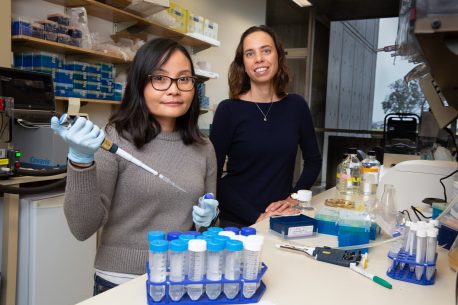
点击此处 用于高分辨率图像。.
版权:萨克研究所
Every cell in the body has the same set of DNA, which contains the instructions for making every possible cell type. Teams of large protein complexes (known as chromatin remodelers) activate or silence genes, directing an embryonic stem cell down a particular path. Like a team of contractors planning to renovate a house, these protein complexes contain varying subunits, the combination of which changes the physical shape of DNA and determines which genes can be accessed to direct the cell to become, for example, a lung cell or brain cell.
Hargreaves’s team wanted to better understand how these subunits come together and how particular subunits might dictate a complex’s function. So they turned to a protein called BRD9, which was known to associate with the BAF family of chromatin remodelers and was suspected to be a subunit. The team applied a chemical inhibitor of BRD9 to dishes of embryonic stem cells and performed a series of experiments to comprehensively analyze the cells’ pluripotency in association with changes in BAF complex activity.
The group was surprised to discover that BRD9 acts as a brake on embryonic stem cell development. When BRD9 is working, cells retain their pluripotency, whereas when its activity is inhibited cells start moving on to the next stage of development. Further work to identify which BAF complexes were at work in the cells revealed another surprise: BRD9 was part of an as-yet-unknown BAF complex.
“For me, what was most exciting about our study was the fact that we had discovered a new BAF complex in embryonic stem cells,” says Jovylyn Gatchalian, a Salk research associate and the paper’s first author.
Adds Hargreaves, “What we see with this work is that there’s biochemical diversity at the level of individual variants of the BAF complex that allows for greater regulatory control. Understanding the complexities of that control is going to be key to any regenerative therapies.”
The team next wants to examine how GBAF interacts with various structural proteins that help keep the genome organized.
Other authors included Shivani Malik, Josephine Ho, Dong-Sung Lee, Timothy W. R. Kelso, Maxim N. Shokhirev and Jesse R. Dixon of Salk.
The work was funded by the National Institutes of Health (R00 CA184043-03), the V Foundation for Cancer Research (V2016-006), a T32 Cancer Training Grant (T32CA009370) and a National Institute of General Medical Sciences
National Research Service Award (F32 GM128377-01).
日记
Nature Communications
作者
Jovylyn Gatchalian, Shivani Malik, Josephine Ho, Dong-Sung Lee, Timothy W. R. Kelso, Maxim N. Shokhirev, Jesse R. Dixon, Diana C. Hargreaves
宣传办公室
电话:(858) 453-4100
press@salk.edu
萨尔克研究所是一个独立的非营利性研究机构,由首个安全有效的脊髓灰质炎疫苗的研发者乔纳斯·索尔克于1960年创立。该研究所的使命是推动以合作、敢于冒险为特点的基础性研究,以应对癌症、阿尔茨海默病和农业脆弱性等社会最紧迫的挑战。这项基础科学支撑着所有的转化研究,产生有助于全球新药和创新的见解。.