2020年8月19日
Salk researchers develop transplantable human cells that make insulin, controlling blood sugar without immunosuppressants in mouse models
Salk researchers develop transplantable human cells that make insulin, controlling blood sugar without immunosuppressants in mouse models
拉霍亚—索尔克研究所的科学家们在追求安全有效的I型糖尿病治疗方法方面取得了重大进展。I型糖尿病影响着美国约160万人口,每年造成的经济损失高达$144亿美元。.
利用干细胞技术,索尔克研究所的研究人员生成了首批能够逃避免疫系统的人类胰岛素生成胰腺细胞簇,相关细节发表在该期刊上 自然 2020年8月19日。这些“免疫屏蔽”的细胞簇一经移植到体内,就能在不使用免疫抑制药物的情况下控制小鼠的血糖。.
“Most type 1 diabetics are children and teenagers,” says Salk Professor 罗纳德·埃文斯, senior author and holder of the March of Dimes Chair in Molecular and Developmental Biology. “This is a disease that is historically hard to manage with drugs. We hope that regenerative medicine in combination with immune shielding can make a real difference in the field by replacing damaged cells with lab-generated human islet-like cell clusters that produce normal amounts of insulin on demand.”
Type 1 diabetes is a lifelong condition that is challenging to manage, even with automated devices that deliver insulin to regulate blood sugar. Transplants of pancreatic beta islets—clusters of cells that make insulin and other hormones—from donor tissue can provide a cure, but require patients to take life-long immunosuppressing drugs, which carry serious risks. For decades, researchers have sought a better way to replenish lost pancreatic cells. Now, device-free transplantation of insulin-producing cells like these brings us a step closer to curing the disease, according to the lab.
点击此处 用于高分辨率图像。.
版权:萨克研究所
In a previous study, the Evans lab overcame an impediment in the field, in which stem-cell-derived beta-like cells produced insulin, but were not functional. The cells did not release insulin in response to glucose, as they were simply under powered, according to Evans. His team discovered a genetic switch called ERR-gamma that when flipped, “turbo-charges” the cells.
“When we add ERR-gamma, the cells have the energy they need to do their job,” says Michael Downes, a Salk senior staff scientist and co-author of both studies. “These cells are healthy and robust and can deliver insulin when they sense high glucose levels.”
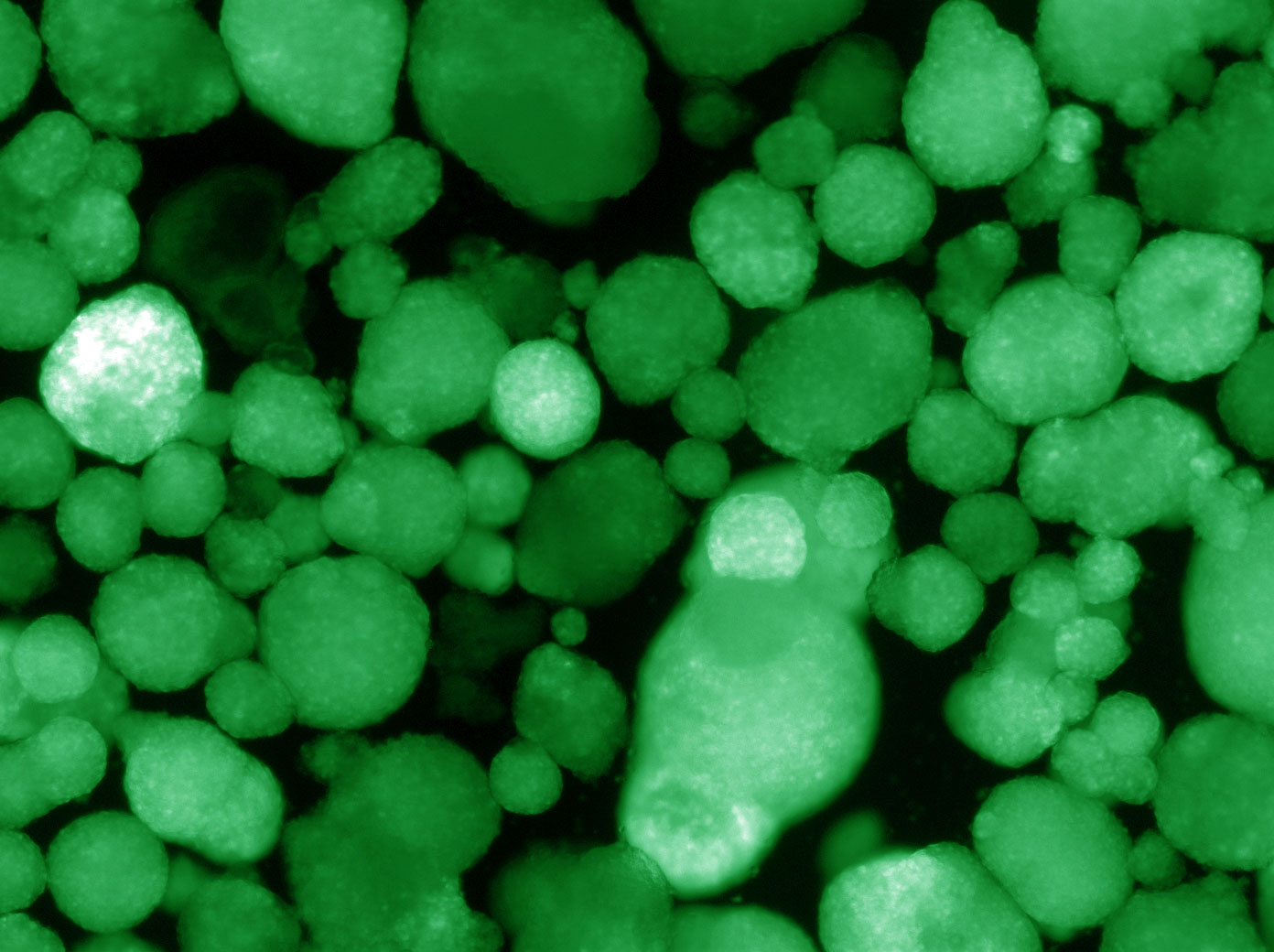
A critical part of the new study was to develop a way to grow beta-like cells in a three-dimensional environment that approximates the human pancreas. This gave the cells an islet-like property. Importantly, the team discovered that a protein called WNT4 was able to turn on the ERR-gamma-driven maturation switch. This combination of steps generated functional cell clusters that mimic human islets: so-called human islet-like organoids (HILOs).
Next the team tackled the complex issue of immune rejection. Normal tissue transplants require lifelong immune-suppressive therapies to protect the tissue from being attacked by the immune system; however these therapies also increase the risk for infections. Inspired by the successes of immunotherapy drugs for cancer, the team initially showed that the checkpoint protein PD-L1 protected the transplanted cells. “By expressing PD-L1, which acts as an immune blocker, the transplanted organoids are able to hide from the immune system,” says first author Eiji Yoshihara, a former staff scientist in the lab.
点击此处 用于高分辨率图像。.
版权:萨克研究所
Yoshihara then developed a method to induce PD-L1 in HILOs with short pulses of the protein interferon gamma. When transplanted into diabetic mice, these immune-evasive HILOs provided sustained blood glucose control in diabetic mice with healthy immune systems.
“This is the first study to show that you can protect HILOs from the immune system without genetic manipulation,” Downes explains. “If we are able to develop this as a therapy, patients will not need to take immune-suppressing drugs.”
More research needs to be done before this system can be advanced to clinical trials. The transplanted organoids need to be tested in mice for longer periods of time to confirm that their effects are long-lasting. More work needs to be done to ensure they would be safe to use in humans as well. “We now have a product that could potentially be used in patients without requiring any kind of device,” Evans concludes.
Other researchers on the paper were Carolyn O’Connor, Emanuel Gasser, Zong Wei, Tae Gyu Oh, Tiffany W. Tseng, Dan Wang, Fritz Cayabyab, Yang Dai, Ruth T. Yu, and Annette R. Atkins of Salk and Christopher Liddle of the Westmead Institute for Medical Research and Sydney Medical School in Australia.
This work was supported by grants from California Institute of Regenerative Medicine grant DISC2-11175, National Institutes of Health grant 1RO1DK120480-01, the Leona M. and Harry B. Helmsley Charitable Trust, to Evans. Liddle and Downes were funded by grants from the National Health and Medical Research Council of Australia Project. Yoshihara was supported by a DRC P&F grant. Thank you also to Steven and Lisa Altman for supporting the lab.
DOI: 10.1038/s41586-020-2631-z
For an FAQ about this work, 点击这里.
日记
自然
作者
Eiji Yoshihara, Carolyn O’Connor, Emanuel Gasser, Zong Wei, Tae Gyu Oh, Tiffany W. Tseng, Dan Wang, Fritz Cayabyab, Yang Dai, Ruth T. Yu, Christopher Liddle, Annette R. Atkins, Michael Downes, Ronald M. Evans
宣传办公室
电话:(858) 453-4100
press@salk.edu
萨尔克研究所是一个独立的非营利性研究机构,由首个安全有效的脊髓灰质炎疫苗的研发者乔纳斯·索尔克于1960年创立。该研究所的使命是推动以合作、敢于冒险为特点的基础性研究,以应对癌症、阿尔茨海默病和农业脆弱性等社会最紧迫的挑战。这项基础科学支撑着所有的转化研究,产生有助于全球新药和创新的见解。.