2019 年 9 月 23 日
Salk scientists uncover mechanism of chemotherapy drug by combining computational and experimental methods
Salk scientists uncover mechanism of chemotherapy drug by combining computational and experimental methods
LA JOLLA—Colorectal cancer is a common lethal disease, and treatment decisions are increasingly influenced by which genes are mutated within each patient. Some patients with a certain gene mutation benefit from a chemotherapy drug called cetuximab, although the mechanism of how this drug worked was unknown.
Salk scientists have combined computational biology with experimental investigations to discover, for the first time, the mechanism for why these patients respond to cetuximab, which will help doctors identify more effective, targeted treatment plans for people diagnosed with colorectal cancer. The findings were published in 科学信号学 on September 24, 2019, and demonstrate the power of blending computational and experimental approaches as well as how foundational scientific research can translate to an immediate impact for patients.
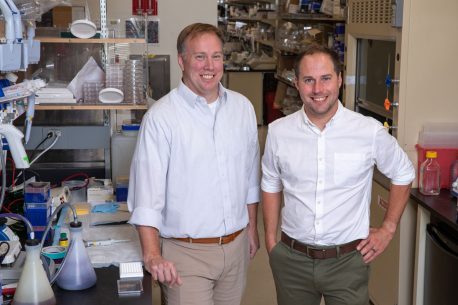
“This study has direct clinical implications because now doctors can start prescribing this effective drug to colorectal cancer patients with this mutation immediately,” says Edward Stites, senior author of the paper and an assistant professor in the Integrative Biology Laboratory. “The work also highlights the necessity of mathematical models based on fundamental biochemistry as a tool for understanding the behaviors of biological networks that are relevant to disease.”
点击此处 用于高分辨率图像。.
Approximately 40 percent of patients with colorectal cancer have a mutated KRAS gene in cells in their tumors. Most KRAS mutants cause the patient not to benefit from cetuximab. Patients with the KRAS G13D mutation are exceptions and have appeared to respond to cetuximab, but the mechanism of action has not been apparent so this drug is not commonly used on these patients. Doctors are hesitant to prescribe a drug without a known mechanism due to possible interaction with other medications or unforeseen side effects.
“Our goal was to elucidate a mechanism for why tumors that harbor KRAS G13D mutations are sensitive to cetuximab,” says Thomas McFall, first author on the paper and a postdoctoral fellow in the Stites lab. “Understanding this mechanism will aid doctors in receiving insurance support for prescribing cetuximab, which could benefit upwards of 10,000 colorectal cancer patients per year.”
To understand why KRAS G13D tumors responded to cetuximab, the researchers first used computational models to simulate complex reactions and tease out biochemical differences between healthy and mutant genes based on the biochemical understanding of each process and previous clinical trial data. This told them where to look in their laboratory tests to identify and quantify the molecular mechanism that explains why KRAS G13D patients respond differently. The researchers replicated their findings across three genetically distinct cell lines to demonstrate the reliability of the results.
In a cell with no KRAS mutations, a known tumor suppressor called neurofibromin keeps healthy KRAS proteins well-behaved. But most KRAS mutations are overly active and cannot be controlled by neurofibromin. When mutated KRAS is present, neurofibromin attempts to control the mutant KRAS at the expense of controlling the healthy KRAS. So why is the KRAS G13D mutation any different? Why does it respond to Cetuximab? The scientists discovered that even though KRAS G13D is overly active, it is doing so without neurofibromin being aware. Thus, neurofibromin can still keep the healthy KRAS under control. Additionally, the researchers demonstrated that cetuximab will only work to suppress tumors as long as there is neurofibromin available to suppress the activity of healthy KRAS.
“This work demonstrates the power of computational systems biology approaches to address problems in personalized medicine,” says Stites. “Doctors could sequence the gene to find out if the patient has this KRAS G13D variant, and if they do, then doctors could confidently prescribe cetuximab. That’s important, because it will give many cancer patients a new treatment option.”
Next, the authors plan to examine the mechanisms of more KRAS gene mutation variants that do not bind to neurofibromin, as patients with these variants may also benefit from taking cetuximab.
Other authors included Jolene K. Diedrich, Stacy L. Littlechild, Kendra V. Paskvan, Laura Sisk-Hackworth and James J. Moresco of Salk along with Meron Mengistu and Andrey S. Shaw of Genentech.
The work was funded by the National Institutes of Health (K22CA216318 and T32CA009370) and the Helmsley Center for Genomic Medicine.
DOI: 10.1126/scisignal.aaw8288
日记
科学信号学
作者
Thomas McFall, Jolene K. Diedrich, Meron Mengistu, Stacy L. Littlechild, Kendra V. Paskvan, Laura Sisk-Hackworth, James J. Moresco, Andrey S. Shaw and Edward C. Stites
宣传办公室
电话:(858) 453-4100
press@salk.edu
萨尔克研究所是一个独立的非营利性研究机构,由首个安全有效的脊髓灰质炎疫苗的研发者乔纳斯·索尔克于1960年创立。该研究所的使命是推动以合作、敢于冒险为特点的基础性研究,以应对癌症、阿尔茨海默病和农业脆弱性等社会最紧迫的挑战。这项基础科学支撑着所有的转化研究,产生有助于全球新药和创新的见解。.