August 23, 2019
Salk scientists develop a new genome-editing tool that could help treat many disorders caused by gene mutations
Salk scientists develop a new genome-editing tool that could help treat many disorders caused by gene mutations
LA JOLLA—The ability to edit genes in living organisms offers the opportunity to treat a plethora of inherited diseases. However, many types of gene-editing tools are unable to target critical areas of DNA, and creating such a technology has been difficult as living tissue contains diverse types of cells.
Now, Salk Institute researchers have developed a new tool—dubbed SATI—to edit the mouse genome, enabling the team to target a broad range of mutations and cell types. The new genome-editing technology, described in Cell Research on August 23, 2019, could be expanded for use in a broad range of gene mutation conditions such as Huntington’s disease and the rare premature aging syndrome progeria.
点击此处 用于高分辨率图像。.
版权:萨克研究所
“This study has shown that SATI is a powerful tool for genome editing,” says 胡安·卡洛斯·伊兹皮苏亚·贝尔蒙特, a professor in Salk’s Gene Expression Laboratory and senior author of the paper. “It could prove instrumental in developing effective strategies for target-gene replacement of many different types of mutations, and opens the door for using genome-editing tools to possibly cure a broad range of genetic diseases.”
Techniques that modify DNA—notably the CRISPR-Cas9 system—have generally been most effective in dividing cells, such as those in the skin or the gut, using the cells’ normal DNA repair mechanisms. The Izpisua Belmonte lab previously showed that their CRISPR/Cas9-based gene-editing technology, called HITI (for homology-independent targeted integration), could target both dividing and non-dividing cells. Protein-coding regions function like recipes for making proteins, while areas called non-coding regions act as chefs deciding how much food to make. These non-coding regions make up the vast majority of DNA (~98%) and regulate many cellular functions including turning genes off and on, so could be a valuable target for future gene therapies.
“We sought to create a versatile tool to target these non-coding regions of the DNA, which would not affect the function of the gene, and enable the targeting of a broad range of mutations and cell types,” says Mako Yamamoto, co-first author on the paper and a postdoctoral fellow in the Izpisua Belmonte lab. “As a proof-of-concept, we focused on a mouse model of premature aging caused by a mutation that is difficult to repair using existing genome-editing tools.”
The new gene knock-in method, which the scientists call SATI (short for intercellular linearized Single homology Arm donor mediated intron-Targeting Integration) is an advancement of the previous HITI method to enable it to target additional areas of the genome. SATI works by inserting a normal copy of the problematic gene into the non-coding region of the DNA before the mutation site. This new gene then becomes integrated into the genome alongside the old gene via one of several DNA repair pathways, relieving the organism of the detrimental effects of the original, mutated gene, without risking damage associated with fully replacing it.
The scientists tested the SATI technology in living mice with progeria, which is caused by a mutation in the LMNA gene. Both humans and mice with progeria show signs of premature aging, cardiac dysfunction and dramatically shortened life span due to the accumulation of a protein called progerin. By using SATI, a normal copy of LMNA gene was inserted in the progeria mice. The researchers were able to observe diminished features of aging in several tissues including the skin and spleen, along with an extension of life span (45% increase compared to untreated progeria mice). A similar extension of life span, when translated to humans, would be more than a decade. Thus, the SATI system represents the first 体内 gene correction technology that can target non-coding regions of DNA in multiple tissue types.
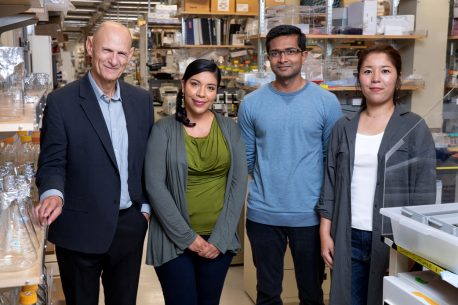
点击此处 用于高分辨率图像。.
版权:萨克研究所
Next, the team aims to improve the efficiency of SATI by increasing the number of cells that incorporate the new DNA.
“Specifically, we will investigate the details of the cellular systems involved in DNA repair to refine the SATI technology even further for better DNA correction,” says Reyna Hernandez-Benitez, co-first author on the paper and a postdoctoral fellow in the Izpisua Belmonte lab.
Other authors included Keiichiro Suzuki, Rupa Devi Soligalla, Emi Aizawa, Fumiyuki Hatanaka, Masakazu Kurita, Pradeep Reddy, Alejandro Ocampo, Tomoaki Hishida, Masahiro Sakurai, Amy N. Nemeth, Concepcion Rodriguez Esteban of Salk; Zhe Li, Christopher Wei and Kun Zhang of the University of California San Diego; Estrella Nuñez Delicado of Universidad Catolica San Antonio de Murcia; Jun Wu of University of Texas Southwestern Medical Center; Josep M. Campistol of the Hospital Clinic of Barcelona in Spain; Pierre Magistretti of the King Abdullah University of Science and Technology in Saudi Arabia; Pedro Guillen of the Clinica CEMTRO in Spain; Jianhui Gong, Yilin Yuan and Ying Gu of the BGI-Shenzhen in China; Guang-Hui Liu of the Chinese Academy of Sciences; and Carlos López-Otín from the Universidad de Oviedo in Spain.
The work was funded by the 2016 Salk Women & Science Special Award, the JSPS KAKENHI (15K21762 and 18H04036), the Takeda Science Foundation, The Uehara Memorial Foundation, the National Institutes of Natural Sciences (BS291007), The Sumitomo Foundation (170220), The Naito Foundation, The Kurata Grants (1350), the Mochida Memorial Foundation, The Inamori Foundation, the Guangdong Provincial Key Laboratory of Genome Read and Write (No. 2017B030301011), Guangdong Provincial Academician Workstation of BGI Synthetic Genomics (No. 2017B090904014), the Shenzhen Peacock Plan (No. KQTD20150330171505310), The Leona M. and Harry B. Helmsley Charitable Trust (2012-PG-MED002), the G. Harold and Leila Y. Mathers Charitable Foundation, the National Institutes of Health (R01HL123755 and 5 DP1 DK113616), The Progeria Research Foundation, The Glenn Foundation, KAUST, The Moxie Foundation, the Fundación Dr. Pedro Guillen, the Asociación de Futbolistas Españoles, and Universidad Católica San Antonio de Murcia (UCAM).
DOI: 10.1038/s41422-019-0213-0
日记
Cell Research
作者
Keiichiro Suzuki, Mako Yamamoto, Reyna Hernandez-Benitez, Zhe Li, Christopher Wei, Rupa Devi Soligalla, Emi Aizawa, Fumiyuki Hatanaka, Masakazu Kurita, Pradeep Reddy, Alejandro Ocampo, Tomoaki Hishida, Masahiro Sakurai, Amy N. Nemeth, Estrella Nuñez Delicado, Josep M. Campistol, Pierre Magistretti, Pedro Guillen, Concepcion Rodriguez Esteban, Jianhui Gong, Yilin Yuan, Ying Gu, Guang-Hui Liu, Carlos López-Otín, Jun Wu, Kun Zhang, and Juan Carlos Izpisua Belmonte
宣传办公室
电话:(858) 453-4100
press@salk.edu
萨尔克研究所是一个独立的非营利性研究机构,由首个安全有效的脊髓灰质炎疫苗的研发者乔纳斯·索尔克于1960年创立。该研究所的使命是推动以合作、敢于冒险为特点的基础性研究,以应对癌症、阿尔茨海默病和农业脆弱性等社会最紧迫的挑战。这项基础科学支撑着所有的转化研究,产生有助于全球新药和创新的见解。.