July 24, 2018
Organization—or lack of it—in brain’s piriform cortex allows us to differentiate one smell from another
Organization—or lack of it—in brain’s piriform cortex allows us to differentiate one smell from another
LA JOLLA—Can you tell the smell of a rose from the scent of a lilac? If so, you have your brain’s piriform cortex to thank. Compared to many parts of the brain, the piriform cortex—which lets animals and humans process information about smells—looks like a messy jumble of connections between cells called neurons. Now, Salk Institute researchers have illuminated how the randomness of the piriform cortex is actually critical to how the brain distinguishes between similar odors.
点击此处 用于高分辨率图像。.
版权:萨克研究所
“The standard paradigm is that information in the brain is encoded by which cells are active, but that’s not true for the olfactory system,” says Charles Stevens, Distinguished Professor Emeritus in Salk’s Molecular Neurobiology Laboratory and coauthor of the new work. “In the olfactory system, it turns out it’s not a matter of which cells are active, but how 许多 cells are active and how active they are.”
Aside from better understanding how smells are processed, the new research, published in the Journal of Comparative Neurology on July 17, 2018, could also lead to greater insight into how some parts of the brain organize information.
When odorant molecules—the signature of any given smell—bind to the receptors in a person’s nose, the signal is transmitted to the olfactory bulb, and from there to the piriform cortex. In other sensory systems—like the visual system—information maintains a strict order as it moves through the brain. Particular parts of the eye, for instance, always transmit information to specific parts of the visual cortex. But researchers have long known that this order is missing in the piriform cortex.
“We haven’t been able to discern any order in the piriform cortex connections in any species,” says coauthor Shyam Srinivasan, an assistant project scientist at the University of California San Diego’s Kavli Institute for Brain and Mind. “Any given odor lights up about 10 percent of neurons that seem to be scattered all over the piriform cortex.”
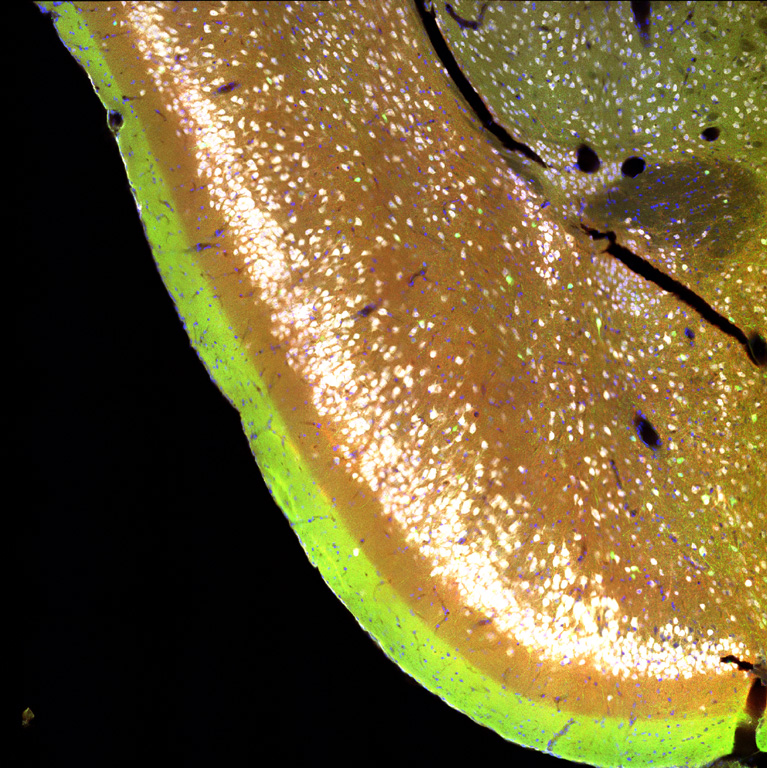
To start working out the details of how the piriform cortex encodes odor information—and whether its connections are truly random—Stevens and Srinivasan analyzed the piriform cortices of nine mice using a variety of staining and microscopy techniques that let them visualize different cell types in the brain region. Their first goal: to quantify the number and density of cells in the piriform cortex.

点击此处 用于高分辨率图像。.
版权:萨克研究所
“This was really like a survey,” explains Srinivasan. “We counted the cells in different representative areas and averaged them across the whole region.”
The mouse piriform cortex, they concluded, has around half a million neurons in it, divided equally between the larger, less dense posterior piriform and the smaller, more dense anterior piriform.
Using this initial information on density and neuron number, as well as knowledge from previous studies on the number of neurons in the olfactory bulb and how many neuronal connections—or synapses—connect the olfactory bulb to the piriform cortex, the pair of researchers was able to draw a surprising finding: each neuron in the olfactory bulb is connected to nearly every single neuron in the piriform cortex.
“Every cell in the piriform is getting information from essentially every odor receptor there is,” says Stevens. “There’s not one ‘coffee smell’ neuron but a whole bunch of coffee cell neurons all over the place.” Rather than a single receptor detecting one odor and lighting up one cluster of telltale neurons, he explains, each odor has a fingerprint that’s based more on the strength of the connections—while the smell of coffee may activate nearly the same neurons in the piriform cortex as the smell of chocolate, they’ll activate each neuron to a different degree.
“One advantage to this system is that it can encode very complex information,” says Srinivasan. “It also makes it very robust to noise.” If one neuron sends a “noisy” signal—stronger or weaker activation than it should—the noise gets cancelled out by the many other neurons sending simultaneous, more accurate signals.
The researchers would like to repeat the work in other animals to see where similarities and differences lie. They also are interested in looking into other areas of the brain that have long been assumed to be dominated by seemingly random connections to see if they’re organized in the same way.
Stevens and Srinivasan, who also had a paper come out in the 神经科学杂志 on July 13 about using the fruit fly olfactory learning circuit to improve the current crop of deep learning algorithms, were funded by the Kavli Institute for Brain and Mind at UC San Diego and the National Science Foundation.
日记
Journal of Comparative Neurology
作者
Shyam Srinivasan and Charles F. Stevens
宣传办公室
电话:(858) 453-4100
press@salk.edu
萨尔克研究所是一个独立的非营利性研究机构,由首个安全有效的脊髓灰质炎疫苗的研发者乔纳斯·索尔克于1960年创立。该研究所的使命是推动以合作、敢于冒险为特点的基础性研究,以应对癌症、阿尔茨海默病和农业脆弱性等社会最紧迫的挑战。这项基础科学支撑着所有的转化研究,产生有助于全球新药和创新的见解。.