October 6, 2014
Hu Cang awarded $1.5 million to pursue transformative and innovative research
Hu Cang awarded $1.5 million to pursue transformative and innovative research
LA JOLLA–Scientists at the Salk Institute have scored a rare hat trick with a third assistant professor from the 韦特先进生物光子学中心 being named a recipient of the prestigious National Institutes of Health (NIH) Director’s New Innovator Award.
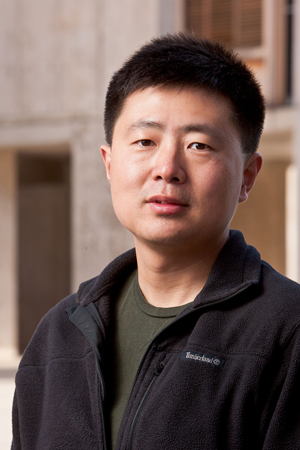
Hu Cang will receive the New Innovator Award for 2014, joining the two other Salk researchers who were also previously recipients of the prize. The award will provide Cang with $1.5 million to support his research on cutting-edge microscopy. Only 50 New Innovator Awards were given out this year.
The NIH Director’s New Innovator Award is a highly selective program with hundreds of researchers from the nation’s top scientific institutions competing for the award. Cang, along with a select group of other young investigators, will receive this funding to pursue novel ideas with the potential to have a significant impact on human health.
“We are very proud of Dr. Cang and grateful for NIH’s continuing support of young researchers who pursue creative and highly innovative science,” says William Brody, president of the Salk Institute. “The ability to see molecular components of cellular structures are crucial to advancing biology and medicine, and his work is expanding the frontiers of microscopy.”
The New Innovator award will support Cang in his work in developing a “super lens” that sees things far smaller than previously possible. Cang’s group has already made a microscope that can focus light down to a smaller point than ever before, letting them track individual proteins on the surface of a cell. He’s particularly interested in using his new approach to study the structure of genetic material, which is notoriously hard to visualize. Being able to see how strands of DNA fold and loop when they’re packed within a cell nucleus might reveal how genes are turned on and off in both healthy and diseased cells.
“The fact that all three of our junior faculty at the Waitt Advanced Biophotonics Center have won this prestigious award speaks to our ability to recruit the very best young scientists and highlights the exceptionally high quality of science that we do here,” says Martin Hetzer, faculty director of the center and holder of Salk’s Jesse and Caryl Philips Foundation Chair.
“By putting these incredible tools of the Biophotonics Center in the hands of Salk investigators in an interdisciplinary teamwork environment, breakthroughs are bound to happen,” says Ted Waitt, vice-chair of the Salk Institute Board of Trustees and chairman of the Waitt Foundation. “This exciting hat-trick leads the way to a continued bright future of the Center and speaks to the high quality of research at the Salk Institute.”
Björn Lillemeier, an assistant professor in the 诺米斯基金会免疫生物学与微生物病原学实验室 和 阿克塞尔·尼默雅恩, an assistant professor in the Waitt Advanced Biophotonics Center, received the award in 2012.
“Brilliant scientists, such as past New Innovator award recipient Björn Lillemeier and others, are able to make groundbreaking discoveries because of technologies the Salk has in place to advance success,” said Heini Thyssen, former trustee and founder of the Nomis Laboratory at the Salk Institute.
Lillemeier, holder of Salk’s Helen McLoraine Developmental Chair, aims to understand how cellular communication is controlled in space and time. He creates unique optical microscopy techniques that visualize the molecular organization of plasma membrane signaling in live cells. His research reveals new signaling mechanisms that can be used to target the large number of diseases associated with membrane signaling defects.
Nimmerjahn, holder of the Hearst Foundation Developmental Chair, develops novel research tools to understand brain cells called glia in intact healthy and diseased brains. The New Innovator award supported his research into microglia, the resident immune cells in the brain that are involved in essentially all brain pathologies. Better understanding their signaling mechanisms may lead to new or improved disease prevention and treatment strategies.
Established in 2007, the NIH Director’s New Innovator Award addresses two important goals: stimulating highly innovative research and supporting promising new investigators. For more information on the New Innovator award, including a complete list of this year’s awardees, please visit: http://commonfund.nih.gov/newinnovator.
关于索尔克生物研究所:
索尔克生物研究所是世界顶尖的基础研究机构之一,其国际知名的教职人员在一个独特、协作和富有创造性的环境中,深入探究生命科学的基本问题。索尔克科学家们致力于发现和指导未来几代研究人员,通过研究神经科学、遗传学、细胞和植物生物学以及相关学科,在癌症、衰老、阿尔茨海默氏症、糖尿病和传染病的认识方面做出了开创性的贡献。.
教职员工的成就获得了无数荣誉,包括诺贝尔奖和美国国家科学院院士资格。该研究所由脊髓灰质炎疫苗先驱 Jonas Salk 医生于 1960 年创立,是一家独立的非营利组织和建筑地标。.
宣传办公室
电话:(858) 453-4100
press@salk.edu