April 26, 2016
Salk scientists find a drug that slows protein production, helping neurons affected by a genetic disease
Salk scientists find a drug that slows protein production, helping neurons affected by a genetic disease
LA JOLLA—Salk Institute scientists showed how an FDA-approved drug boosts the health of brain cells by limiting their energy use. Like removing unnecessary lighting from a financially strapped household to save on electricity bills, the drug—called rapamycin—prolongs the survival of diseased neurons by forcing them to reduce protein production to conserve cellular energy.
Rapamycin has been shown to extend lifespan and reduce symptoms in a broad range of diseases and, at the cellular level, is known to slow down the rate at which proteins are made. But the new Salk research, published in the journal eLife, suggests that rapamycin could also target the neural damage associated with Leigh syndrome, a rare genetic disease, and potentially other forms of 神经退行性疾病 as well.
版权:萨克研究所
“Our study shows that protein production in neurons is one of the major utilizers of energy and that neurons of Leigh syndrome degenerate because they can’t sustain a high enough level of energy,” says 托尼·亨特, the Renato Dulbecco Chair and American Cancer Society Professor in Salk’s Molecular and Cell Biology Laboratory, who led the research.
Previous studies on rapamycin, which blocks a key energy sensor in cells, found that it can alter the immune system, extend lifespan and treat disorders, including lupus and Alzheimer’s disease. Researchers assumed that the drug prevented the neurodegeneration seen in Alzheimer’s by encouraging cells to degrade damaged components and aggregated proteins. But recent data hinted that the drug might also have an effect on the mitochondria, organelles that act as cells’ powerhouses, producing energy in the form of adenosine triphosphate (ATP).
Xinde Zheng, a research associate in the Hunter lab, was already studying the properties of cells affected by Leigh syndrome, whose inherited neurodegeneration is caused by a mutation in mitochondrial DNA that reduces ATP production. Zheng wondered how rapamycin would affect the neurons plagued by the diseased mitochondria. He and Hunter teamed up with the lab of 鲁斯蒂·盖奇, a professor in Salk’s Laboratory of Genetics and holder of the Vi and John Adler Chair for Research on Age-Related Neurodegenerative Disease. Zheng, together with Leah Boyer, then a researcher in Gage’s lab and now director of Salk’s Stem Cell Core, generated diseased neurons by taking skin cells from patients with Leigh syndrome, reprogramming them into stem cells in culture and then coaxing them to develop into brain cells in a dish.
Though cells must make proteins to survive, protein production is a highly energy-consuming process and, for diseased cells, the process leaves too few energy reserves to deal with cellular stress or other demands.
“Reducing protein production in aging neurons allows more energy for the cell to put toward folding proteins correctly and handling stress,” says Zheng, the first author of the new paper. “The impact of our finding is that modulation of protein synthesis could be a general approach to treating neurodegeneration.”
点击此处 用于高分辨率图像。.
版权:萨克研究所
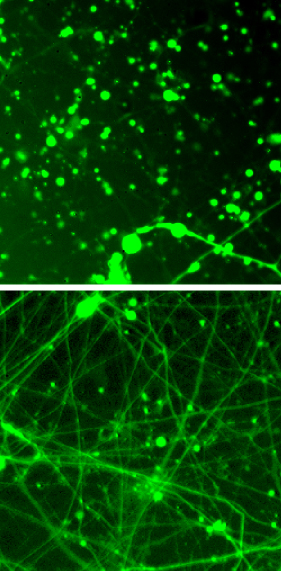
In their study, the team found that Leigh syndrome neurons decayed in the dish and showed clear signs of energy depletion. Meanwhile, Leigh syndrome neurons exposed to rapamycin had more ATP and showed less degeneration. By turning down the dial on protein production, the diseased and damaged neurons were able to survive longer.
“We are surprised and delighted that rapamycin’s effect to reduce protein synthesis as an energy-austerity approach may lead to a potential treatment for mitochondria-related neurodegenerative diseases,” says Gage.
This is a good example of the value of studying a disease in a dish, according to Hunter. “It’s led to a lot of new insights into the underlying biology of this rare and understudied condition,” he adds.
More work is needed to determine whether the findings on rapamycin hold true in animal models of Leigh syndrome and other neurodegenerative diseases, and to ascertain how exactly rapamycin is altering the metabolism of the cells.
Other researchers on the study were Mingji Jin, Youngsung Kim, Weiwei Fan, Cedric Bardy, Travis Berggren 和 罗纳德·M·埃文斯, all of the Salk Institute.
这项工作以及参与研究的学者得到了以下机构资助: 美国国立卫生研究院, , 那个 霍华德·休斯医学研究所, ,, Calouste Gulbenkian Foundation Fellowship, a 加州再生医学研究所 Postdoctoral Training Award, and the 赫尔姆斯利基因组医学中心.
日记
eLife
作者
Xinde Zheng, Leah Boyer, Mingji Jin, Yongsung Kim, Weiwei Fan, Cedric Bardy, Travis Berggren, Ronald M Evans, Fred H Gage, Tony Hunter
宣传办公室
电话:(858) 453-4100
press@salk.edu
萨尔克研究所是一个独立的非营利性研究机构,由首个安全有效的脊髓灰质炎疫苗的研发者乔纳斯·索尔克于1960年创立。该研究所的使命是推动以合作、敢于冒险为特点的基础性研究,以应对癌症、阿尔茨海默病和农业脆弱性等社会最紧迫的挑战。这项基础科学支撑着所有的转化研究,产生有助于全球新药和创新的见解。.