
December 5, 2016
Salk scientists discover a small protein important for cellular housekeeping
Salk scientists discover a small protein important for cellular housekeeping
LA JOLLA—We all know how hard it is to find something small like a dropped contact lens that blends into the background. It’s similarly tough for biologists to find tiny proteins against the complex background of the cell. But, increasingly, scientists are learning that such microproteins, which are overlooked by traditional detection methods, also have important biological roles to play.
Using a new microprotein detection strategy, Salk scientists discovered a human microprotein involved in one of the cells’ key housekeeping tasks: clearing out genetic material that’s no longer needed. The new molecule could provide a better understanding of how the levels of genes, including disease genes, are controlled in the cell.
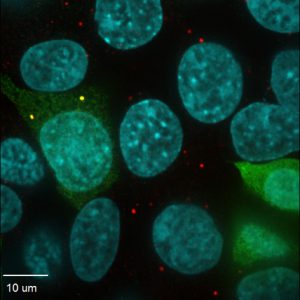
点击此处 用于高分辨率图像
Credit: MIT/Yale University
“Despite how much we know about the human genome, there are still blind spots in the genome discovery algorithms,” says 艾伦·萨加特利安, Salk professor and one of the senior authors on the paper that appears in the December 5, 2016 issue of Nature Chemical Biology. “You can sequence the whole human genome and never know a protein, like this one, was there because it’s too short and falls below the usual length requirement for gene assignment algorithms.”
In cells, a gene’s DNA is transcribed into mRNA, which then guides production of specific proteins. After the necessary protein is created, the RNA blueprint is recycled to stop the production of the protein. While this process is crucial for healthy cells, no one was aware of a critical microprotein in this process, called NoBody (for non-annotated P-body dissociating polypeptide).
Saghatelian and Salk researcher Jiao Ma, with co-senior author Sarah Slavoff and first author Nadia D’Lima, both of Yale University, decided to study NoBody because its sequence is conserved throughout evolution, suggesting it had a critical function in human biology. Their experiments showed that NoBody interacts with proteins involved in the mRNA recycling process known to form P-body granules—clusters of mRNAs and proteins that perform the first step in breaking down the mRNAs. The team found that the introduction of NoBody into these cells caused the disappearance of these P-body granules and that changes to NoBody levels inside cells can disturb the RNA recycling pathway, highlighting a biochemical function for NoBody and potential target for future therapeutics related to RNA dysfunction.
Part of the reason this molecule has been overlooked for so long, according to Saghatelian, is that no one knew NoBody existed. In addition, no one looked for microproteins because it was unclear whether any microproteins would have important functions. “The discovery of NoBody and its function in mRNA recycling suggests that at least some of the hundreds of other microproteins that we have found might also be functional, which is an exciting proposition,” he says.
Slavoff adds, “The fact that NoBody has been present in this intensively studied complex of proteins all this time, but completely escaped our notice, really hammers home how many more currently unknown microproteins could be associated with essential cellular machineries.”
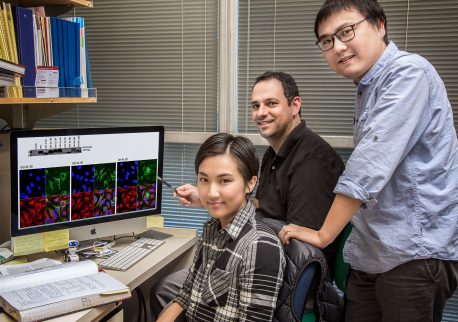
点击此处 用于高分辨率图像
版权:萨克研究所
To get around issues of detection and find out what small microproteins might be overlooked, the paper’s authors combined genomic sequencing and protein mass spectrometry (proteomics) to predict and identify non-annotated microproteins. The team began by isolating the contents of cells from the commonly studied myeloid leukemia cell line and removing the larger proteins to leave behind only the smaller ones. Then they used an analytical chemistry technique called liquid chromatography-mass spectroscopy proteomics to determine the amino acid sequences of every protein, including microproteins, that were present in the sample.
To figure out which genes these mapped to, the team used a homemade computational method to predict every possible microprotein from a myeloid cell’s total mRNA content, which they sequenced using genomics techniques. This custom database was then used to search their proteomics data for novel microproteins and led to the discovery of over 400 novel microproteins, including NoBody.
“We predict millions of theoretical protein sequences from the genomics data, but the key was to determine which of those predicted sequences are real using mass spectrometry data,” says Ma, who was the lead on this project in the Saghatelian lab.
The group thinks that NoBody might signal other important microproteins that might be involved in disease. Protein granules are found in many biological processes and are of particular relevance in neurological diseases, where proteins clump and aggregate together, such as in the amyloid plaques that are associated with Alzheimer’s disease.
“While NoBody is not directly involved in Alzheimer’s disease or other diseases, this discovery suggests that other microproteins might be,” adds Saghatelian, who is also holder of the Dr. Frederik Paulsen Chair. “The search for and characterization of these other microproteins in biology and disease represents an exciting frontier in molecular biology.”
Other authors on the paper included Qian Chu of the Salk Institute, Lauren Winkler of Yale University, Ken H. Loh of the Massachusetts Institute of Technology, Elizabeth O. Corpuz and Jens Lykke-Anderson of the 加州大学圣地亚哥分校, and Bogdan A. Budnik of Harvard University.
The work was funded by a George E. Hewitt Foundation for Medical Research postdoctoral fellowship, the 美国国立卫生研究院, 利昂娜·M·哈里·B·赫尔姆斯利慈善信托 grant, and Dr. Frederik Paulsen Chair/Ferring Pharmaceuticals.
日记
Nature Chemical Biology
作者
Nadia G. D’Lima, Jiao Ma, Lauren Winkler, Qian Chu, Ken H. Loh, Elizabeth O. Corpuz, Bogdan A. Budnik, Jens Lykke-Andersen, Alan Saghatelian, and Sarah A. Slavoff
宣传办公室
电话:(858) 453-4100
press@salk.edu
萨尔克研究所是一个独立的非营利性研究机构,由首个安全有效的脊髓灰质炎疫苗的研发者乔纳斯·索尔克于1960年创立。该研究所的使命是推动以合作、敢于冒险为特点的基础性研究,以应对癌症、阿尔茨海默病和农业脆弱性等社会最紧迫的挑战。这项基础科学支撑着所有的转化研究,产生有助于全球新药和创新的见解。.




