January 8, 2016
Factor in how malignant tumors spread may also be a key to treatment
Factor in how malignant tumors spread may also be a key to treatment
LA JOLLA—Glioblastoma multiforme is a particularly deadly 癌症. A person diagnosed with this type of brain tumor typically survives 15 months, if given the best care. The late Senator Ted Kennedy succumbed to this disease in just over a year.
But scientists at the Salk Institute have discovered a key to how these tumor cells proliferate so quickly —and ways to turn this engine of tumor growth into a target for cancer treatment.
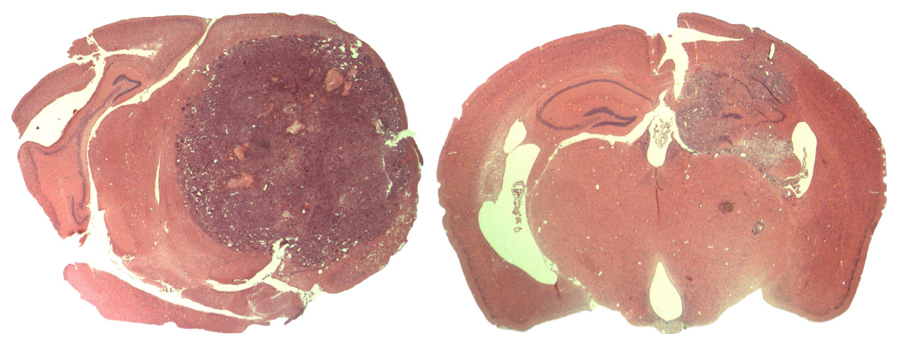
Click here to download a high-resolution image.
图片:由萨克生物研究所提供
“This is a disease for which there has been practically no improvement in treatment outcome for years,” said 英德·维尔马, professor in the Salk Institute’s Laboratory of Genetics and senior author of the paper published January 8, 2016 in the journal 科学进展. “It is clear that even if a surgeon removes 99.99 percent of a glioblastoma multiforme tumor, what is left behind will come back and grow into more tumor.”
To study how glioblastoma multiforme spreads, Verma’s team focused on a transcription factor called nuclear factor kB (or NF-kB). A transcription factor is a protein that binds to DNA and controls the fate of gene expression for a particular set of genes. Several known factors can trigger NF-kB activity in a cell, including ultraviolet and ionizing radiation, immune proteins (cytokines) and DNA damage.
In the case of glioblastoma multiforme, Verma and colleagues ran a battery of tests to show how overzealous NF-kB activity pushed the cancer cells to proliferate, and how stopping NF-kB slowed cancer growth and increased survival in mice.
“Our experiments confirmed that NF-kB is required for the cancer cell to proliferate,” says Dinorah Friedmann-Morvinski, first author of the paper and currently a researcher in the department of biochemistry and molecular biology at Tel Aviv University in Israel. “But now we have finally found a way to ameliorate the tumor to increase lifespan.”
Verma’s team started with a mouse model of glioblastoma multiforme and used genetic tools to manipulate cells into shutting down NF-kB activity in two ways. The team ramped up the presence of a protein called IkBaM, which inhibits NF-kB activity. They also eliminated an enzyme that increases NF-kB activity. With less NF-kB activity, tumor growth slowed and mice lived significantly longer then mice whose NF-kB activity was left alone. But while these genetic experiments demonstrated the role of NF-kB in glioblastoma multiforme, they aren’t a feasible treatment in humans.
“So we asked how could we manipulate the system using pharmacology rather than genetics,” says Verma.
Scientists have long suspected that one reason why glioblastoma multiforme comes back so quickly after surgery is the so-called tumor microenvironment. In other words, a tumor changes the environment of its surroundings (nearby tissues) to make it easier for cancer cells to thrive, Verma explains.

Click here to download a high-resolution image.
图片:由萨克生物研究所提供
Instead of using genetic tools, Verma and colleagues sought to treat the brain tumors in a way that also changed the tumor microenvironment. The scientists fed mice a peptide (called NBD) that is known to block NF-kB activity when NF-kB is triggered by cytokines (proteins produced by the immune system). The NBD peptide easily travels across the central nervous system, and can successfully penetrate glioblastoma tumor cells. Treating mice with the NBD peptide doubled their typical survival time compared to mice that didn’t get the NBD peptide.
“We could increase survival time from one month without treatment to three months with treatment,” says Verma. “That’s a profound increase in life expectancy, especially considering a mouse only lives for two years.” Yet, while the NBD peptide kept the tumors at bay, the peptide treatment eventually causes toxicity, most likely in the liver. So researchers explored another tactic to slow NF-kB activity.
Curbing NF-kB activity can be tricky because NF-kB has many important roles: it helps regulate cell survival, inflammation and immunity among many other functions in the cell.
“The ultimate goal is to block NF-kB, but because it turns on many genes—at least 100—our aim became finding the handful of genes that directly affect tumor growth,” says Verma. “Then we can be more selective in treatment.”
Salk scientists tracked which genes were influenced by NF-kB and found one, Timp1, which has been previously implicated in lung cancer. Targeting the Timp1 gene in treatment also slowed tumor growth and increased survival time in mice by a few months.
“In the future we want to focus on ways to reduce the toxicity of anti-NF-kB drugs,” said Friedmann-Morvinski. “We may do this by specifically targeting these drugs to the tumor, or by identifying downstream targets of the NF-kB pathway, like Timp1, that also prolong survival.” Further experiments may identify treatments that target NF-kB activity in a safe, but effective way.
Other authors on the paper included Rajesh Narasimamurthy, Yifeng Xia, Chad Myskiw and Yasushi Soda of the Salk Institute for Biological Studies.
这项工作由...资助 美国国立卫生研究院, , 那个 H.N. and Frances C. Berger Foundation, ,和 Leona M. 和 Harry B. Helmsley 慈善信托基金.
日记
科学进展
作者
Dinorah Friedmann-Morvinski, Rajesh Narasimamurthy, Yifeng Xia, Chad Myskiw, Yasushi Soda, Inder M. Verma
宣传办公室
电话:(858) 453-4100
press@salk.edu
萨尔克研究所是一个独立的非营利性研究机构,由首个安全有效的脊髓灰质炎疫苗的研发者乔纳斯·索尔克于1960年创立。该研究所的使命是推动以合作、敢于冒险为特点的基础性研究,以应对癌症、阿尔茨海默病和农业脆弱性等社会最紧迫的挑战。这项基础科学支撑着所有的转化研究,产生有助于全球新药和创新的见解。.