November 19, 2015
The ability to turn human skin cells into neurons that produce serotonin will be a boon for researchers
The ability to turn human skin cells into neurons that produce serotonin will be a boon for researchers
LA JOLLA—Scientists at the Salk Institute have taken human skin cells and turned them into neurons that signal to one another using serotonin, a brain chemical that is crucial to our mental well-being.
Although serotonin neurons comprise only a small fraction of the brain’s cells, these neurons are tied to debilitating disorders such as major depression, schizophrenia and autism. Depression is commonly treated using selective serotonin reuptake inhibitors, which heighten serotonin signaling in the small gaps between neighboring neurons.
Described October 27, 2015 in 分子精神病学, the method gives researchers a new lens with which to study serotonin’s mechanisms and how they may go awry in mental illness.
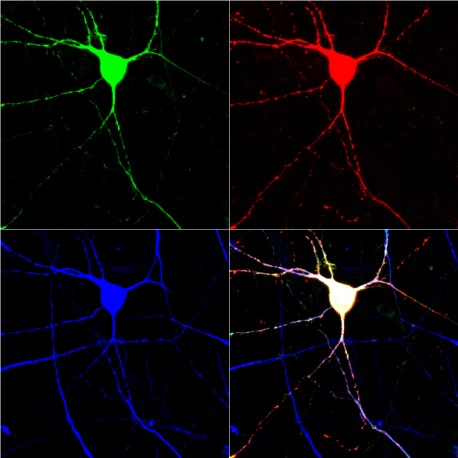
点击此处 用于高分辨率图像。.
Image: Krishna Vadodaria/Salk Institute
“We can finally start asking questions about cells from people affected by depression and other disorders,” says Salk Professor 鲁斯蒂·盖奇, the study’s senior investigator.
Scientists have long been producing specialized types of human cells for study in culture dishes. For nearly a decade, for example, it has been possible to transform the cells of specific tissues, converting them into pluripotent stem cells (iPS) and, in turn, prompting them to develop into other types of cells, including neurons. Although more recent methods have turned skin cells directly into neurons, those neurons use a different brain chemical, glutamate.
In the new study, the Salk team isolated the minority population of serotonin neurons that were differentiated from stem cells and asked what unique genes were activated in these cells. The researchers then found a cocktail of six gene-activating proteins that worked to direct differentiation to serotonergic neurons directly from human fibroblasts.
“When I looked into the microscope and saw serotonin positive neurons, it was really exciting and the moment when I said, ‘Wow, we’ve got serotonergic neurons!’” says the study’s lead author Krishna Vadodaria, a research associate in the Gage laboratory. “While these neurons may not be identical to the brain’s serotonergic neurons, the iSNs have functional properties of neurons, produce serotonin and respond to antidepressants in the dish, which will help us more accurately study serotonergic neurotransmission in neuropsychiatric disorders.”
Other authors on the study include Jerome Mertens, Apua Paquola, Cedric Bardy, Xinyi Li, Roberto Jappelli, Lianna Fung, Carol Marchetto, Michael Hamm and Mark Gorris, all of the Salk Institute; and Philipp Koch of the University of Bonn in Germany.
This study was supported by the Swiss National Science Foundation (SNSF), the
Glenn Center for Aging Research, the FP7 Marie Curie, Lynn and Edward Streim, the Robert and Mary Jane Engman Foundation, the JPB基金会, ,和 Leona M. 和 Harry B. Helmsley 慈善信托基金.
日记
分子精神病学
作者
KC Vadodaria, J Mertens, A Paquola, C Bardy, X Li, R Jappelli, L Fung1, MC Marchetto, M Hamm, M Gorris, P Koch and FH Gage
宣传办公室
电话:(858) 453-4100
press@salk.edu
萨尔克研究所是一个独立的非营利性研究机构,由首个安全有效的脊髓灰质炎疫苗的研发者乔纳斯·索尔克于1960年创立。该研究所的使命是推动以合作、敢于冒险为特点的基础性研究,以应对癌症、阿尔茨海默病和农业脆弱性等社会最紧迫的挑战。这项基础科学支撑着所有的转化研究,产生有助于全球新药和创新的见解。.