November 19, 2014
A combination of two unexpected drugs targets tumors
A combination of two unexpected drugs targets tumors
LA JOLLA–Scientists at the Salk Institute have discovered a powerful one-two punch for countering a common genetic mutation that often leads to drug-resistant cancers. The dual-drug therapy–with analogs already in use for other diseases–doubled the survival rate of mice with lung cancer and halted cancer in pancreatic cells.
Lung cancer, which affects nonsmokers as well as smokers, is the most common cancer worldwide, causing 1.6 million deaths a year, far more than pancreatic, breast and colon cancer combined. About 30 percent of the most common type of lung cancer (non-small) contains a mutation in a gene called KRAS. This mutation can also lead to hard-to-treat cancer in the pancreas, thyroid and colon.
“There really have been no effective treatments to target the KRAS mutation so far,” says 英德·维尔马, a professor in the 遗传实验室 and American Cancer Society Professor of Molecular Biology. “We found a drug combination that successfully targets KRAS and stops tumor growth in the mouse model.”
The new discovery, detailed November 19 in 科学转化医学, shows how the two-pronged attack successfully hindered KRAS and other cellular processes to halt or shrink tumor growth.
When activated, mutated KRAS clings to cell membranes and recruits proteins to ramp up cancer growth. Researchers have developed drugs to disable enzymes that tether KRAS to the cell membrane, but these drugs typically ended up being toxic because those enzymes are needed in the body for normal functions.
“The Achilles’ heel of KRAS is its movement to the membrane,” says Verma, who is also holder of Salk’s Irwin and Joan Jacobs Chair in Exemplary Life Science.
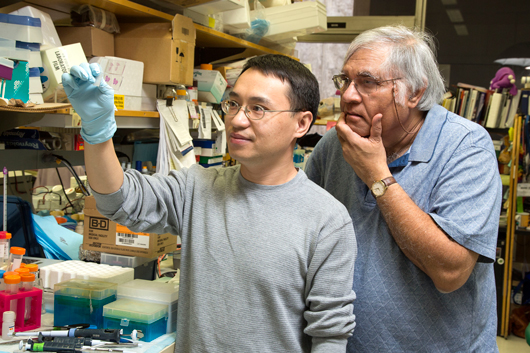
Yifeng Xia and Inder Verma, professor of the Salk Laboratory of Genetics
点击此处 用于高分辨率图像。.
图片:由萨克生物研究所提供
The researchers took a new approach to targeting this membrane interaction when they noticed that a drug called Zometa, typically used to stop the breakdown and growth of cells in bone disease, also interfered with cell membrane interactions. In previous work, the team added carbon chains to a molecule similar to Zometa, to create a lipophilic bisphosphonate (BP) that blocked KRAS from attaching to the cell membrane.
“For the first time, we had the ability to interfere with KRAS without being completely toxic,” says Verma.
This, however, wasn’t enough. Tumors were still proliferating, in part because the new BP led to failed attempts of a process called autophagy, where cells, under stress, self-destruct and break down into nutrients that can be used by other cells.
Autophagy can be both good and bad in fighting cancer: in some cases, autophagy prompts cancer cells to die; in other settings, it creates a cellular environment that helps tumors thrive. With the BP treatment, cells began the process of autophagy but failed, leading to junk protein accumulation and an inflamed environment that helped the tumors to survive.
But, as demonstrated in the new work, when the researchers added a chemical called rapamycin, cells were able to carry out autophagy successfully and prevented tumor cells from proliferating. Rapamycin, discovered in the 1970s, is used in the clinic for preventing organ rejection and has also been linked to anti-cancer effects.
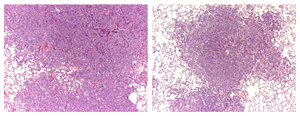
Mutation of the KRAS gene leads to a common and hard-to-treat lung cancer. A new combination therapy (lipophilic bisphosphonate and rapamycin) administered to mice for 40 days resulted in shrunken tumor size (right).
点击此处 用于高分辨率图像。.
图片:由萨克生物研究所提供
“We found if we also activated autophagy–with the rapamycin–and combine it with the inhibitor of the cell membrane–the BP–there were significant cell deaths in the tumors,” says Yifeng Xia, Salk researcher and first author of the new work.
When they injected the combination in mouse lung tumors, tumors shrunk or stopped growing. The study also found that a pancreatic cancer cell line responded to the dual treatment. Next, the team plans to test toxicity of the new BP. The group is also working with the University of California, San Diego, Moores Cancer Center to design human clinical trials to test the dual therapy.
“Those two drugs have not been used together as far as we know for KRAS-related cancer treatment,” adds Xia. “We are excited about the potential and that these molecules are already being used in clinical trials in some form.”
In addition to Verma and Xia, authors on the paper included Shen Shen, Narayana Yeddula, Wolfgang Fischer and William Low of the Salk Institute; Yi-Liang Liu, Wei Zhu, Francisco Guerra and Eric Oldfield of the University of Illinois at Urbana-Champaign; and Yonghua Xie, Xiaoying Zhou and Yonghui Zhang of the Tsinghua University.
这项工作由...资助 美国国立卫生研究院, Ipsen Biomeasure, the H.N. and Frances C. Berger Foundation 和 Leona M. 和 Harry B. Helmsley 慈善信托基金.
关于索尔克生物研究所:
索尔克生物学研究所是世界上首屈一指的基础研究机构之一,其国际知名的教职员工在一个独特的、协作和创新的环境中,深入探索生命科学的基本问题。索尔克科学家既注重科学发现,也注重培养下一代研究人员,通过研究神经科学、遗传学、细胞生物学、植物生物学及相关学科,为我们理解癌症、衰老、阿尔茨海默病、糖尿病和传染病做出了开创性的贡献。.
教职员工的成就获得了无数荣誉,包括诺贝尔奖和美国国家科学院院士资格。该研究所由脊髓灰质炎疫苗先驱 Jonas Salk 医生于 1960 年创立,是一家独立的非营利组织和建筑地标。.
日记
科学转化医学
作者
Yifeng Xia, Yi-Liang Liu, Yonghua Xie, Wei Zhu, Francisco Guerra, Shen Shen, Narayana Yeddula, Wolfgang Fischer, William Low, Xiaoying Zhou, Yonghui Zhang, Eric Oldfield, Inder M. Verma
宣传办公室
电话:(858) 453-4100
press@salk.edu