2018年1月10日
LA JOLLA—Salk researchers have discovered how to curb the growth of cancer cells by blocking the cells’ access to certain nutrients. The approach, detailed in a new paper published today in 自然, took advantage of knowledge on how healthy cells use a 24-hour cycle to regulate the production of nutrients and was tested on glioblastoma brain tumors in mice.
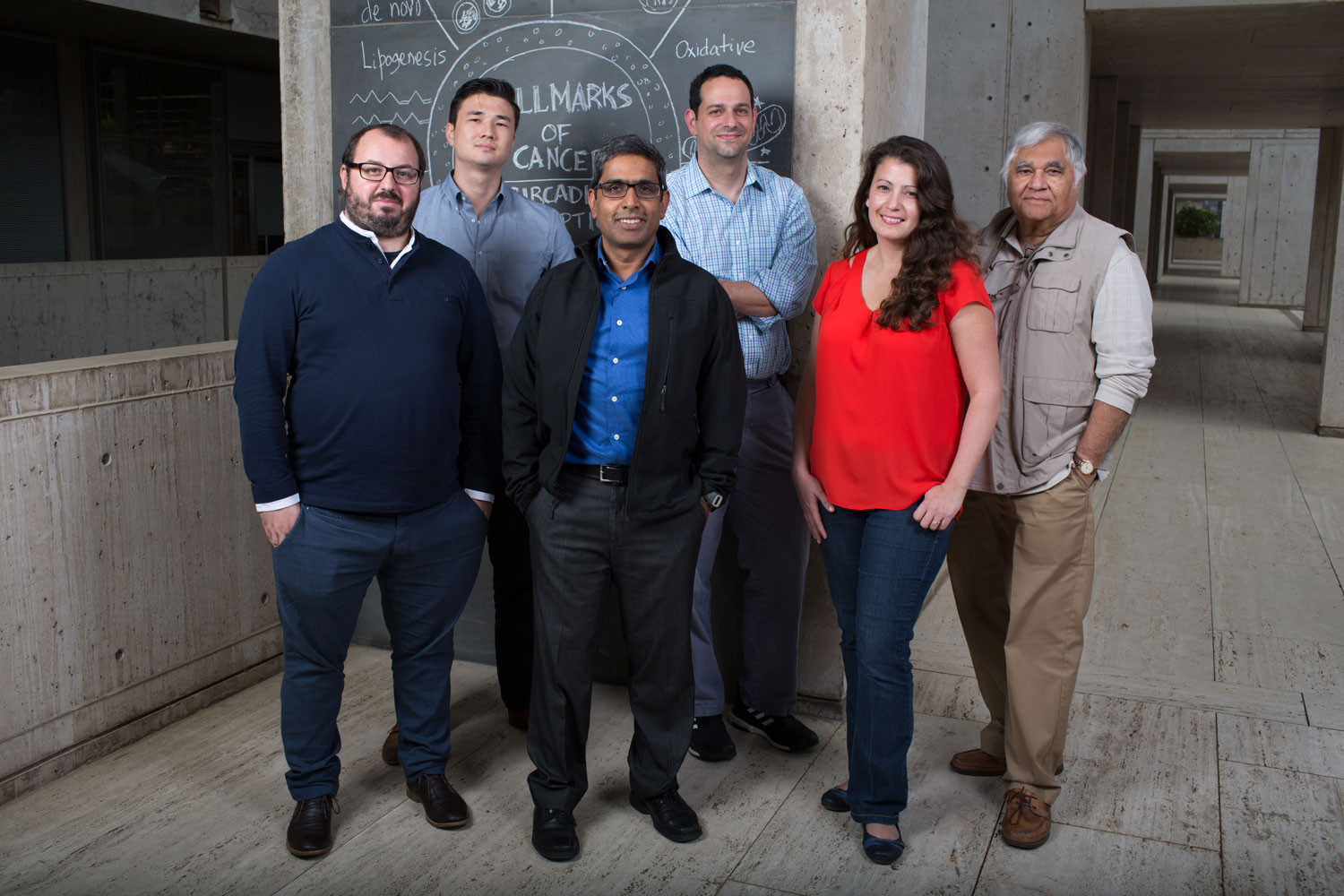
“When we block access to these resources, cancer cells starve to death but normal cells are already used to this constraint so they’re not affected,” says 萨奇达南达·潘达, a professor in the Salk Institute’s Regulatory Biology Laboratory and lead author of the paper.
The circadian cycle, the intrinsic clock that exists in all living things, is known to help control when individual cells produce and use nutrients, among many other functions. Scientists previously discovered that proteins known as REV-ERBα and REV-ERBβ are responsible for turning on and off cells’ ability to synthesize fats, as well as their ability to recycle materials—a process called autophagy—throughout the day. In healthy cells, fat synthesis and autophagy are allowed to occur for about 12 hours a day when REV-ERB protein levels remain low. The rest of the time, higher levels of the REV-ERB proteins block the processes so that the cells are not flooded with excessive fat synthesis and recycled nutrients. In the past, researchers developed compounds to activate REV-ERBs in the hopes of stopping fat synthesis to treat certain metabolic diseases.
点击此处 用于高分辨率图像。.
版权:萨克研究所
Panda and his colleagues wondered whether activating REV-ERBs would slow cancer growth, since cancer cells heavily rely on the products of both fat synthesis and autophagy to grow.
“While current cancer research was investigating established cancer hallmarks/characteristic we decided to explore something completely new,” says Research Associate Gabriele Sulli, the paper’s first and co-corresponding author. “Given the importance of the circadian clock in the regulation of many cellular and physiological processes we hypothesize that targeting the circadian clock with drugs may open the way to novel anticancer strategies. This study is very exciting because it sheds light on a new uncharacterized way to treat cancer with very limited toxicity.”
Adds Panda, “We’ve always thought about ways to stop cancer cells from dividing. But once they divide, they also have to grow before they can divide again, and to grow they need all these raw materials that are normally in short supply. So cancer cells devise strategies to escape the daily constraints of the circadian clock.”
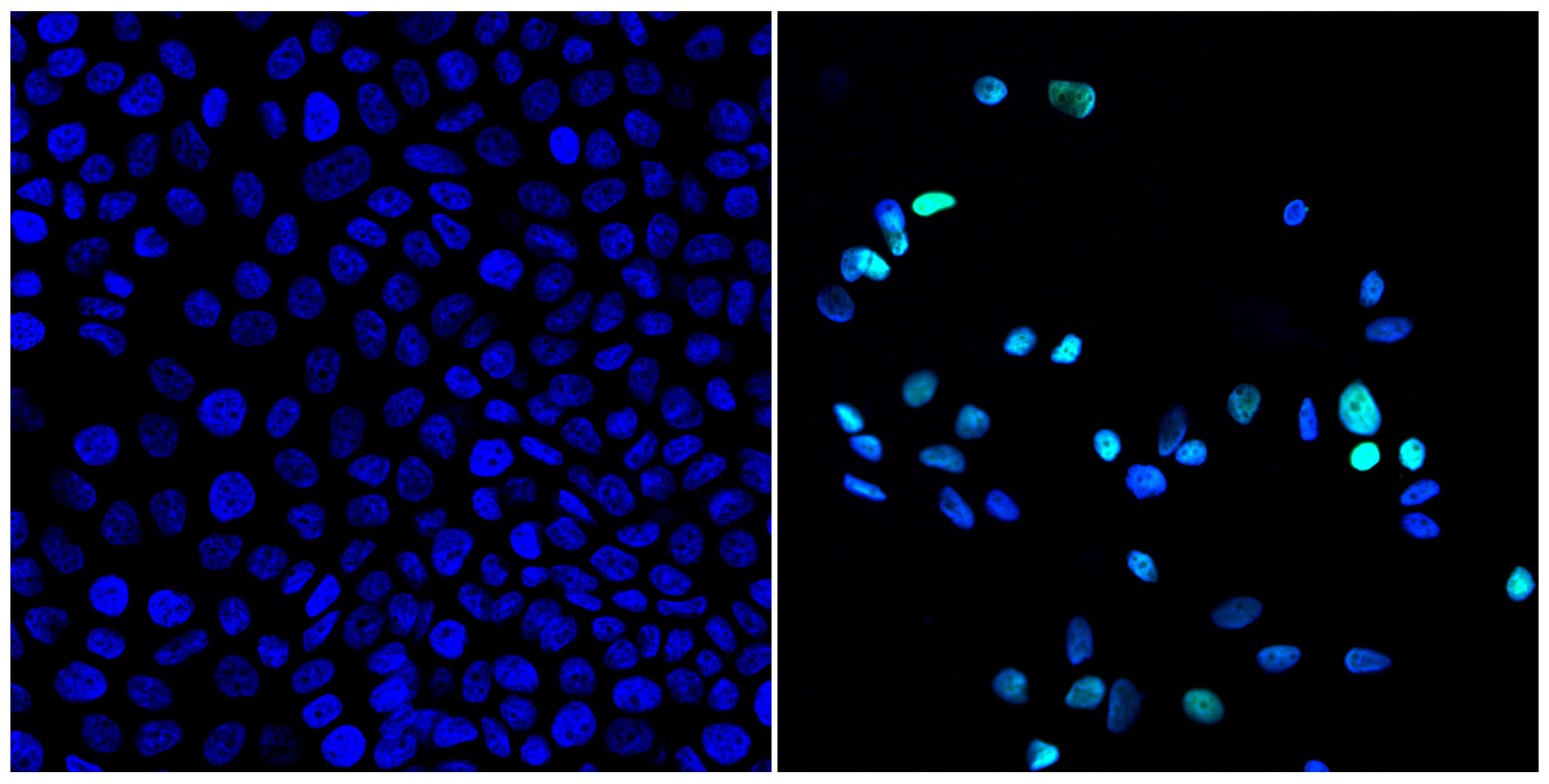
Although cancer cells contain REV-ERB proteins, somehow they remain inactive. Panda’s team used two REV-ERB activators that had already been developed—SR9009 and SR9011—in studies on a variety of cancer cells, including those from T cell leukemia, breast cancer, colorectal cancer, melanoma and glioblastoma. In each cell line, treatment with the REV-ERB activators was enough to kill the cells. The same treatment on healthy cells had no effect. “Activating REV-ERBs seemed to work in all the types of cancer we tried,” says Panda. “That makes sense because irrespective of where or how a cancer started, all cancer cells need more nutrients and more recycled materials to build new cells.”
点击此处 用于高分辨率图像
版权:萨克研究所
Panda then went on to test the drugs on a new mouse model of glioblastoma recently developed by 英德·维尔马, a professor in the Salk Institute’s Laboratory of Genetics. Once again, the REV-ERB activators were successful at killing cancer cells and stopping tumor growth but seemed not to affect the rest of the mice’s cells. Verma says the findings are not only exciting because they point toward existing REV-ERB activators as potential cancer drugs, but also because they help shine light on the importance of the link between the circadian cycle, metabolism and cancer.
“These are all fundamental elements required by all living cells,” says Verma. “By affecting REV-ERBs, you get to the heart of how cells grow and proliferate, but there are lots of other ways to get at this as well.”
Verma says his group is planning follow-up studies on how, exactly, the REV-ERB activators alter metabolism, as well as whether they may affect the metabolism of bacteria in the microbiome, the collection of microbes that live in the gut. Panda’s team is hoping to study the role of other circadian cycle genes and proteins in cancer.
Panda, Verma and coauthor 艾伦·萨加特利安, also a Salk professor, are all members of the Salk Cancer Center, a National Cancer Institute–designated basic research cancer center.
Other researchers on the study were Amy Rommel and Matthew J. Kolar of the Salk Institute; Xiaojie Wang and Maksim V. Plikus of the University of California, Irvine; and Francesca Puca of The University of Texas MD Anderson Cancer Center.
The work and the researchers involved were supported by grants from Worldwide Cancer Research, the National Institutes of Health, the Pew Charitable Trust, the National Cancer Institute, the American Federation of Aging Research, the H. N. and Frances C. Berger Foundation, the Glenn Center for Aging Research, The Leona M. and Harry B. Helmsley Charitable Trust, the Istituto Superiore di Sanità and AIRC Associazione Italiana per la Ricerca sul Cancro.
日记
自然
作者
Gabriele Sulli, Amy Rommel, Xiaojie Wang, Matthew J. Kolar, Francesca Puca, Alan Saghatelian, Maksim V. Plikus, Inder M. Verma, Satchidananda Panda
宣传办公室
电话:(858) 453-4100
press@salk.edu
萨尔克研究所是一个独立的非营利性研究机构,由首个安全有效的脊髓灰质炎疫苗的研发者乔纳斯·索尔克于1960年创立。该研究所的使命是推动以合作、敢于冒险为特点的基础性研究,以应对癌症、阿尔茨海默病和农业脆弱性等社会最紧迫的挑战。这项基础科学支撑着所有的转化研究,产生有助于全球新药和创新的见解。.