January 4, 2022
New molecular pathway controls blood glucose, circumventing insulin resistance
New molecular pathway controls blood glucose, circumventing insulin resistance
LA JOLLA—The discovery of insulin 100 years ago opened a door that would lead to life and hope for millions of people with diabetes. Ever since then, insulin, produced in the pancreas, has been considered the primary means of treating conditions characterized by high blood sugar (glucose), such as diabetes. Now, Salk scientists have discovered a second molecule, produced in fat tissue, that, like insulin, also potently and rapidly regulates blood glucose. Their finding could lead to the development of new therapies for treating diabetes, and also lays the foundation for promising new avenues in metabolism research.
The study, which was published in 细胞代谢 on January 4, 2022, shows that a hormone called FGF1 regulates blood glucose by inhibiting fat breakdown (lipolysis). Like insulin, FGF1 controls blood glucose by inhibiting lipolysis, but the two hormones do so in different ways. Importantly, this difference could enable FGF1 to be used to safely and successfully lower blood glucose in people who suffer from insulin resistance.

“Finding a second hormone that suppresses lipolysis and lowers glucose is a scientific breakthrough,” says co-senior author and Professor 罗纳德·埃文斯, holder of the March of Dimes Chair in Molecular and Developmental Biology. “We have identified a new player in regulating fat lipolysis that will help us understand how energy stores are managed in the body.”
When we eat, energy-rich fats and glucose enter the bloodstream. Insulin normally shuttles these nutrients to cells in muscles and fat tissue, where they are either used immediately or stored for later use. In people with insulin resistance, glucose is not efficiently removed from the blood, and higher lipolysis increases the fatty acid levels. These extra fatty acids accelerate glucose production from the liver, compounding the already high glucose levels. Moreover, fatty acids accumulate in organs, exacerbating the insulin resistance—characteristics of diabetes and obesity.
Previously, the lab showed that injecting FGF1 dramatically lowered blood glucose in mice and that chronic FGF1 treatment relieved insulin resistance. But how it worked remained a mystery.
In the current work, the team investigated the mechanisms behind these phenomena and how they were linked. First, they showed that FGF1 suppresses lipolysis, as insulin does. Then they showed that FGF1 regulates the production of glucose in the liver, as insulin does. These similarities led the group to wonder if FGF1 and insulin use the same signaling (communication) pathways to regulate blood glucose.
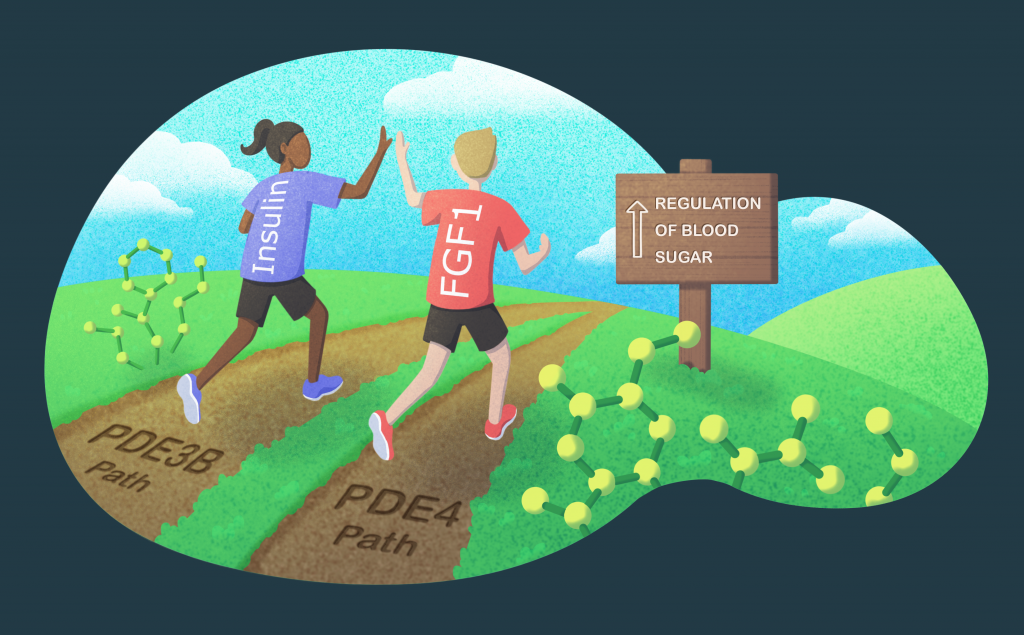
It was already known that insulin suppresses lipolysis through PDE3B, an enzyme that initiates a signaling pathway, so the team tested a full array of similar enzymes, with PDE3B at the top of their list. They were surprised to find that FGF1 uses a different pathway—PDE4.

“This mechanism is basically a second loop, with all the advantages of a parallel pathway. In insulin resistance, insulin signaling is impaired. However, with a different signaling cascade, if one is not working, the other can. That way you still have the control of lipolysis and blood glucose regulation,” says first author Gencer Sancar, a postdoctoral researcher in the Evans lab.
Finding the PDE4 pathway opens new opportunities for drug discovery and basic research focused on high blood glucose (hyperglycemia) and insulin resistance. The scientists are eager to investigate the possibility of modifying FGF1 to improve PDE4 activity. Another route is targeting multiple points in the signaling pathway before PDE4 is activated.
“The unique ability of FGF1 to induce sustained glucose lowering in insulin-resistant diabetic mice is a promising therapeutic route for diabetic patients. We hope that understanding this pathway will lead to better treatments for diabetic patients,” says co-senior author Michael Downes, a senior staff scientist in the Evans lab. “Now that we’ve got a new pathway, we can figure out its role in energy homeostasis in the body and how to manipulate it.”
Other authors included Sihao Liu, Emanuel Gasser, Jacqueline G. Alvarez, Christopher Moutos, Kyeongkyu Kim, Yuhao Wang, Timothy F. Huddy, Brittany Ross, Yang Dai, David Zepeda, Brett Collins, Emma Tilley, Matthew J. Kolar, Ruth T. Yu, Annette R. Atkins and Alan Saghatelian of Salk; Tim van Zutphen, Theo H. van Dijk and Johan W. Jonker of the University of Groningen, in the Netherlands.
The research was supported by the National Institutes of Health, the Nomis Foundation, the March of Dimes, Deutsche Forschungsgemeinschaft (DFG), Netherlands Organization for Scientific Research, the European Foundation for the Study of Diabetes and the Swiss National Science Foundation.
日记
细胞代谢
作者
Gencer Sancar, Sihao Liu, Emanuel Gasser, Jacqueline G. Alvarez, Christopher Moutos, Kyeongkyu Kim, Tim van Zutphen, Yuhao Wang, Timothy F. Huddy, Brittany Ross, Yang Dai, David Zepeda, Brett Collins, Emma Tilley, Matthew J. Kolar, Ruth T. Yu, Annette R. Atkins, Theo H. van Dijk, Alan Saghatelian, Johan W. Jonker, Michael Downes and Ronald M. Evans
宣传办公室
电话:(858) 453-4100
press@salk.edu
萨尔克研究所是一个独立的非营利性研究机构,由首个安全有效的脊髓灰质炎疫苗的研发者乔纳斯·索尔克于1960年创立。该研究所的使命是推动以合作、敢于冒险为特点的基础性研究,以应对癌症、阿尔茨海默病和农业脆弱性等社会最紧迫的挑战。这项基础科学支撑着所有的转化研究,产生有助于全球新药和创新的见解。.