September 6, 2017
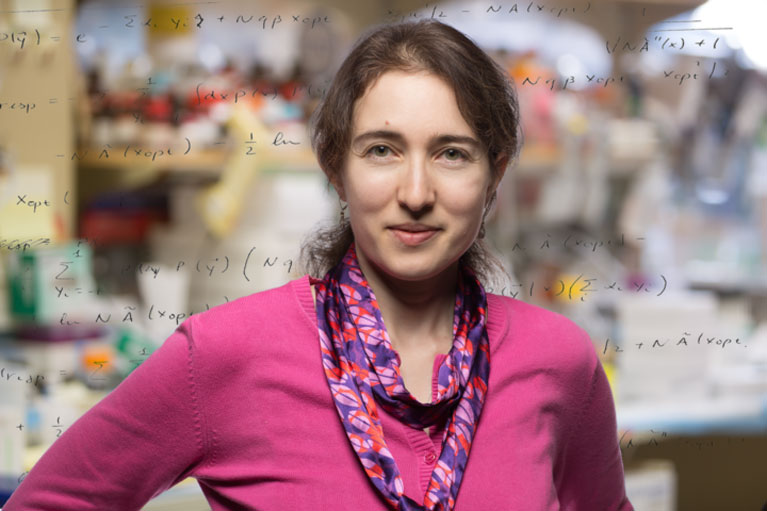
拉霍亚—索尔克副教授 塔季扬娜·沙尔佩 has been awarded a grant of approximately $950,000 over 4 years by the National Science Foundation to study how the brain processes complex sounds. This grant is part of a multi-national project together with groups in France and Israel.
点击此处 用于高分辨率图像
版权:萨克研究所
“Tatyana’s computational approach and modeling is at the cutting edge of neurobiology research,” says Salk President 伊丽莎白·布莱克本. “This award will allow her to continue to make important discoveries about how the brain processes sounds and test theories about how different types of neurons work together. Such work could inform better ways to treat hearing loss or improve speech-recognition technologies.”
Sharpee, who is a member of Salk’s Computational Neurobiology Laboratory, seeks to develop a unifying theory of “biological control” to understand the universal principles of behavior. Specifically, she is uncovering how animals sense and adapt to their environment as well as make predictions and decisions. To do this, she applies mathematical strategies—like statistics and probability models—to chart the principles by which the brain’s billions of neurons exchange energy and information.
“This grant represents a tremendous opportunity to solve the mysteries of auditory processing by combining electrical recordings from the brain, simulations of large scale neural circuits, and statistical analysis of both model and real responses to understand how different types of neurons in the auditory cortex represent naturalistic sounds,” says Sharpee. “I could not be more excited about it.”
The grant brings together three groups, one experimental and two computational, to develop models based on known properties of neural networks to describe how different types of neurons cooperate to represent sounds. In addition to deepening our understanding of auditory perception, the researchers from Salk, Hebrew University in Jerusalem and Paris–Descartes University hope to gain insights into general principles of cooperation between neurons within a single neural network.
“The work Dr. Sharpee and her colleagues are doing is really exciting and difficult,” says Kenneth Whang, NSF program manager, Information & Intelligent Systems division in the directorate for Computer & Information Science & Engineering. “They are bringing together computational models of what a brain network can accomplish with the mechanisms underlying those processes. This is critically important for understanding how large numbers of neurons work together to power our perceptions and other cognitive functions.”
The research has implications for understanding representation of signals in other senses (vision, touch) as well as the general principles of neural coding in the brain, and offers a number of potential practical applications, including the design of improved hearing aids and artificial speech recognition systems.
Additionally, because an altered balance between types of neurons has been implicated in a number of attention deficits and psychiatric disorders, including autism and schizophrenia, the project could also reveal new ways of treating those diseases.
The grant also includes an outreach component that will involve music and speech perception demonstrations for K–12 students and exhibitions.
宣传办公室
电话:(858) 453-4100
press@salk.edu
萨尔克研究所是一个独立的非营利性研究机构,由首个安全有效的脊髓灰质炎疫苗的研发者乔纳斯·索尔克于1960年创立。该研究所的使命是推动以合作、敢于冒险为特点的基础性研究,以应对癌症、阿尔茨海默病和农业脆弱性等社会最紧迫的挑战。这项基础科学支撑着所有的转化研究,产生有助于全球新药和创新的见解。.