2014 年 12 月 4 日
Findings could lead to new therapeutics for disorders such as fibromyalgia and phantom limb pain
Findings could lead to new therapeutics for disorders such as fibromyalgia and phantom limb pain
LA JOLLA–Pain typically has a clear cause–but not always. When a person touches something hot or bumps into a sharp object, it’s no surprise that it hurts. But for people with certain chronic pain disorders, including fibromyalgia and phantom limb pain, a gentle caress can result in agony.
In a major breakthrough, a team led by researchers at the Salk Institute and Harvard Medical School have identified an important neural mechanism in the spinal cord that appears to be capable of sending erroneous pain signals to the brain.
By charting the spinal circuits that process and transmit pain signals in mice, the study, published online November 20, 2014 in 细胞, lays the groundwork for identifying ways to treat pain disorders that have no clear physical cause.
“Until now, the spinal cord circuitry involved in processing pain has remained a black box,” says Martyn Goulding, Salk professor in the 分子神经生物学实验室 and a co-senior author of the paper. “Identifying the neurons that make up these circuits is the first step in understanding how chronic pain stems from dysfunctional neural processing.”
In many instances, people who suffer from chronic pain are sensitive to stimuli that don’t normally cause pain, such as a light touch to the hand or a subtle change in skin temperature. These conditions, referred to generally as forms of allodynia, include fibromyalgia and nerve damage that is caused by diseases such as 糖尿病, 癌症 and autoimmune disorders.
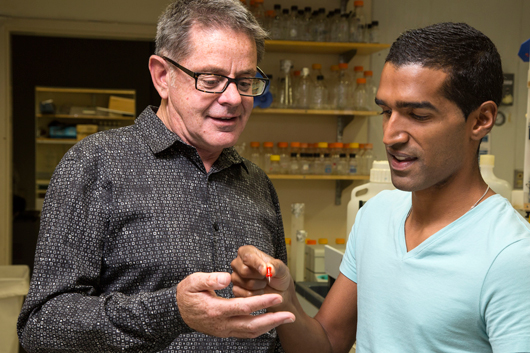
Salk Professor Martyn Goulding and Jovanny Bourane, Salk research associate
点击此处 用于高分辨率图像。.
图片:由萨克生物研究所提供
In other instances, the mysterious pain arises after amputation of a limb, which often leads to discomfort that seems to be centered on the missing appendage. These sensations often subside in the months following the amputation, but may linger indefinitely, causing long-term chronic pain for the sufferer.
“These disorders are extremely frustrating for patients, because there is still no effective treatment for such chronic pain disorders,” says Qiufu Ma, a professor of neurobiology at Harvard Medical School and co-senior author on the paper.
Scientists have long theorized that pain signals are sent from sensory neurons in the limbs and other extremities to transmission neurons in the spinal cord, which then relay the information to the brain. At each of these three steps–extremities, spinal cord and brain–the pain information can be altered or even blocked before being relayed onward through the nervous system to the brain. The circuitry in the spinal cord is particularly important, as it is able to gate painful stimuli, thereby acting as a checkpoint between the body and the brain to make sure that only the most important pain signals are transmitted.
Previous studies had determined that two types of sensory neurons appeared to be involved in these circuits: pain receptors and touch receptors.
In their new study, the Salk and Harvard researchers set out to precisely identify the spinal neurons involved in these circuits. They deciphered the role each of two neuronal cell types play in the processing of pain signals in the dorsal horn, the location where the sensory neurons connect with the spinal cord.
The scientists discovered that a class of mechanoreceptors in the skin that detect painful mechanical stimuli are part of a feedback circuit in which excitatory neurons that produce the hormone somatostatin are inhibited by neurons that synthesize dynorphin (a natural analgesic molecule that produces effects similar to opiates).
The inhibitory neurons they identified appear to control whether touch activates the excitatory neurons to send a pain signal to the brain.
This finding begins to explain how a light touch can cause discomfort in someone with allodynia: if something is awry in the pain circuitry, then the sensations of touch that normally travels through the mechanoreceptors could instead activate other neurons that trigger a pain signal. Similarly, mechanoreceptor fibers that project to the spinal cord from a missing limb might spur erroneous pain signals.
“Normally, only pain receptors are involved in sending pain signals to the brain, but when the spinal dynorphin inhibitory neurons are lost, touch sensation are now perceived as painful,” says Goulding, holder of Salk’s Frederick W. and Joanna J. Mitchell Chair. “This really opens the door to understanding what’s happening in these pain disorders where the cause of the pain is seemingly innocuous or not known. It could be that something has gone awry in how this spinal circuitry is operating, so sensations become jumbled together and emerge as pain.”
Other researchers on the paper include Bo Duan, Longzhen Cheng, Xiangyu Ren, Michael Krashes, Wendy Knowlton and Bradford B. Lowell of Harvard Medical School; Steeve Bourane, Olivier Britz, Christopher Padilla, Lidia Garcia-Campmany and Tomoko Velasquez of Salk Institute; Sarah E. Ross of University of Pittsburgh; and Yun Wang of Fudan University, China.
该研究得到了 美国国立卫生研究院 和 Natural Science Foundation of China.
关于索尔克生物研究所:
索尔克生物学研究所是世界上首屈一指的基础研究机构之一,其国际知名的教职员工在一个独特的、协作和创新的环境中,深入探索生命科学的基本问题。索尔克科学家既注重科学发现,也注重培养下一代研究人员,通过研究神经科学、遗传学、细胞生物学、植物生物学及相关学科,为我们理解癌症、衰老、阿尔茨海默病、糖尿病和传染病做出了开创性的贡献。.
教职员工的成就获得了无数荣誉,包括诺贝尔奖和美国国家科学院院士资格。该研究所由脊髓灰质炎疫苗先驱 Jonas Salk 医生于 1960 年创立,是一家独立的非营利组织和建筑地标。.
日记
细胞
作者
Bo Duan, Longzhen Cheng, Steeve Bourane, Olivier Britz, Christopher Padilla, Lidia Garcia-Campmany, Michael Krashes, Wendy Knowlton, Tomoko Velasquez, Xiangyu Ren, Sarah E. Ross, Bradford B. Lowell, Yun Wang, Martyn Goulding, Qiufu Ma
宣传办公室
电话:(858) 453-4100
press@salk.edu