2017年8月30日
Overactive protein synthesis found in premature aging disease may also play role in normal aging
Overactive protein synthesis found in premature aging disease may also play role in normal aging
LA JOLLA—It may seem paradoxical, but studying what goes wrong in rare diseases can provide useful insights into normal health. Researchers probing the premature aging disorder Hutchinson-Gilford progeria have uncovered an errant protein process in the disease that could help healthy people as well as progeria sufferers live longer.
Scientists at the Salk Institute found that protein synthesis is overactive in people with progeria. The work, described in Nature Communications on August 30, 2017, adds to a growing body of evidence that reducing protein synthesis can extend lifespan—and thus may offer a useful therapeutic target to counter both premature and normal aging.
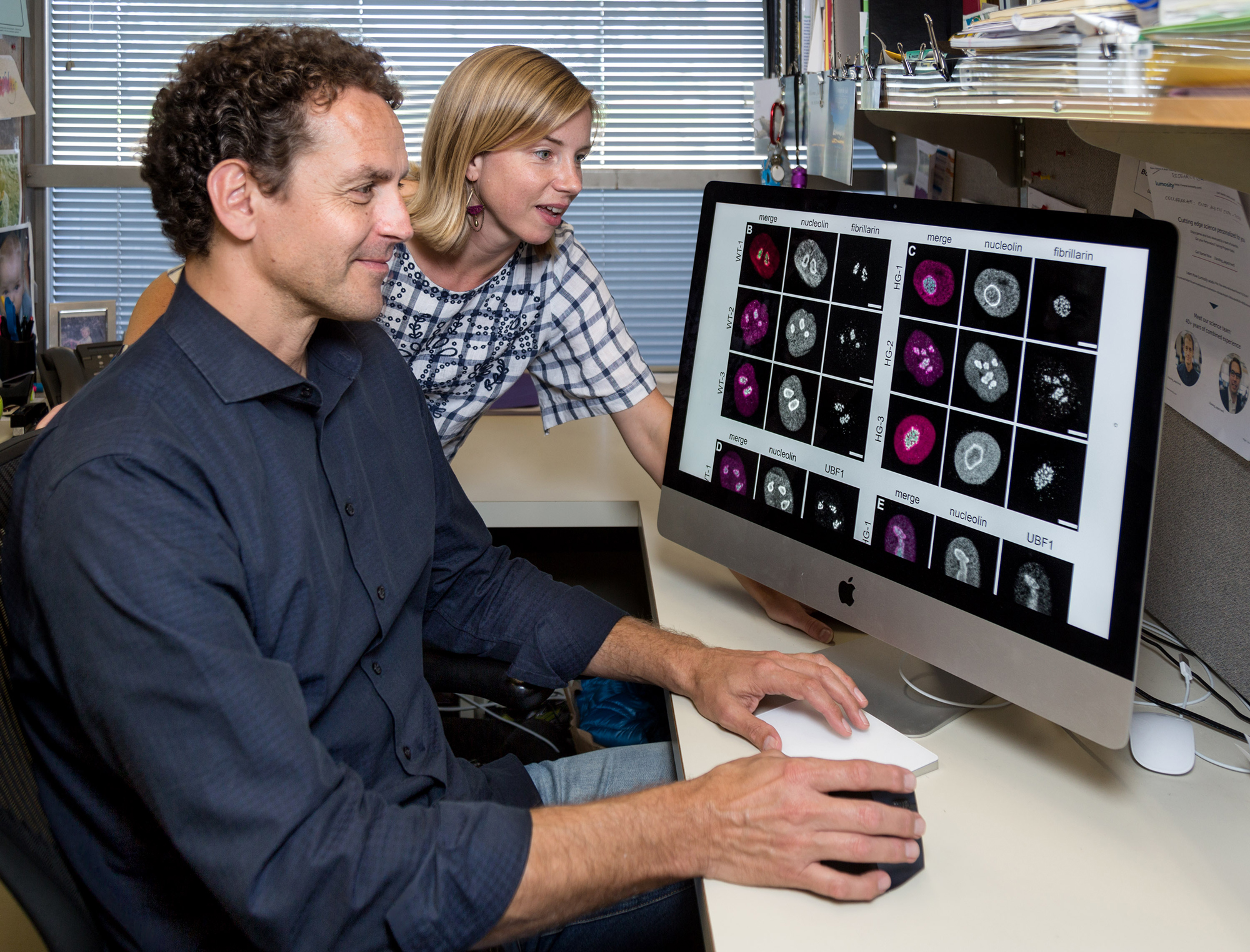
“The production of proteins is an extremely energy-intensive process for cells,” says 马丁·赫策尔, vice president and chief science officer of the Salk Institute and senior author of the paper. “When a cell devotes valuable resources to producing protein, other important functions may be neglected. Our work suggests that one driver of both abnormal and normal aging could be accelerated protein turnover.”
点击此处 用于高分辨率图像。.
版权:萨克研究所
Hutchinson-Gilford progeria is a very rare genetic disease causing people to age 8 to 10 times faster than the rest of us and leading to an early death. The rare mutation occurs in one of the structural proteins in the cell nucleus, lamin A, but it has been unclear how a single defective protein in the nucleus causes the myriad rapid-aging features seen in the disease.
Initially, Salk Staff Scientist Abigail Buchwalter, first author of the paper, was interested in whether the mutation was making the lamin A protein less stable and shorter lived. After measuring protein turnover in cultured cells from skin biopsies of both progeria sufferers and healthy people, she found that it wasn’t just lamin A that was affected in the disease.
“We analyzed all the proteins of the nucleus and instead of seeing rapid turnover in just mutant lamin A and maybe a few proteins associated with it, we saw a really broad shift in overall protein stability in the progeria cells,” says Buchwalter. “This indicated a change in protein metabolism that we hadn’t expected.”
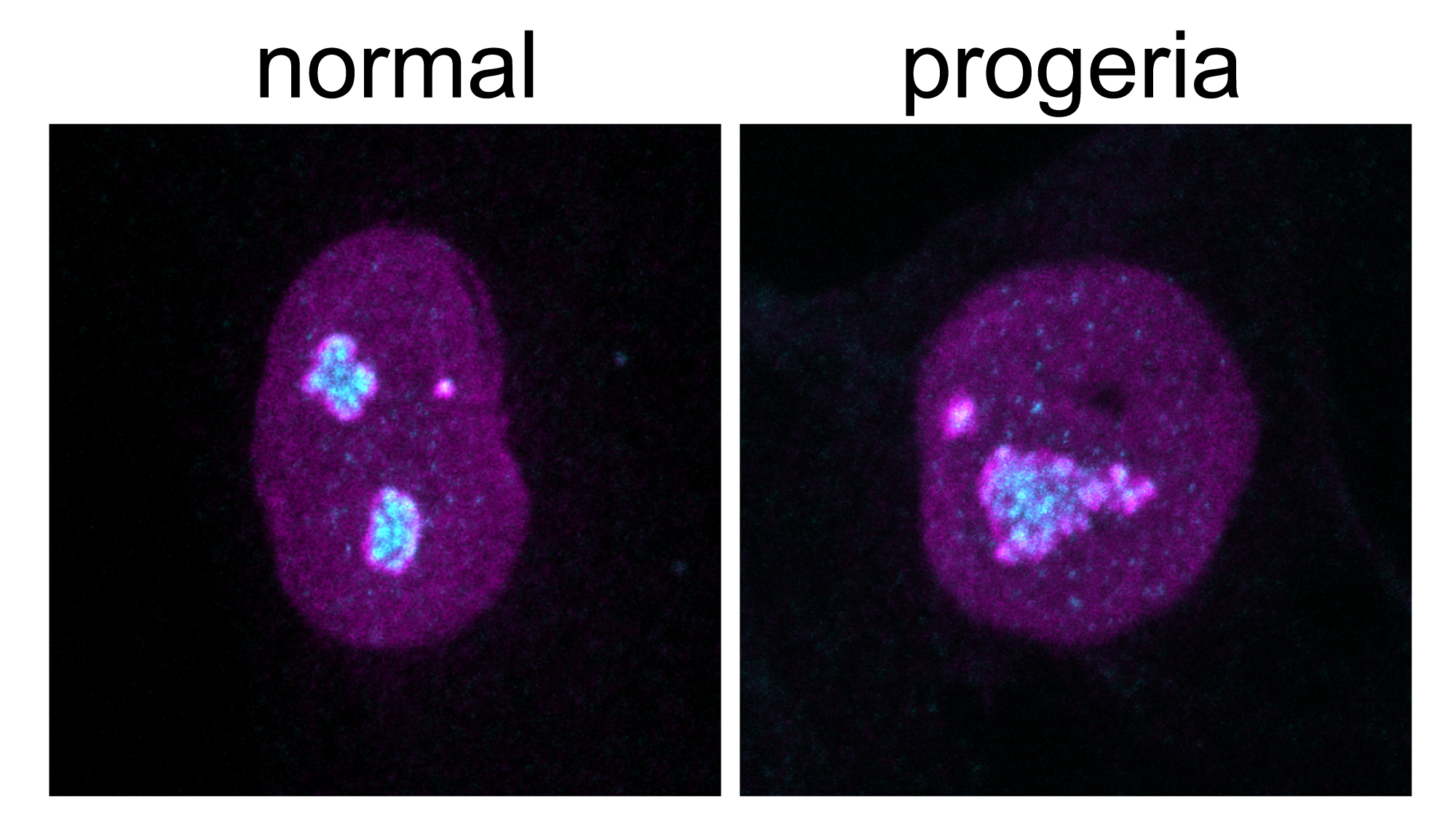
Along with the rapid turnover of proteins, the team found that the nucleolus, which makes protein-assembling structures called ribosomes, was enlarged in the prematurely aging cells compared to healthy cells.
点击此处 用于高分辨率图像
版权:萨克研究所
Even more intriguing, the team found that nucleolus size increased with age in the healthy cells, suggesting that the size of the nucleolus could not only be a useful biomarker of aging, but potentially a target of therapies to counter both premature and normal aging.
The work supports other research that appears in the same issue showing that decreasing protein synthesis extends lifespan in roundworms and mice. The Hetzer lab plans to continue studying how nucleolus size may serve as a reliable biomarker for aging.
“We always assume that aging is a linear process, but we don’t know that for sure,” says Hetzer, who also holds the Jesse and Caryl Philips Foundation Chair. “A biomarker such as this that tracks aging would be very useful, and could open up new ways of studying and understanding aging in humans.”
这项工作由...资助 美国国立卫生研究院, , 那个 Nomis Foundation, ,和 Glenn Center for Aging Research.
日记
Nature Communications
作者
Abigail Buchwalter and Martin W. Hetzer
宣传办公室
电话:(858) 453-4100
press@salk.edu
萨尔克研究所是一个独立的非营利性研究机构,由首个安全有效的脊髓灰质炎疫苗的研发者乔纳斯·索尔克于1960年创立。该研究所的使命是推动以合作、敢于冒险为特点的基础性研究,以应对癌症、阿尔茨海默病和农业脆弱性等社会最紧迫的挑战。这项基础科学支撑着所有的转化研究,产生有助于全球新药和创新的见解。.