July 11, 2023
Salk scientists discover dopamine regulates worm egg-laying and food-seeking behaviors in response to predation
Salk scientists discover dopamine regulates worm egg-laying and food-seeking behaviors in response to predation
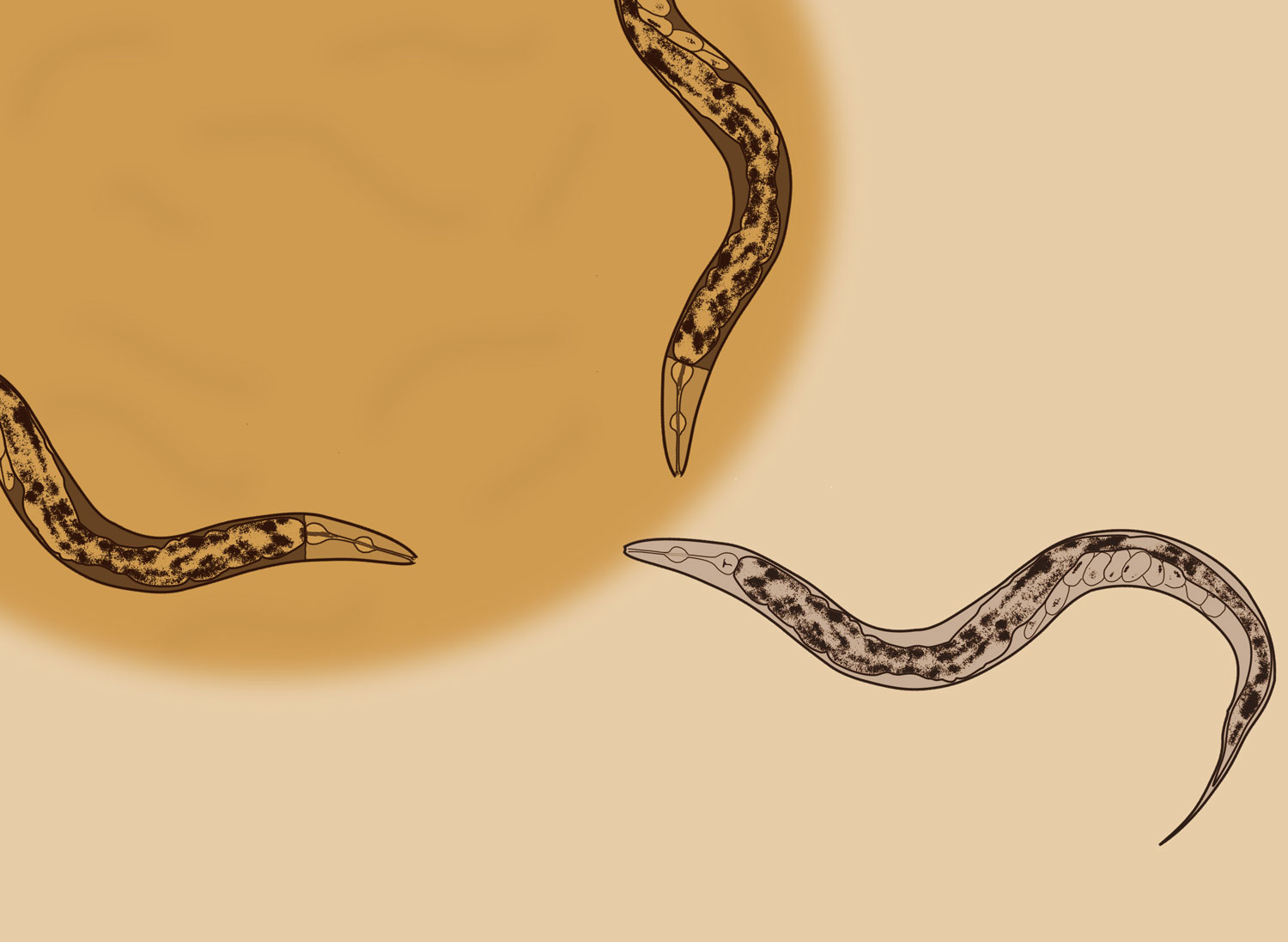
LA JOLLA—The life of the tiny worm called Caenorhabditis elegans consists mostly of looking for food, eating food, and laying eggs. So, when any of these behaviors are disrupted, there’s cause for concern. In a new study, Salk Institute scientists discovered that the “feel good” brain chemical dopamine regulates anxious worm behavior in the presence of nipping predators.
研究发现,发表于 eLife on July 11, 2023, illuminate how this dopamine-regulated brain pathway may be related to anxiety and could provide insight into human conditions, such as post-traumatic stress disorder (PTSD).
“Worms are a wonderful model for studying anxiety because the cause of their anxiety is typically known, like predation,” says Professor 斯里坎特·查拉萨尼, senior author of the new work. “Thus, we can use worms to better understand fundamental neural pathways related to anxiety and stress responses that could be conserved across species.”
In this study, the researchers observed what happened when a predator worm species (Pristionchus pacificus) nipped at the worms, discouraging the worms from eating the food source. In response, the worms moved away from the food source, and the predators were able to eat more. Additionally, the worms also laid their eggs away from the old food source and the threat of predation.
The researchers noticed that the worms would stay away even after the predators had left—indicating the worms were learning that it was safer to stay away. Furthermore, the behavior of laying the eggs far away from predators was regulated by dopamine. But when the researchers blocked dopamine pathways in the worms, they did not avoid predators as frequently to lay their eggs.
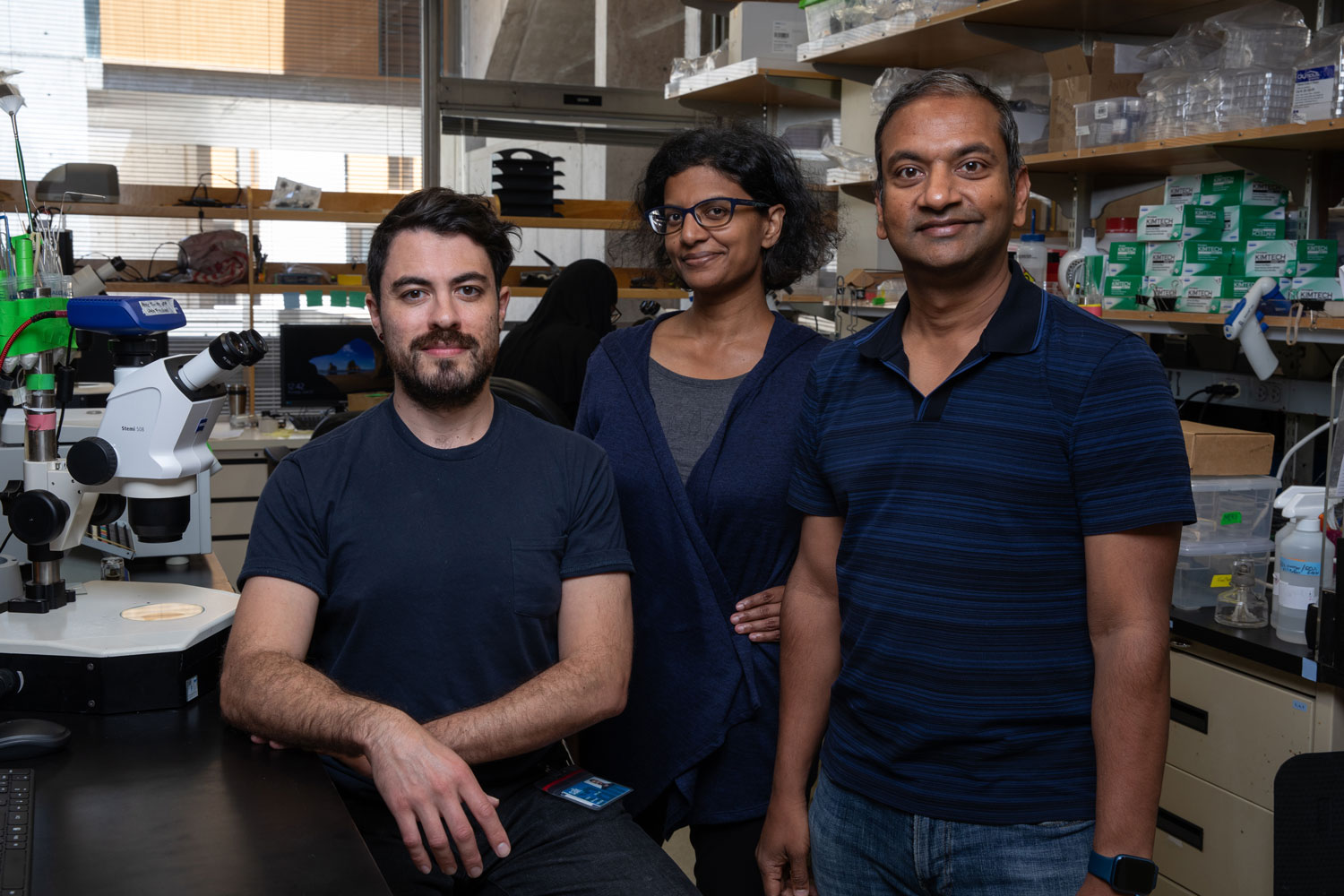
“To understand how the brain works, it is important to study it in its natural context,” says co-first author Amy Pribadi, a former graduate student researcher in Chalasani’s lab. “To do that, we can use a simple worm with an easily constructed natural environment, then look at how that worm’s brain networks and molecules modulate behavior in that ‘natural’ environment.”
Additionally, the researchers explored how the presence of smaller patches of food away from the main food source impacted worm-predator interactions. While predators were busy monopolizing a main food source, the presence of alternate (albeit smaller) food sources elsewhere made the worms more likely to avoid predators.

“Worms make decisions based on environmental changes similar to more complex animals and humans,” says co-first author Michael Rieger, a postdoctoral researcher in Chalasani’s lab. “Difficulty adapting to change—especially due to threat or stress—is common in humans, especially those with neurological disorders. Our research in this simple organism reveals new avenues for exploring the neuroscience of decision-making, which we hope can generalize all the way up the food chain to humans.”
In the future, the team will examine the role of another brain chemical called serotonin in this evasive behavior, since serotonin is known to regulate other dopamine-dependent behaviors, like searching for food. They also hope their study serves as a springboard for future inquiry into the impact of other brain signaling pathways that influence feeding, reproduction, and other behaviors.
“By looking at worms, you capture so much intricate biology in an animal that has evolved over billions of years,” says Chalasani. “Any insight—even in worms—into the mechanisms of predator-prey behaviors enriches our understanding of so many other phenomena that exhibit this biological push-pull relationship, like the co-evolution of animals and their environment or the delicate balance of chemical conversations between cells.”
Other authors include Kaila Rosales and Kirthi C. Reddy of Salk.
The work was supported by a National Science Foundation Graduate Research Fellowship, an Innovation Grant from Kavli Institute of Brain and Mind, and the National Institutes of Health (R01 MH113905).
DOI: https://doi.org/10.7554/eLife.83957
日记
eLife
标题
Dopamine signaling regulates predator-driven changes in Caenorhabditis elegans’ egg laying behavior
作者
Amy Pribadi, Michael A. Rieger, Kaila Rosales, Kirthi C. Reddy, and Sreekanth H. Chalasani
宣传办公室
电话:(858) 453-4100
press@salk.edu
萨尔克研究所是一个独立的非营利性研究机构,由首个安全有效的脊髓灰质炎疫苗的研发者乔纳斯·索尔克于1960年创立。该研究所的使命是推动以合作、敢于冒险为特点的基础性研究,以应对癌症、阿尔茨海默病和农业脆弱性等社会最紧迫的挑战。这项基础科学支撑着所有的转化研究,产生有助于全球新药和创新的见解。.