
May 20, 2011
LA JOLLA, CA—A multi-institutional team headed by Ursula Bellugi, professor and director of the Laboratory for Cognitive Neuroscience at the Salk Institute for Biological Studies, has been awarded a $5.5 million Program Project Grant by the National Institute of Child Health and Human Development (NICHD) to link social behavior to its underlying neurobiological and molecular genetic basis using Williams syndrome as a model.
“How the brain processes social information and integrates it with other forms of perception and learning is one of the major frontiers in neuroscience,” says Bellugi. “Using Williams syndrome as the basis for a new approach to social neuroscience is exciting and promising, in part because its genetic basis is clearly understood, and it is associated with a very specific pattern of cognitive strengths and weaknesses and some puzzling paradoxes.”
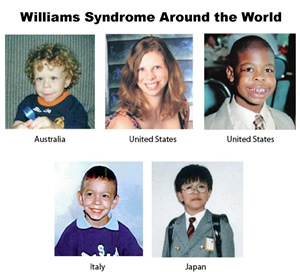
Although Williams syndrome is a clearly defined genetic disorder, the culture in which children grow up influences the expression their sociability.
Image: Courtesy of Dr. Ursula Bellugi, Salk Institute for Biological Studies and Carol Zitzer-Comfort, California State University in Long Beach.
Williams syndrome arises from a faulty recombination event during the development of sperm or egg cells. As a result, virtually everyone with Williams syndrome has exactly the same set of genes missing (25 to 28 genes are missing from one of two copies of chromosome 7). There also are rare cases of individuals who retain one or more genes that most people with the disorder have lost.
To children with Williams syndrome, people are much more comprehensible than inanimate objects. Despite myriad health problems and generally low IQs, they are extremely gregarious, irresistibly drawn to strangers, and insist on making eye contact. The children are confounded by the visual world around them, however: asked to draw a bicycle, they will show all the parts, but strew them randomly across the page. It is this strange mix of mental peaks and valleys that Bellugi and her collaborators hope will allow them to untangle the connections between genes and social behavior.
“Understanding the mechanisms and pathways underlying the organization of human social behavior is important in a wide variety of mental disorders,” says Bellugi. “By dissecting Williams syndrome, we hope to gain new insight into other neurodevelopmental disorders such as autism.”
The current grant is the latest chapter in a unique and exceptionally successful scientific alliance under the umbrella of a longstanding NICHD-funded Program Project, one of the first of its kind. Led by Bellugi, a team of researchers working in such disparate fields as social cognition, stem cell biology, neuronal architecture and neuroimaging are looking to Williams syndrome to provide clues to some of the mysteries of the genetic basis of social behavior.
Participating researchers:
索尔克生物研究所
Ursula Bellugi (Program Director)
弗雷德·盖奇
Terry Sejnowski
加州大学圣地亚哥分校
Katerina Semendefari
Alysson Muotri
Eric Halgren
University of Utah
Julie Korenberg
关于索尔克生物研究所:
索尔克生物研究所是世界顶尖的基础研究机构之一,其国际知名的教职人员在一个独特、协作和富有创造性的环境中,深入探究生命科学的基本问题。索尔克科学家们致力于发现和指导未来几代研究人员,通过研究神经科学、遗传学、细胞和植物生物学以及相关学科,在癌症、衰老、阿尔茨海默氏症、糖尿病和传染病的认识方面做出了开创性的贡献。.
学院取得了许多成就,获得了包括诺贝尔奖和美国国家科学院院士在内的无数荣誉。该研究所由脊髓灰质炎疫苗先驱 Jonas Salk 博士于 1960 年创立,是一家独立的非营利组织和建筑地标。.
宣传办公室
电话:(858) 453-4100
press@salk.edu




