2025年2月14日
Salk scientists discover SSRI Prozac regulates immune response and prevents sepsis in mice, demonstrating potential new use for the popular drug
Salk scientists discover SSRI Prozac regulates immune response and prevents sepsis in mice, demonstrating potential new use for the popular drug
LA JOLLA—Antidepressants like Prozac are commonly prescribed to treat mental health disorders, but new research suggests they could also protect against serious infections and life-threatening sepsis. Scientists at the Salk Institute have now uncovered how the drugs are able to regulate the immune system and defend against infectious disease—insights that could lead to a new generation of life-saving treatments and enhance global preparedness for future pandemics.
The Salk study follows recent findings that users of selective serotonin reuptake inhibitors (SSRIs) like Prozac had less severe COVID-19 infections and were less likely to develop long COVID. Another study found that Prozac—also known as fluoxetine—was effective in protecting mice against sepsis, a life-threatening condition in which the body’s immune system overreacts to an infection and can cause multi-organ failure or even death. By identifying a mechanism to explain fluoxetine’s surprising defense-boosting effects, Salk researchers have brought fluoxetine and potentially other SSRIs closer to clinical testing for use against infections and immune disorders.
研究结果发表在 科学进展 on February 14, 2025.
“When treating an infection, the optimal treatment strategy would be one that kills the bacteria or virus while also protecting our tissues and organs,” says Professor 贾内尔·艾尔斯, holder of the Salk Institute Legacy Chair and Howard Hughes Medical Institute Investigator. “Most medications we have in our toolbox kill pathogens, but we were thrilled to find that fluoxetine can protect tissues and organs, too. It’s essentially playing offense 和 defense, which is ideal, and especially exciting to see in a drug that we already know is safe to use in humans.”
While our immune systems do their best to protect us against infections, sometimes they can overreact. In sepsis, the inflammatory response spins so out of control that it starts damaging a person’s own tissues and organs to the point of failure. This same overreaction is also characteristic of severe COVID-19 illness.
An obvious solution would presumably be to suppress the inflammatory response, but doing so can actually make patients more vulnerable to their initial infection—and more susceptible to new ones. Timing is also critical, as immunosuppressive drugs need to be administered before any tissue damage has taken place.
Instead, an ideal treatment would 1) proactively control the intensity and duration of the immune response to prevent any bodily damage and 2) kill the infection that puts the body at risk to begin with.
To understand what SSRIs might be doing in this context, the researchers studied mice with bacterial infections and separated them into two categories: one pretreated with fluoxetine and the other not. Excitingly, they saw the mice pretreated with fluoxetine were protected from sepsis, multi-organ damage, and death. The team then launched a series of follow-up experiments to make sense of these effects.
First, they measured the number of bacteria in each mouse population eight hours after infection. Mice treated with fluoxetine had fewer bacteria at this stage, signifying a less severe infection. The findings demonstrated that fluoxetine had antimicrobial properties, which allowed it to limit bacterial growth.
Next, the researchers measured the levels of different inflammatory molecules in each group. They saw more anti-inflammatory IL-10 in their pretreated populations and deduced that IL-10 prevented sepsis-induced hypertriglyceridemia—a condition in which the blood contains too many fatty triglycerides. This enabled the heart to maintain the proper metabolic state, protecting the mice from infection-induced morbidity and mortality.
The team decoupled this IL-10-dependent protection from multi-organ damage and death from their earlier discovery of fluoxetine’s antimicrobial effects, in turn revealing the drug’s dual-purpose potential to 1) kill pathogens and 2) alleviate infection-induced damage to the body.
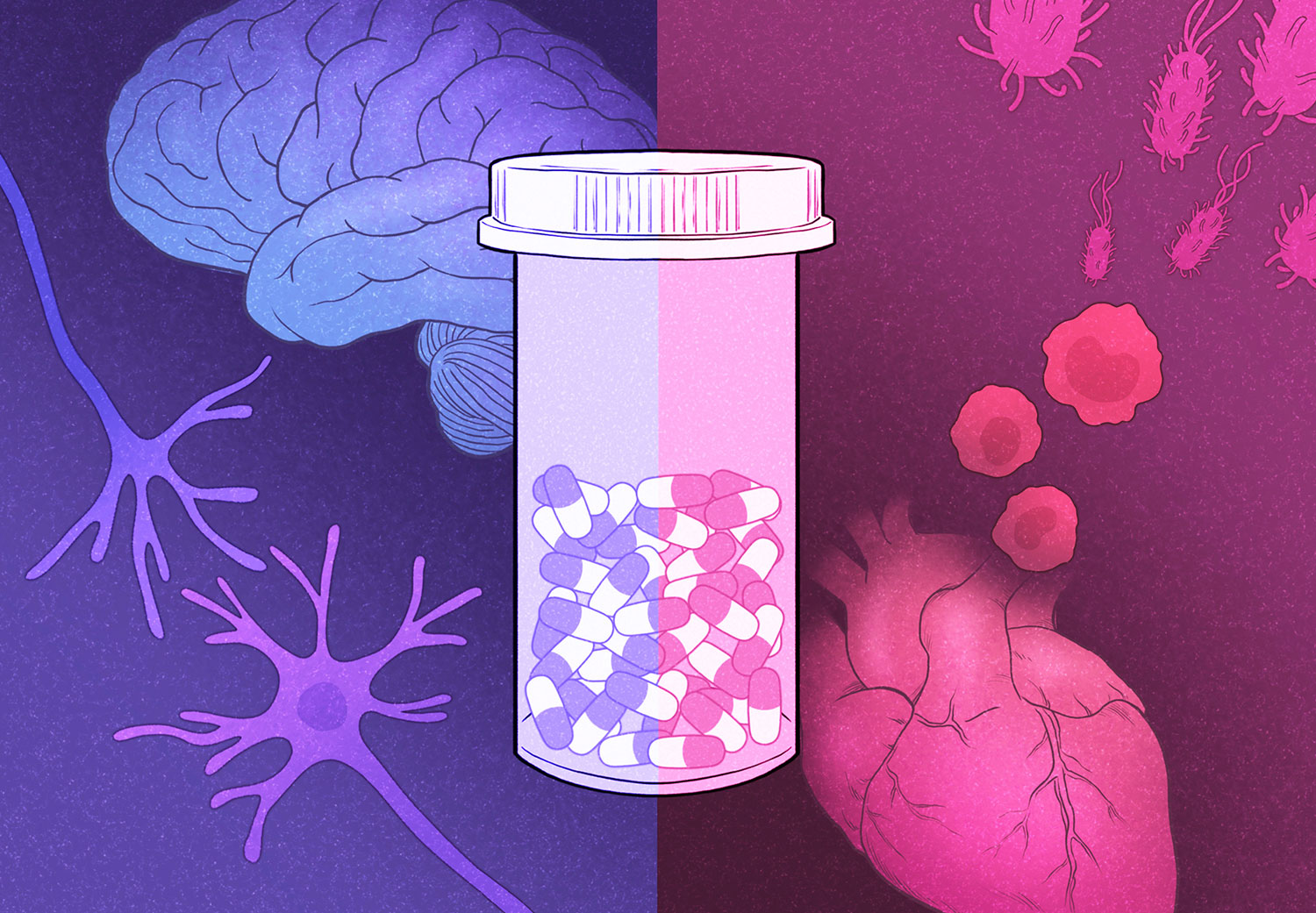
To understand how fluoxetine’s influence on serotonin levels might be contributing to these effects, the researchers also looked at two new mouse populations: Both were pretreated with fluoxetine, but one had circulating serotonin, while the other did not. Circulating serotonin is a little chemical messenger that travels your brain and body to regulate things like mood, sleep, and pain, and is the main target for fluoxetine’s mental health effects. They found that fluoxetine’s positive health outcomes were entirely unrelated to circulating serotonin—regardless of whether the mice had serotonin in circulation, they experienced the same infection defense benefits from fluoxetine.
“That was really unexpected, but also really exciting,” says study first author Robert Gallant, a former graduate student researcher in Ayres’ lab. “Knowing fluoxetine can regulate the immune response, protect the body from infection, 和 have an antimicrobial effect—all entirely independent from circulating serotonin—is a huge step toward developing new solutions for life-threatening infections and illnesses. It also really goes to show how much more there is to learn about SSRIs.”
Ayres and Gallant say their next step is to explore fluoxetine dosing regimens appropriate for septic individuals. They’re also eager to see whether other SSRIs can have the same effects.
“Fluoxetine, one of the most prescribed drugs in the United States, is promoting cooperation between host and pathogen to defend against infection-induced disease and mortality,” says Ayres, also the head of Molecular and Systems Physiology Laboratories at Salk. “Finding dual protective and defensive effects in a repurposed drug is really exciting.”
Other authors include Karina Sanchez, Emeline Joulia, and Christian Metallo of Salk and Jessica Snyder of the University of Washington.
The work was supported by the National Institutes of Health (DPI AI144249, R01 AI14929, F31 AI169988, T32 GM007240-43, T32 GM133351, NCI CCSG: P30CA014195) and the NOMIS Foundation.
DOI: 10.1126/sciadv.adu4034
日记
科学进展
作者
Robert M. Gallant, Karina K. Sanchez, Emeline Joulia, Jessica M. Snyder, Christian M. Metallo, Janelle S. Ayres
宣传办公室
电话:(858) 453-4100
press@salk.edu
萨尔克研究所是一个独立的非营利性研究机构,由首个安全有效的脊髓灰质炎疫苗的研发者乔纳斯·索尔克于1960年创立。该研究所的使命是推动以合作、敢于冒险为特点的基础性研究,以应对癌症、阿尔茨海默病和农业脆弱性等社会最紧迫的挑战。这项基础科学支撑着所有的转化研究,产生有助于全球新药和创新的见解。.