
October 23, 2013
Key differences in the regulation of jumping genes may have arisen relatively recently in evolution
Key differences in the regulation of jumping genes may have arisen relatively recently in evolution
LA JOLLA, CA—Researchers at the Salk Institute for Biological Studies have, for the first time, taken chimpanzee and bonobo skin cells and turned them into induced pluripotent stem cells (iPSCs), a type of cell that has the ability to form any other cell or tissue in the body.
Mouse iPSCs were created in 2006 by Kazutoshi Takahashi and Shinya Yamanaka at Kyoto University in Japan, and human iPSCs soon followed—feats which earned Yamanaka the Nobel Prize in Physiology or Medicine last year. Now scientists regularly use iPSCs to model diseases using cells that would be otherwise difficult to obtain from a living person or animal. By adding a combination of four key factors, a skin cell can be made into an iPSC, which can then be coaxed into forming liver, lung and brain cells in a culture dish.
It’s now possible to not only model disease using the cells, but also to compare iPSCs from humans to those of our closest living relatives—great apes, with which we share a majority of genes—for insight into what molecular and cellular features make us human.
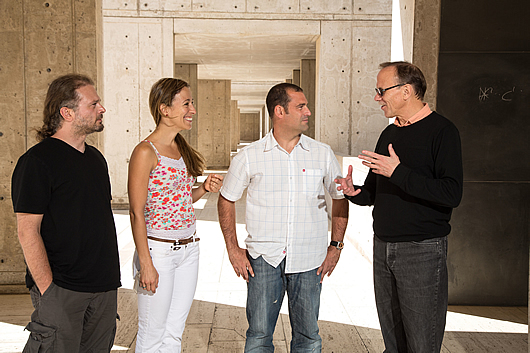
From left: Salk scientists Ahmet Denli, Carol Marchetto, Iñigo Narvaiza and Fred Gage
图片:由萨克生物研究所提供
“Comparing human, chimpanzee and bonobo cells can give us clues to understand biological processes, such as infection, diseases, brain evolution, adaptation or genetic diversity,” says senior research associate Iñigo Narvaiza, who led the study with senior staff scientist Carol Marchetto at the Salk Institute in La Jolla. “Until now, the sources for chimpanzee and bonobo cells were limited to postmortem tissue or blood. Now you could generate neurons, for example, from the three different species and compare them to test hypotheses.”
In the new study, published online October 23, 2013, in the journal 自然, scientists found disparities in the regulation of jumping genes or transposons—DNA elements that can copy and paste themselves into spots throughout the genome—between humans and non-human primate cells. Jumping genes provide a means to rapidly shuffle DNA and might be shaping the evolution of our genomes, the scientists say.
Working in the lab of Salk’s 弗雷德·盖奇, the Vi and John Adler Chair for Research on Age-Related Neurodegenerative Disease, Narvaiza, Marchetto and their colleagues identified genes that are differentially expressed between iPSCs from humans and both chimpanzees and bonobos.
To the group’s surprise, two of those genes code for proteins that restrict a jumping gene called long interspersed element-1 or L1, for short. Compared with non-human primate cells, human iPSCs expressed higher levels of these restrictors, called APOBEC3B and PIWIL2. “We weren’t expecting that,” Marchetto says. “Those genes caught our eyes, so they were the first targets we focused on.”
L1 and a handful of other jumping genes are abundant throughout our genomes. Where these bits of DNA insert themselves is hard to predict, and they can produce variable effects. For example, they might completely disrupt genes, modulate them, or cause them to be processed into entirely new proteins.
Using L1 tagged with a fluorescent marker, the group observed higher numbers of fluorescent iPSCs from non-human primates compared with humans. In separate experiments, they produced iPSCs with too much or too little APOBEC3B and PIWIL2, finding—as expected—that an excess of the two proteins dampened the mobility and reduced the appearance of newly inserted DNA in the non-human primate cells.
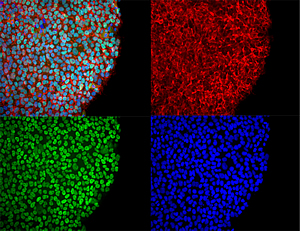
This microscope image shows induced pluripotent stem cells (iPSCs) from our closest living relatives.
Skin cells from bonobos (pigmy chimps) were reprogrammed to pluripotent stem cells, an advance that allows scientists to study the differences between the neurons of humans and chimps. The colors show different aspects of the cells’ molecular components.
Image: Courtesy of Carol Marchetto, Salk Institute for Biological Studies
These results suggested that L1 elements insert themselves less often throughout our genomes. Indeed, looking at genomes of humans and chimpanzees that had already been sequenced, the researchers found that the primates had more copies of L1 sequences than did humans.
The question that remains is what would be the impact of differences in L1 regulation? “It could mean that we have gone, as humans, through one or more bottlenecks in evolution that decrease the variability present in our genome,” says Marchetto, though the hypothesis is admittedly hard to prove. It is known, however, that humans’ genomes are less variable than chimpanzees’.
The new study provides proof of concept that the iPSC technology can be used to understand some of the evolutionary differences between humans and non-human primates, says Narvaiza. The group plans to make technology, and all the data, available to the broader research community—which is especially helpful now that great ape research is severely restricted in the United States and abroad—so that other scientists can learn about primates using non-invasive, ethically sound methods.
The team plans to differentiate the stem cells into other tissues, such as neurons, and compare how the cells from different species behave. They will also use the iPSC technology to investigate how chimpanzees might differ from people in susceptibility to 癌症, genetic diseases and viral infection.
Other researchers on the study were Ahmet Denli, Christopher Benner, Thomas Lazzarini, and Apuã Paquola of the Salk Institute for Biological Studies; Jason Nathanson
and Gene Yeo of the University of California San Diego, Department of Cellular and Molecular Medicine; Keval Desai of the University of California San Diego, Division of Biological Sciences; Roberto Herai and Alysson Muotri of the University of California San Diego, School of Medicine; Matthew Weitzman of the Department of Pathology and Laboratory Medicine at the University of Pennsylvania Perelman School of Medicine; and senior and corresponding author Fred H. Gage of the Salk Institute and Center for Academic Research and Training in Anthropogeny.
这项工作得到了...的支持 美国国立卫生研究院, , 那个 G. Harold & Leila Y. Mathers Foundation 和 Leona M. 和 Harry B. Helmsley 慈善信托基金.
关于索尔克生物研究所:
索尔克生物研究所是世界顶尖的基础研究机构之一,其国际知名的教职人员在一个独特、协作和富有创造性的环境中,深入探究生命科学的基本问题。索尔克科学家们致力于发现和指导未来几代研究人员,通过研究神经科学、遗传学、细胞和植物生物学以及相关学科,在癌症、衰老、阿尔茨海默氏症、糖尿病和传染病的认识方面做出了开创性的贡献。.
学院取得了许多成就,获得了包括诺贝尔奖和美国国家科学院院士在内的无数荣誉。该研究所由脊髓灰质炎疫苗先驱 Jonas Salk 博士于 1960 年创立,是一家独立的非营利组织和建筑地标。.
日记
自然
作者
Maria C. N. Marchetto, Iñigo Narvaiza, Ahmet M. Denli, Christopher Benner, Thomas A. Lazzarini, Jason L. Nathanson, Apuã C. M. Paquola, Keval N. Desai, Roberto H. Herai, Matthew D. Weitzman, Gene W. Yeo, Alysson R. Muotri, Fred H. Gage
宣传办公室
电话:(858) 453-4100
press@salk.edu




