April 9, 2015
Salk scientists discover a learning circuit in worms that gives clues to human behavior
Salk scientists discover a learning circuit in worms that gives clues to human behavior
LA JOLLA–If you had 10 chances to roll a die, would you rather be guaranteed to receive $5 for every roll ($50 total) or take the risk of winning $100 if you only roll a six?
Most animals, from roundworms to humans, prefer the more predictable situation when it comes to securing resources for survival, such as food. Now, Salk scientists have discovered the basis for how animals balance learning and risk-taking behavior to get to a more predictable environment. The research reveals new details on the function of two chemical signals critical to human behavior: dopamine–responsible for reward and risk-taking–and CREB–needed for learning.
“Previous research has shown that certain neurons respond to changes in light to determine variability in their environment, but that’s not the only mechanism,” says senior author 斯里坎特·查拉萨尼, an assistant professor in Salk’s 分子神经生物学实验室. “We discovered a new mechanism that evaluates environmental variability, a skill crucial to animals’ survival.”
By studying roundworms (Caenorhabditis elegans), Salk researchers charted how this new circuit uses information from the animal’s senses to figure out how predictable the environment and prompt the worm to move to a new location if needed. The work was detailed April 9, 2015 in 神经元.
The circuit, made up of 16 of the 302 neurons in the worm’s brain, likely has parallels in more complex animal brains, researchers say, and could be a starting point to understanding–and fixing–certain psychiatric or behavioral disorders.
“What was surprising is the degree to which variability in animal behavior can be explained by variability in their past sensory experience and not just noise,” says 塔季扬娜·沙尔佩, associate professor and co-senior author of the paper. “We can now predict future animal behaviors based on past sensory experience, independent of the influence of genetic factors.”
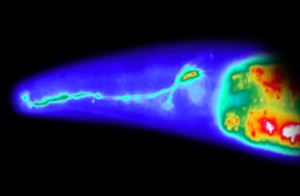
This image shows a single sensory neuron in the roundworm Caenorhabditis elegans. Salk researchers demonstrated how a neural circuit uses prior experience to modify future behaviors. The work reveals new details on the function of two chemical signals critical to animal–and human–behavior: dopamine (responsible for reward and risk-taking) and CREB (needed for learning).
点击此处 用于高分辨率图像。.
图片:由萨克生物研究所提供
The team discovered that two pairs of neurons in this learning circuit act as gatekeepers. One pair responds to large increases of the presence of food and the other pair responds to large decreases of the presence of food. When either of these high-threshold neurons detect a large change in an environment (for example, the smell of a lot of food to no food) they induce other neurons to release the neurotransmitter dopamine.
Dumping dopamine onto a brain–human or otherwise–makes one more willing to take risks. It’s no different in the roundworm: stimulated by large varieties in its environment, dopamine surges in the worm’s system and activates four other neurons in the learning circuit, giving them a greater response range. This prompts the worm to search more actively in a wider area (risk-taking) until it hits a more consistent environment. The amount of dopamine in its system serves as its memory of the past experience: about 30 minutes or so and it forgets information gathered in the time before that.
While it’s been known that the presence of dopamine is tied to risk-taking behavior, how exactly dopamine does this hasn’t been well understood. With this new work, scientists now have a fundamental model of how dopamine signaling leads the worm to take more risks and explore new environments.
“The connection between dopamine and risk is conserved across animals and is already known, but we showed mechanistically how it works,” says Chalasani, who is also holder of the Helen McLoraine Developmental Chair in Neurobiology. “We hope this work will lead to better therapies for neurodegenerative and behavioral diseases and other disorders where dopamine signaling is irregular.”
Interestingly, the scientists found that the high-threshold neurons also lead to increased signaling from a protein called CREB, known in humans and other animals to be essential to learning and retaining new memories. The researchers showed that not only are the presence of CREB important to learning, but the amount of CREB protein determines how quickly an animal learns. This surprising connection could lead to new avenues of research for brain enhancements, adds Chalasani.
How did researchers test all of this in worms exactly? They began by placing worms in dishes that contained either a large or a small patch of edible bacteria. Worms in the smaller patches tended to reach the edges more frequently, experiencing large changes in variability (edges have large amounts of food compared to the center). Worms on the large patch, however, reached the edge less frequently, thereby experiencing a general stable environment (mainly an area with constant food).
Salk Institute researchers discovered how a neural circuit in roundworms balance learning and risk-taking behavior to get to a more predictable environment. Worms have two pairs of neurons that respond to large changes environment, such as different concentrations of food in a small space (left panel). As a result, the worms experience a greater increase in dopamine and risk-taking behavior to prompt them to move to a more stable space. When worms experience less variety in their environment, they experience less dopamine (right panel). The neural circuit likely has parallels in more complex animals and could help to explain behavior.
Video: Courtesy of the Salk Institute for Biological Studies
Using genetics, imaging, behavioral analysis and other techniques, researchers found that when worms are on small patches, the two pairs of high-threshold neurons respond to the greater variation and signal leading to increased dopamine. When worms in these smaller patches (and higher dopamine) were taken out and put into a new dish, they explored a larger area, taking more of a risk. Worms from the larger patches, however, produced less dopamine and were more cautious, exploring just a small space when placed in a new area.
Additionally, when the protein CREB was present in larger amounts, the team found that the worms took far less time to learn about their food variability. “Normally the worms took about 30 minutes or so to explore and learn about food, but as you keep increasing the CREB protein they learn it faster,” says Chalasani. “So dopamine stores the memory of what these worms learn while CREB regulates how quickly they learn.”
Authors include Adam J. Calhoun of the 加州大学圣地亚哥分校; Navin Pokala of The Rockefeller University; and Ada Tong, James A. J. Fitzpatrick, Tatyana O. Sharpee and Sreekanth H. Chalasani, all of the Salk Institute.
这项工作由...资助 美国国立卫生研究院, , 那个 国家科学基金会 和 丽塔·艾伦基金会.
关于索尔克生物研究所:
索尔克生物学研究所是世界上首屈一指的基础研究机构之一,其国际知名的教职员工在一个独特的、协作和创新的环境中,深入探索生命科学的基本问题。索尔克科学家既注重科学发现,也注重培养下一代研究人员,通过研究神经科学、遗传学、细胞生物学、植物生物学及相关学科,为我们理解癌症、衰老、阿尔茨海默病、糖尿病和传染病做出了开创性的贡献。.
教职员工的成就获得了无数荣誉,包括诺贝尔奖和美国国家科学院院士资格。该研究所由脊髓灰质炎疫苗先驱 Jonas Salk 医生于 1960 年创立,是一家独立的非营利组织和建筑地标。.
日记
神经元
作者
Adam J. Calhoun, Navin Pokala, Ada Tong, James A. J. Fitzpatrick, Tatyana O. Sharpee and Sreekanth H. Chalasani
宣传办公室
电话:(858) 453-4100
press@salk.edu