May 10, 2023

How aggression-promoting brain peptide works in fruit flies

Salk scientists investigate how neuropeptides affect specific neurons, providing insight into how the brain communicates in autism-spectrum and attention-deficit disorders

索尔克新闻


How aggression-promoting brain peptide works in fruit flies

Salk scientists investigate how neuropeptides affect specific neurons, providing insight into how the brain communicates in autism-spectrum and attention-deficit disorders

LA JOLLA—In addition to communicating with neurotransmitters, the brain also uses small proteins called neuropeptides. Neuropeptides send signals between neurons, working similarly to neurotransmitters but with key differences like a greater size and an ability to travel far away from the neuron that produces them. Though their importance is widely recognized, the way neuropeptides move around the brain and influence neurons has remained poorly understood—until now.

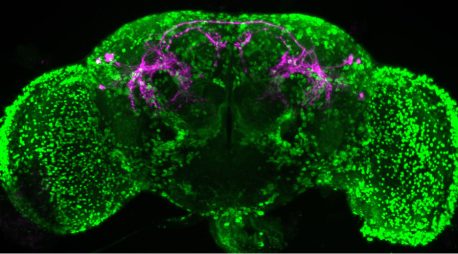
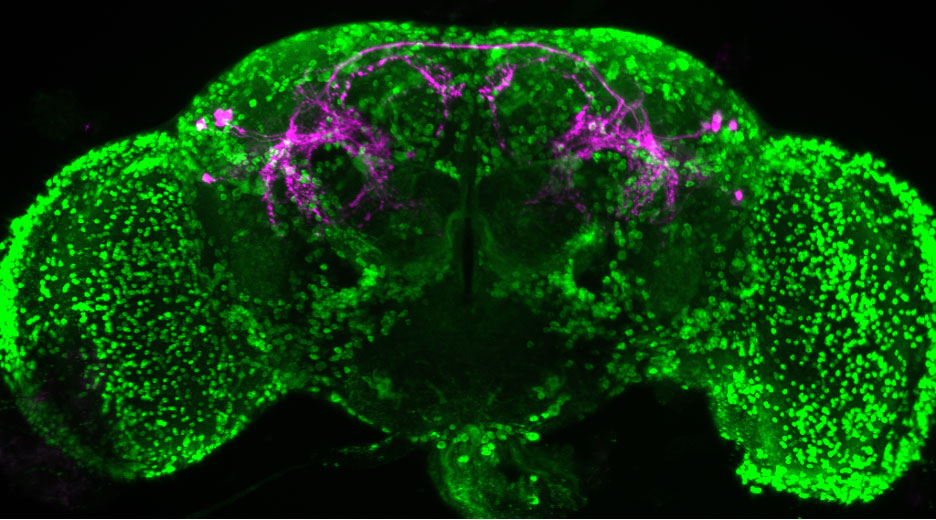
A fruit fly brain showing male-specific tachykininergic neurons (magenta), which make the neuropeptide tachykinin, and neurons that express TkR86C (green), which receive tachykinin.
点击此处 用于高分辨率图像。.
版权:萨克研究所

A study by Salk scientists published in the Journal of Neuroscience on May 10, 2023, reveals the variable influence that neuropeptides can have on brain activity and illuminates how the brain communicates in flies—an important step to understanding the underlying causes of human conditions, like autism-spectrum disorder or attention-deficit disorders.

“Studies have been treating neuropeptides like they have a single origin and single target that produces a simple outcome, but they have far more influence than that,” says senior author Kenta Asahina, an associate professor in the Molecular Neurobiology Laboratory. “Neuropeptides can do many things, with diverse and previously unexplored effects that have huge impacts on behavior.”

Neuropeptides can affect a range of behaviors, including eating, mating, and sleeping, as well as feeling fearful or stressed. Some neurons release neuropeptides as signaling molecules, while other neurons receive neuropeptides via receptors located on the cell’s surface. Prior to the Salk study, neuropeptides were assumed to have a general, systemic effect on all neurons that express the matching receptor. But growing evidence suggests a particular neuropeptide might control different behaviors, like eating or being aggressive, by acting on distinct brain circuits.

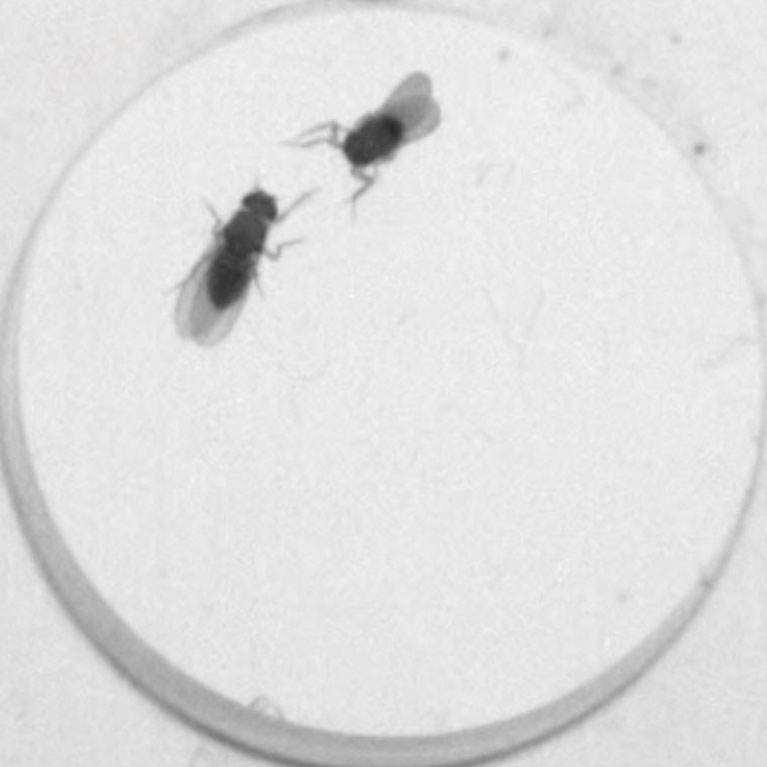
A male fly (left) with an excess amount of tachykinin attacking a female fly (right)—a behavior unlikely when tachykinin levels are normal.
点击此处 用于高分辨率图像。.
版权:萨克研究所

In this study, Asahina’s team wanted to examine the neuropeptide tachykinin, which is known to increase aggression in many animal species, including fruit flies, mice, and even humans. They were curious to know how tachykinin affects neuron communication and animal behavior.

To track tachykinin, the team created a molecular flag to label fruit fly neurons with receptors for tachykinin. Using the flag, the team could visualize how tachykinin activated some neurons, which could create specific behaviors in the flies. The differences in expressed receptors, coupled with certain behaviors, represent a novel mechanism for neuronal communication using neuropeptides.

The differences in expressed receptors represent an often-overlooked mechanism for neuronal communication using neuropeptides, because one type of neuropeptides can activate different receptors at different concentrations.

Neurons trigger one another to fire like a line of falling dominoes, and neuropeptides help the process along—almost like giving each domino a little extra push. The researchers found that tachykinin from a single male-specific type of neuron (flies have sex-specific neurons) affected two separate downstream groups of neurons, which—like all dominoes after the first—depended on the neuropeptide signal to act. The first group of neurons expressed a specific tachykinin receptor (TkR86C) and were required for promoting aggressive behavior. The second group of neurons expressed another type of tachykinin receptor (TkR99D) and was only activated when tachykinin was overproduced. Tachykinin affected neurons in different parts of the brain and the neurons responded differently with varying tachykinin concentration. Additionally, the activity patterns in the two groups of neurons were related to the levels of male aggression in the fruit flies.

From left: Kenta Asahina and Margot Wohl.
点击此处 用于高分辨率图像。.
版权:萨克研究所

“By imaging fruit fly brains, we were able to see two distinct subsets of neurons that had receptors for the neuropeptide tachykinin,” says Margot Wohl, the paper’s first author and a former graduate student researcher in Asahina’s lab. “It turns out tachykinin was signaling to each receptor in different areas of the brain, but the receptors responded differently when we increased tachykinin concentration. This is likely a way to control complex behavior—like how the fly decides who to fight and with how much aggression—and can help us better understand the influence of neuropeptides across the brain.”

The findings highlight how neuropeptides released from a small group of neurons can reshape activity patterns in multiple downstream groups of neurons throughout the fly brain to impact behavior. This discovery also lays the foundation for future investigations into how neuropeptides impact complex behaviors.

“We may be looking at fruit flies, but the implications of our research extend far beyond them,” says Asahina. “We know that neuropeptides are also in human brains, and by looking at this comparatively simple fruit fly model we can begin to understand how neuropeptides may influence our own brains—in health and in dysfunction.”

Other authors include Jett Liu of the Salk Institute.

The work was supported by the Mary K. Chapman Foundation, Rose Hills Foundation, and National Institutes of Health (NIDCD R01 DC015577).

DOI: 10.1523/JNEUROSCI.1734-22.2023

出版信息

日记

The Journal of Neuroscience

标题

Drosophila tachykininergic neurons modulate the activity of two groups of receptor expressing neurons to regulate aggressive tone

作者

Margot P. Wohl, Jett Liu, Kenta Asahina

研究领域

更多信息

宣传办公室
电话:(858) 453-4100
press@salk.edu

萨尔克生物学研究所

萨尔克研究所是一个独立的非营利性研究机构,由首个安全有效的脊髓灰质炎疫苗的研发者乔纳斯·索尔克于1960年创立。该研究所的使命是推动以合作、敢于冒险为特点的基础性研究,以应对癌症、阿尔茨海默病和农业脆弱性等社会最紧迫的挑战。这项基础科学支撑着所有的转化研究,产生有助于全球新药和创新的见解。.