March 6, 2013
Salk epigenetic findings may aid in crop production
Salk epigenetic findings may aid in crop production
LA JOLLA, CA—Scientists at the Salk Institute for Biological Studies have identified patterns of epigenomic diversity that not only allow plants to adapt to various environments, but could also benefit crop production and the study of human diseases.
Published March 6 in 自然, the findings show that in addition to genetic diversity found in plants throughout the world, their epigenomic makeup is as varied as the environments in which they are found. Epigenomics is the study of the pattern of chemical markers that serve as a regulatory layer on top of the DNA sequence. Depending on where they grow, the plants’ epigenomic differences may allow them to rapidly adapt to their environments.
Epigenomic modifications alter gene expression without changing the letters of the DNA alphabet (A-T-C-G), providing cells with an additional tool to fine-tune how genes control the cellular machinery. These changes occur not only in plants, but in humans as well.
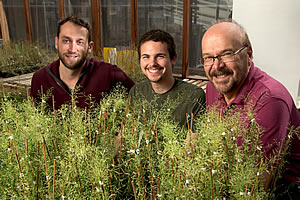
From left to right: Salk researchers Robert J. Schmitz, Matthew D. Schultz and Joseph Ecker.
图片:由萨克生物研究所提供
“We looked at plants collected from around the world and found that their epigenomes are surprisingly different,” says senior author 约瑟夫·R·艾克, ,索尔克研究所的教授 植物分子与细胞生物学实验室 and holder of the Salk International Council Chair in Genetics. “This additional diversity may create a way for plants to rapidly adapt to diverse environments without any genetic change in their DNA, which takes a very long time.”
By understanding epigenomic alterations in plants, scientists may be able to manipulate them for various purposes, including biofuels and creating crops that can withstand stressful events such as drought. That knowledge of epigenomic changes in crop plants could tell producers what to breed for and could have a huge impact on identifying plants that can survive certain conditions and adapt to environmental stressors, says Ecker, who is also a Howard Hughes Medical Institute and Gordon and Betty Moore Foundation Investigator.
Using MethylC-Seq, a method for mapping epigenomic changes developed by Ecker, the researchers analyzed methylation patterns from a population of 拟南芥, a modest mustard weed that has become to plant biology what laboratory mice are to animal biology. The plants were from a variety of climates in the Northern Hemisphere, from Europe to Asia and Sweden to the Cape Verde Islands. Ecker’s team examined the genomes and methylomes of A. thaliana, the makeup of their entire genetic and epigenomic codes, respectively, which is the first step toward understanding the impact of epigenetic changes on the plants’ physical characteristics and ability to adapt to their environment.
“We expected variation in methylation patterns among groups of plants from around the globe,” says co-lead author Robert J. Schmitz, a postdoctoral researcher in Ecker’s lab. “The amount, however, was far greater than we ever anticipated.”
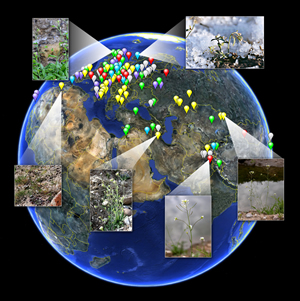
This graphic depicts a collection of wild 拟南芥 from around the world that have adapted to their local environment. This collection of plants was used to understand the patterns of population epigenomic diversity within a species.
Photographs were contributed by Patrick Gooden, Kathleen Donohue and @2011 Google. Graphic was designed by Jamie Simon, Salk Institute for Biological Studies
By analyzing these patterns, Ecker’s team was able to chart their effects on the activity of genes in the plants’ genome. Scientists know that methylation can inactivate genes, but in contrast to DNA mutations, methylation patterns are reversible, giving the plants the ability to temporarily activate genes. The identification of genes that are epigenetically regulated has greatly narrowed the potential candidates important for environmental adaptation.
Methylation silencing also occurs in humans-and that has implications for treating cancer, a hallmark of which is the silencing of tumor suppressor genes. “If these genes are turned off by the epigenome, they could potentially be turned back on by removing the DNA methylation,” says study co-lead author Matthew Schultz, a graduate student in Ecker’s lab. Understanding how these methylation variants form in the wild will help toward better engineering of epigenomes.
Ecker’s team will next study how methylation variations affect the traits of plants. They will examine stress-induced epigenomic changes and how they might provide clues as to which alterations are most important for the plants.
Other researchers on the study were Mark A. Urich, Joseph R. Nery, Mattia Pelizzola, Andrew Alix, Richard B. McCosh, and Huaming Chen, from the Salk Institute; and Ondrej Libiger and Nicholas J. Schork of The Scripps Research Institute.
这项工作得到了...的支持 , , 那个 美国国立卫生研究院, , 那个 霍华德·休斯医学研究所, , 那个 国家科学基金会 (Grants MCB-0929402 and MCB-1122246) and the 戈登和贝蒂·摩尔基金会 (Grant GBMF3034).
关于索尔克生物研究所:
索尔克生物研究所是世界顶尖的基础研究机构之一,其国际知名的教职人员在一个独特、协作和富有创造性的环境中,深入探究生命科学的基本问题。索尔克科学家们致力于发现和指导未来几代研究人员,通过研究神经科学、遗传学、细胞和植物生物学以及相关学科,在癌症、衰老、阿尔茨海默氏症、糖尿病和传染病的认识方面做出了开创性的贡献。.
学院取得了许多成就,获得了包括诺贝尔奖和美国国家科学院院士在内的无数荣誉。该研究所由脊髓灰质炎疫苗先驱 Jonas Salk 博士于 1960 年创立,是一家独立的非营利组织和建筑地标。.
日记
自然
作者
Robert J. Schmitz, Matthew D. Schultz, Mark A. Urich, Joseph R. Nery, Mattia Pelizzola, Ondrej Libiger, Andrew Alix, Richard B. McCosh, Huaming Chen, Nicholas J. Schork, and Joseph R. Ecker
宣传办公室
电话:(858) 453-4100
press@salk.edu