December 7, 2015
Salk team identifies drug that prevents and reverses deadly liver damage in mice
Salk team identifies drug that prevents and reverses deadly liver damage in mice
LA JOLLA—Chronic damage to the liver eventually creates a wound that never heals. This condition, called fibrosis, gradually replaces normal liver cells—which detoxify the food and liquid we consume—with more and more scar tissue until the organ no longer works.
Scientists at the Salk Institute have identified a drug that halts this unchecked accumulation of scar tissue in the liver. The small molecule, called JQ1, prevented as well as reversed fibrosis in animals and could help the millions of people worldwide affected by liver fibrosis and cirrhosis, caused by alcoholism and diseases like hepatitis. These results were published in PNAS the week of December 7, 2015.
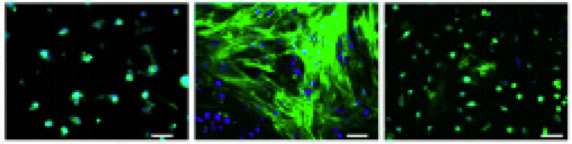
Credit: Salk Institute for Biological Studies
“After too much damage in the liver, the scar tissue itself causes more scar tissue,” says 罗纳德·埃文斯, professor and director of Salk’s Gene Expression Laboratory and a Howard Hughes Medical Institute investigator. “We can actually reverse liver fibrosis in animals and are now exploring potential therapeutic applications for humans.”
When the liver is damaged, small collections of hepatic stellate cells that specialize in storing vitamin A are called upon to tend to the wound. These activated stellate cells shed their vitamin A, travel to the site of injury and create thick, fibrous scar tissue to wall off and repair the damage. However, with prolonged organ stress, healthy liver cells become replaced by scar tissue, eventually leading to organ failure.
“Traditional therapies targeting inflammation don’t work because these cells have multiple ways to bypass the drug,” says Michael Downes, a Salk senior scientist and author of the paper. “In contrast, our strategy was to stop the fibrotic response at the genome level where these pathways converge.”
The search for the critical genome pathway struck gold, uncovering a regulatory protein, called BRD4, that is a master regulator of liver fibrosis.
Click here for a high-resolution image»
图片:由萨克生物研究所提供
With this new knowledge in hand, the Salk team found JQ1 successfully inhibited BRD4 and halted the transformation of hepatic stellate cells into fiber-producing cells. This is good news, as JQ1 is a prototype of a new class of drugs currently being tested in human clinical trials for various cancers.
“JQ1 doesn’t just protect against the wound response, but also reverses the fibrotic response in mice,” says Ruth Yu, a Salk staff researcher and one of the authors of the paper.
“Our results indicate that BRD4 is a driver of chronic fibrosis and a promising therapeutic target for treating liver disease,” says Evans, who also holds the March of Dimes Chair in Molecular and Developmental Biology. “We think this discovery may also treat fibrosis in other organs, like the lung, pancreas and kidney.”
Other authors include Ning Ding, Nasun Hah, Mara Sherman, Chris Benner, Mathias Leblanc and Mingxiao He of the Salk Institute, and Christopher Liddle of the University of Sydney.
The work was funded by the NIH, the National Health and Medical Research Council of Australia Project Grants, the Leona M. and Harry B. Helmsley Charitable Trust, the Samuel Waxman Cancer Research Foundation and Ipsen/Biomeasure.
日记
PNAS
作者
Ning Ding, Nasun Hah, Ruth T. Yu, Mara H. Sherman, Chris Benner, Mathias Leblanc, Mingxiao He, Christopher Liddle, Michael Downes, and Ronald M. Evans
宣传办公室
电话:(858) 453-4100
press@salk.edu
萨尔克研究所是一个独立的非营利性研究机构,由首个安全有效的脊髓灰质炎疫苗的研发者乔纳斯·索尔克于1960年创立。该研究所的使命是推动以合作、敢于冒险为特点的基础性研究,以应对癌症、阿尔茨海默病和农业脆弱性等社会最紧迫的挑战。这项基础科学支撑着所有的转化研究,产生有助于全球新药和创新的见解。.