September 18, 2012
Salk scientists show nine genes at heart of epigenetic changes in induced pluripotent stem cells
Salk scientists show nine genes at heart of epigenetic changes in induced pluripotent stem cells
LA JOLLA, CA—Salk scientists have identified a unique molecular signature in induced pluripotent stem cells (iPSCs), “reprogrammed” cells that show great promise in regenerative medicine thanks to their ability to generate a range of body tissues.
In this week’s 美国国家科学院院刊, the Salk scientists and their collaborators at University of California, San Diego, report that there is a consistent, signature difference between embryonic and induced pluripotent stem cells. The findings could help overcome hurdles to using the induced stem cells in regenerative medicine.
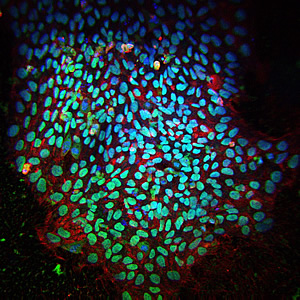
A colony of induced pluripotent stem cells. Blue fluorescence indicates cell nuclei; red and green are markers of pluripotency.
图片:由萨克生物研究所提供
“We believe that iPSCs hold a great potential for the treatment of human patients,” says 胡安·卡洛斯·伊兹皮苏亚·贝尔蒙特, ,索尔克研究所的教授 基因表达实验室 and the senior author on the paper. “Yet we must thoroughly understand the molecular mechanisms governing their safety profile in order to be confident of their function in the human body. With the discovery of these small, yet apparent, epigenetic differences, we believe that we are now one step closer to that goal.”
Embryonic stem cells (ESCs) are known for their “pluripotency,” the ability to differentiate into nearly any cell in the body. Because of this ability, it has long been thought that ESCs would be ideal to customize for therapeutic uses. However, when ESCs mature into specific cell types, and are then transplanted into a patient, they may elicit immune responses, potentially causing the patient to reject the cells.
In 2006, scientists discovered how to revert mature cells, which had already differentiated into particular cell types, such as skin cells or hair cells, back into a pluripotent state. These “induced pluripotent stem cells” (iPSCs), which could be developed from the patient’s own cells, would theoretically carry no risk of immune rejection.
However, scientists found that iPSCs had molecular differences from embryonic stem cells. Specifically, there were epigenetic changes, chemical modifications in DNA that might alter genetic activity. At certain points in the iPSC’s genome, scientists could see the presence of different patterns of methyl groups when compared to the genomes of ESCs. It seemed these changes occurred randomly.
Izpisua Belmonte and his colleagues wanted to understand more about these differences. Were they truly random, or was there a discernable pattern?
Unlike previous studies, which had primarily analyzed iPSCs derived from only one mature type of cells (mainly connective tissue cells called fibroblasts), the Salk and UCSD researchers examined iPSCs derived from six different mature cell types to see if there were any commonalities. They discovered that while there were hundreds of unpredictable changes, there were some that remained consistent across the cell types: the same nine genes were associated with these common changes in all iPSCs.
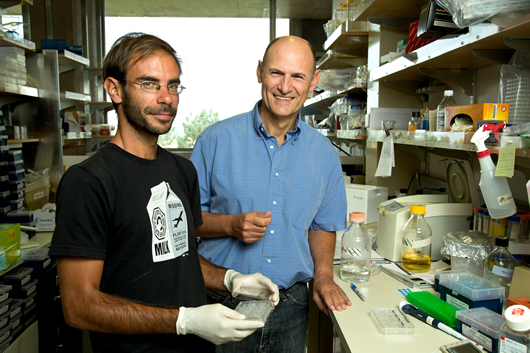
Sergio Ruiz, research associate and Juan Carlos Izpisua Belmonte, Professor, Gene Expression Laboratory.
图片:由萨克生物研究所提供
“We knew there were differences between iPSCs and ESCs,” says Sergio Ruiz, first author of the paper, “We now have an identifying mark for what they are.”
The therapeutic significance of these nine genes awaits further research. The importance of the current study is that it gives stem cells researchers a new and more precise understanding of iPSCs.
Other researches on the study were: Dinh Diep (co-first author), Athurva Gore, Athanasia D. Panopoulos, Nuria Montserrat, Nongluk Plongthongkum, Sachin Kumar, Ho-Lim Fung, Alessandra Giorgetti, Josipa Bilic, Erika M. Batchelder, Holm Zaehres, Natalia G. Kan, Hans R. Schöler, Mark Mercola and Kun Zhang.
The work was supported by grants from the Instituto de Salud Carlos III, the Focht-Powell Fellowship, Fundacion Cellex, MINECO, 赛诺菲, the G. Harold and Leila Y. Mathers Charitable Foundation, 利昂娜·M·哈里·B·赫尔姆斯利慈善信托, CIRM 和 美国国立卫生研究院.
关于索尔克生物研究所:
索尔克生物研究所是世界顶尖的基础研究机构之一,其国际知名的教职人员在一个独特、协作和富有创造性的环境中,深入探究生命科学的基本问题。索尔克科学家们致力于发现和指导未来几代研究人员,通过研究神经科学、遗传学、细胞和植物生物学以及相关学科,在癌症、衰老、阿尔茨海默氏症、糖尿病和传染病的认识方面做出了开创性的贡献。.
学院取得了许多成就,获得了包括诺贝尔奖和美国国家科学院院士在内的无数荣誉。该研究所由脊髓灰质炎疫苗先驱 Jonas Salk 博士于 1960 年创立,是一家独立的非营利组织和建筑地标。.
日记
美国国家科学院院刊
作者
Sergio Ruiz, Dinh Diep, Athurva Gore, Athanasia D. Panopoulos, Nuria Montserrat, Nongluk Plongthongkum, Sachin Kumar, Ho-Lim Fung, Alessandra Giorgetti, Josipa Bilic, Erika M. Batchelder, Holm Zaehres, Natalia G. Kan, Hans R. Schöler, Mark Mercola, Kun Zhang and Juan Carlos Izpisua Belmonte
宣传办公室
电话:(858) 453-4100
press@salk.edu