August 30, 2012
Salk findings of a key genetic mechanism in plant hormone signaling may help save crops from stress and help address human hunger
Salk findings of a key genetic mechanism in plant hormone signaling may help save crops from stress and help address human hunger
LA JOLLA, CA—Scientists at the Salk Institute for Biological Studies have discovered a key genetic switch by which plants control their response to ethylene gas, a natural plant hormone best known for its ability to ripen fruit, but which, under stress conditions, can cause wilted leaves, premature aging and spoilage from over-ripening. The findings, published August 30 in Science magazine, may hold the key to manipulating plants’ ethylene on/off switch, allowing them to balance between drought resistance and growth and, therefore, decrease crop losses from drought conditions.
“In different stress conditions—flooding, drought, chilling, wounding or pathogen attack—ethylene tells plants to make adjustments to these adverse changes,” says senior study author 约瑟夫·埃克尔, ,索尔克研究所的教授 植物分子与细胞生物学实验室 and Howard Hughes Medical Institute-Gordon and Betty Moore Foundation investigator. “Our study discovered a key step in how plants ‘smell’ ethylene gas, which may lead to better ways to control these processes in crop plants.”
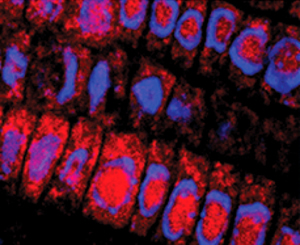
This image of plant cells shows EIN2 (red), a protein that allows plants to control their response to ethylene gas, concentrated in the plant’s nucleus (ringed in blue). Salk scientists discovered how EIN2 allows plants to respond to ethylene, which is crucial in fruit ripening and their response to stress.
Image: Courtesy of Hong Qiao, Salk Insitute for Biological Studies
Plants sense—or smell—ethylene, which triggers a cascade of events in their cells. Ethylene sensors in the cells send a signal to the nucleus, the cells’ central DNA-containing compartment, which initiates genetic programs so the plant can make changes according to the conditions it faces. Scientists, including Ecker and his team, have identified the functions of a number of key regulators in the ethylene signaling pathway, including the protein EIN2 (ethylene insensitive 2).
The EIN2 protein is located in the endoplasmic reticulum, the part of the cell that facilitates the transport of proteins within the cell, and plays an essential role in ethylene signaling. The protein’s function, however, remains enigmatic. Through a variety of sophisticated tests, Ecker’s team uncovered a mechanism by which EIN2 protein processing in the endoplasmic reticulum and movement of signaling molecules into the nucleus are required to activate the ethylene response.
Understanding the mechanism may lead to new methods to help plants thrive in tough conditions. Stress conditions trigger various negative responses in plants, including wilted and rolled leaves, premature leaf senescence (aging), reduced photosynthetic efficiency, loss of chlorophyll, poor pollination, and flower, fruit and seed loss.
The most severe drought in 25 years is impacting crops across the United States, with the potential to wipe out farmers’ incomes and raise food prices. Plant researchers are studying stress conditions in order to improve crop production, which has become more urgent as farmers around the world face climate issues such as drought and extreme temperatures. Curbing crops’ susceptibility to certain stressors could allow for higher yields during droughts and possibly allow drier climates to support profitable crops and feed the world’s growing population.
“Growers can opt to spray their plants with an ethylene inhibitor,” says Hong Qiao, a postdoctoral researcher in Ecker’s laboratory and first author of the paper. “This blocks the plant’s ethylene receptors from smelling ethylene, which has an effect on growth. Without the ethylene response pathway, a tomato would never ripen. Too much ethylene, and the tomato over-ripens. Therefore, basic knowledge of the precise mechanism by which plants control the response to ethylene gas will lead to better ways to control these processes in crop plants.”
Other researches on the study were Shao-shan Carol Huang, Robert J. Schmitz and Mark A. Urich, from the Salk Institute; and Zhouxin Shen and Steven P. Briggs of the University of California, San Diego.
该项工作获得了以下机构的资助: 国家科学基金会, , 那个 霍华德·休斯医学研究所 和 戈登和贝蒂·摩尔基金会.
关于索尔克生物研究所:
索尔克生物研究所是世界顶尖的基础研究机构之一,其国际知名的教职人员在一个独特、协作和富有创造性的环境中,深入探究生命科学的基本问题。索尔克科学家们致力于发现和指导未来几代研究人员,通过研究神经科学、遗传学、细胞和植物生物学以及相关学科,在癌症、衰老、阿尔茨海默氏症、糖尿病和传染病的认识方面做出了开创性的贡献。.
学院取得了许多成就,获得了包括诺贝尔奖和美国国家科学院院士在内的无数荣誉。该研究所由脊髓灰质炎疫苗先驱 Jonas Salk 博士于 1960 年创立,是一家独立的非营利组织和建筑地标。.
日记
科学
作者
Hong Qiao, Zhouxin Shen, Shao-shan Carol Huang, Robert J. Schmitz, Mark A. Urich, Steven P. Briggs and Joseph R. Ecker
宣传办公室
电话:(858) 453-4100
press@salk.edu