March 19, 2018
Salk team charts pathway for fear in worms to reveal more about human anxiety
Salk team charts pathway for fear in worms to reveal more about human anxiety
LA JOLLA—Ask a dozen people about their greatest fears, and you’ll likely get a dozen different responses. That, along with the complexity of the human brain, makes fear—and its close cousin, anxiety—difficult to study. For this reason, clinical anti-anxiety medicines have mixed results, even though they are broadly prescribed. In fact, one in six Americans takes a psychiatric drug.
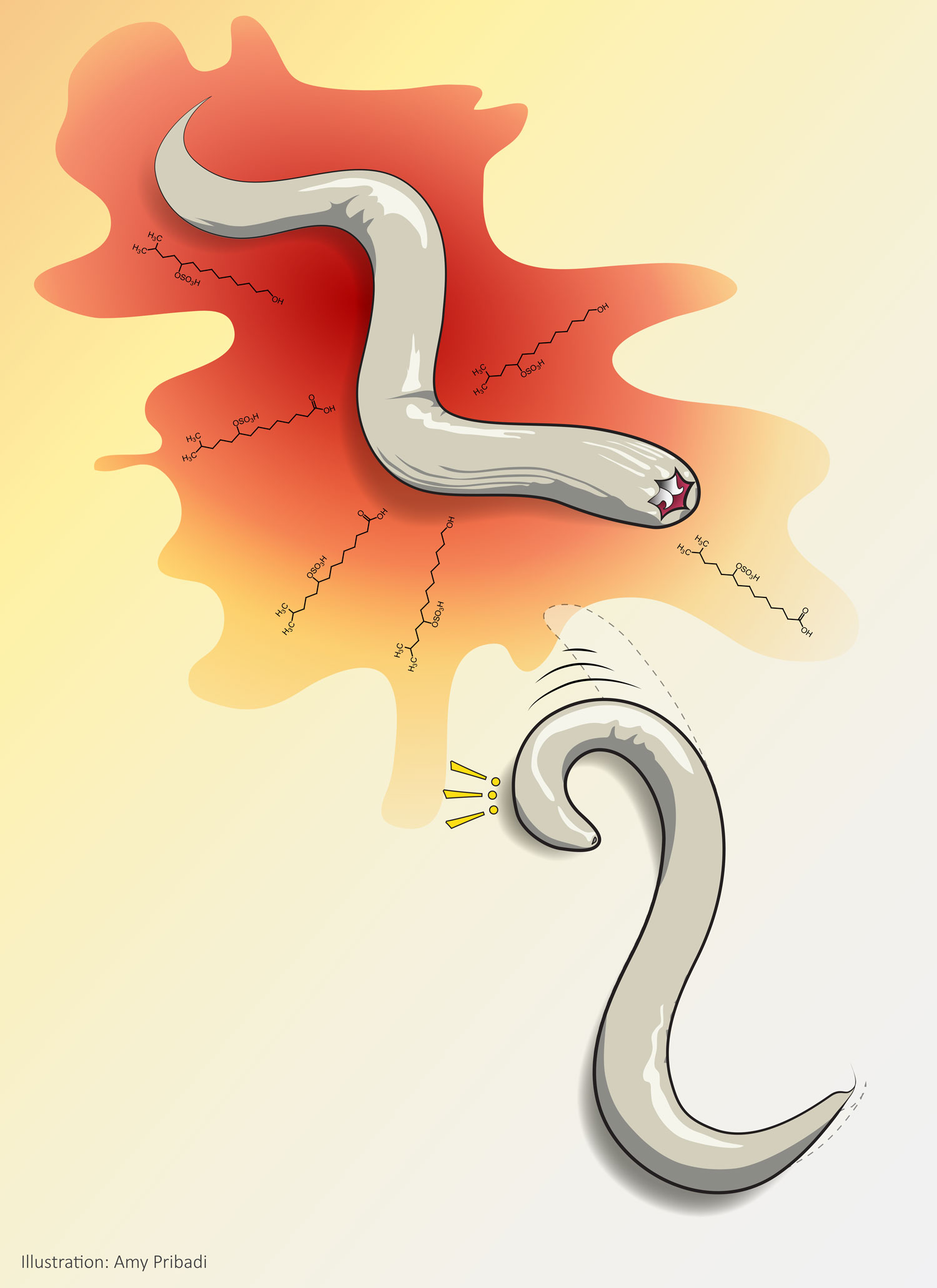
A team of investigators from the Salk Institute uncovered new clues about the mechanisms of fear and anxiety through an unlikely creature: the tiny nematode worm. By analyzing the responses of worms exposed to chemicals secreted by its natural predator and studying the underlying molecular pathways, the team uncovered a rudimentary fear-like response that has parallels to human anxiety. Such insights may eventually help refine prescriptions for current anti-anxiety drugs and enable the development of new drugs to treat conditions like PTSD and panic disorder.
点击此处 用于高分辨率图像。.
Credit: Amy Pribadi
“For the past 30 or 40 years, scientists have used simpler animals to figure out how fear might work in humans,” says 斯里坎特·查拉萨尼, associate professor in Salk’s Molecular Neurobiology Laboratory and senior author of the paper, published in Nature Communications on March 19, 2018. “The idea has been that if you could figure out which underlying signals in the brain are related to fear and anxiety, you could develop better drugs to block them.”
The team at Salk started with a simple creature, the microscopic worm called Caenorhabditis elegans. 秀丽隐杆线虫, which contains only 302 neurons, has a natural predator—another worm called Pristionchus pacificus, which bites and kills 秀丽隐杆线虫. The researchers discovered that by exposing 秀丽隐杆线虫 to chemicals that are excreted by P. pacificus, they could elicit a fear-like response. When it encounters these predator-excreted chemicals, 秀丽隐杆线虫 rapidly reverses direction and crawls away.
They found that this fear-inducing chemical, a new class of molecules called sulfolipids, could activate four redundant brain circuits that led to this behavior. Additionally, 秀丽隐杆线虫 continued to change its behavior even after the fear-chemical was removed. This is analogous to behavior in mice, who express fear when exposed to the scent of cat urine, even if a cat is nowhere nearby.
“For years, we thought that only advanced brains like those of mammals would have this complex reaction,” Chalasani says. “But our study is showing that a simple animal expresses something very much like fear.”
In the experiment, coauthor and UC San Diego graduate student Amy Pribadi soaked 秀丽隐杆线虫 in a solution containing the sulfolipid for 30 minutes. The worms failed to lay eggs, even for an hour after they had been removed from the solution—an indicator of acute stress as well as a longer-term response akin to anxiety. Further research showed that the signaling pathways activated during the worms’ response are similar to the pathways activated when more complex animals experience fear.
When the worms were soaked in a solution containing Zoloft (a human anti-anxiety drug), however, these fear- and anxiety-like responses were not observed. This suggested that at least some of the pathways that the drug acts on to eliminate anxiety in mammals have been preserved by evolution.
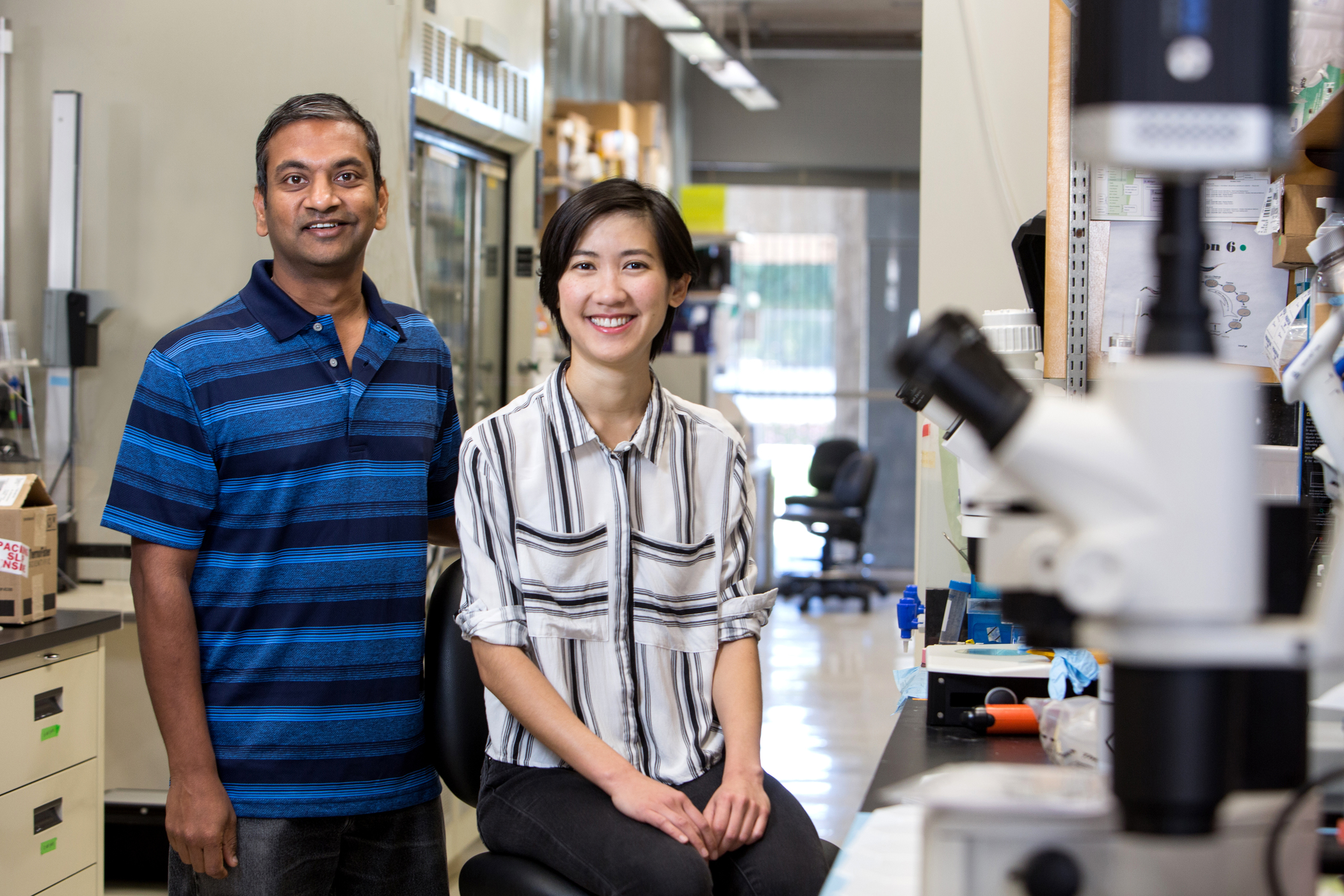
点击此处 用于高分辨率图像。.
版权:萨克研究所
Also intriguingly, the team found that Zoloft acted on the worms’ GABA signaling in a neuron that affects the animal’s sleep. Whether this is also the case in humans is not yet known, but points to a potential pathway to understand why Zoloft works in some people and not others. The research eventually could lead to a change in how these drugs are prescribed.
“We hope the findings from this paper will contribute to the field by providing a broader picture of some of these signaling activities,” Chalasani says. “Our findings suggest that fear and anxiety are ancient and evolved much earlier than we originally thought. The pathways, nerves, circuits and genes that we’ll now be able to study in the worm should inform us about this process in humans.”
In addition, he says, understanding which chemicals may repel nematodes could have implications for developing new kinds of pesticides, potentially ones that are even nontoxic. “秀丽隐杆线虫 is not a pathogen, but many other types of nematodes can do severe damage to crops,” he explains. “Biology research can go in many different directions, and you never know what you’re going to uncover.”
The paper’s other authors were Zheng Liu, Maro J. Kariya, Christopher D. Chute, Sarah G. Leinwand, Ada Tong, and Kevin P. Curran of Salk; Neelanjan Bose and Frank C. Schroeder of Cornell University; and Jagan Srinivasan of Worcester Polytechnic Institute.
This work was funded by the W. M. Keck Foundation, the National Institutes of Health and a Salk Alumni Fellowship.
日记
Nature Communications
作者
Zheng Liu, Maro J. Kariya, Christopher D. Chute, Amy K. Pribadi, Sarah G. Leinwand, Ada Tong, Kevin P. Curran, Neelanjan Bose, Frank C. Schroeder, Jagan Srinivasan and Sreekanth H. Chalasani
宣传办公室
电话:(858) 453-4100
press@salk.edu
萨尔克研究所是一个独立的非营利性研究机构,由首个安全有效的脊髓灰质炎疫苗的研发者乔纳斯·索尔克于1960年创立。该研究所的使命是推动以合作、敢于冒险为特点的基础性研究,以应对癌症、阿尔茨海默病和农业脆弱性等社会最紧迫的挑战。这项基础科学支撑着所有的转化研究,产生有助于全球新药和创新的见解。.