August 4, 2016
Salk Institute researchers show how vision relies on patterns of brain activity
Salk Institute researchers show how vision relies on patterns of brain activity

LA JOLLA—Visual prosthetics, or bionic eyes, are soon becoming a reality, as researchers make strides in strategies to reactivate parts of the brain that process visual information in people affected by blindness.
Bursts in a neuron’s electrical activity—the number of “spikes” that result when brain cells fire—make up the basic code for perception, according to traditional thought. But neurons constantly speed up and slow down their signals. A new study by Salk Institute scientists shows that being able to see the world relies on not just the number of spikes over a window of time but the timing of those spikes as well.
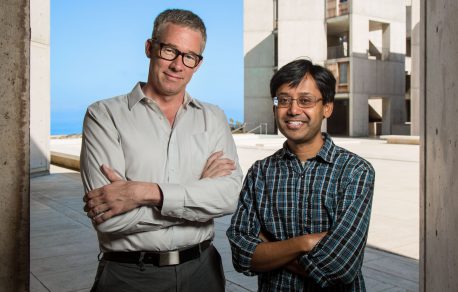
“In vision, it turns out there’s a huge amount of information present in the patterns of neuron activity over time,” says Salk Professor 约翰·雷诺兹, the study’s senior investigator and holder of the Fiona and Sanjay Jha Chair in Neuroscience. “Increased computing power and new theoretical advances have now enabled us to begin to explore these patterns.” The study was published August 4, 2016 in the journal 神经元.
The human brain houses an extensive network of neurons that are responsible for seeing everything from simple shapes—with certain groups of neurons getting excited by a horizontal or a vertical edge, for example—to intricate stimuli, such as faces or specific places. Reynolds’ team focused on a visual brain area called V4, located in the middle of the brain’s visual system. Neurons in V4 are sensitive to the contours that define the boundaries of objects, and help us recognize a shape regardless of where it is in space. But Reynolds and postdoctoral researcher Anirvan Nandy discovered in 2013 that V4 was more complicated: some neurons in the area only care about contours within a designated spot in the visual field.
Those findings led the team to wonder whether the activity code of V4 could be even more nuanced, taking in visual information not only in space but also in time. “We don’t see the world around us as if we are looking at a series of photographs. We live—and see—in real time and our neurons capture that,” says Nandy, lead author of the new paper.
点击此处 用于高分辨率图像
版权:萨克研究所
The scientists collaborated with Salk theoretician and postdoctoral researcher Monika Jadi to create in computer code what they called an “ideal observer.” With access to only the brain data, the computer would decipher—or at least guess—the moving pictures that had been seen. One version of the ideal observer had access to the number of times the neurons fired, whereas the other version had access to the full timing of the spikes. Indeed, the latter observer was able to guess the images more than twice as accurately compared with the more basic observer.
Better ways to record from and stimulate the brain, and better theoretical modeling efforts, have enabled these new findings. Now the group plans to not only observe V4 but to activate it using light through a cutting-edge technique called optogenetics. This, says Reynolds, is like taking the visual system for a spin. It will help them better understand the relationship between patterns of neuron activity and how the brain perceives the world, potentially laying the groundwork for more advanced visual prosthetics.
该研究得到了 美国国立卫生研究院, , 那个 Gatsby Charitable Foundation, , 那个 Swartz Foundation and the Salk Institute Pioneer Fund. The study was also authored by Jude Mitchell, formerly of Salk and now an assistant professor of brain and cognitive sciences at the University of Rochester 在纽约。.
日记
神经元
作者
Anirvan S. Nandy, Jude F. Mitchell, Monika P. Jadi, and John H. Reynolds
宣传办公室
电话:(858) 453-4100
press@salk.edu
萨尔克研究所是一个独立的非营利性研究机构,由首个安全有效的脊髓灰质炎疫苗的研发者乔纳斯·索尔克于1960年创立。该研究所的使命是推动以合作、敢于冒险为特点的基础性研究,以应对癌症、阿尔茨海默病和农业脆弱性等社会最紧迫的挑战。这项基础科学支撑着所有的转化研究,产生有助于全球新药和创新的见解。.